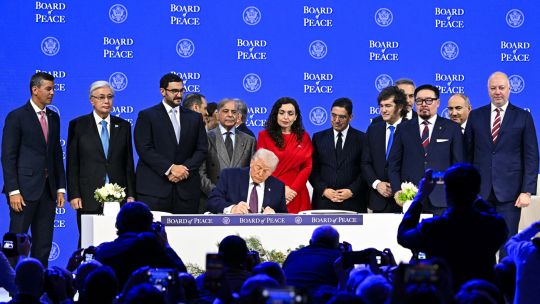
US President Donald Trump kicked off his new “Board of Peace” at Davos on Thursday, with a signing ceremony for a body with a US$1-billion membership fee and a controversial list of invitees.
A group of leaders and senior officials from 19 countries – including Trump allies from Argentina and Hungary – gathered on stage with the US president to put their names to the founding charter of the body.
Trump – who unsurprisingly is also the chairman of the Board of Peace – said they were “in most cases very popular leaders, some cases not so popular. That’s the way it goes in life.”
Originally meant to oversee peace in Gaza after the war between Hamas and Israel, the board’s charter envisions a wider role in resolving international conflicts, sparking concerns that Trump wants it to rival the United Nations.
Trump sought to allay some of those worries on Thursday, saying that the organisation would “work with many others, including the United Nations.”
“Once this board is completely formed, we can do pretty much whatever in conjunction with the United Nations. You know, I’ve always said the United Nations has got tremendous potential,” Trump said.
The Board of Peace’s potential membership has however proved controversial, with Trump having invited Russian President Vladimir Putin, who invaded Ukraine four years ago. Trump said Putin had agreed to join, while the Russian leader said he was still studying the invite.
Permanent members must also pay US $1 billion to join, leading to criticisms that the board could become a “pay to play” version of the UN Security Council.
UK, France snub signing
Key US allies including France and Britain have expressed scepticism, with the UK saying Thursday it would not attend the ceremony.
The members on stage largely held close ties to Trump, including Hungary’s Viktor Orban and Argentina’s Javier Milei, or a wish to show their allegiance to the US president.
Officials from Bahrain, Morocco, Armenia, Azerbaijan, Bulgaria, Indonesia, Jordan, Kazakhstan, Kosovo, Pakistan, Paraguay, Qatar, Saudi Arabia, Turkey, the United Arab Emirates, Uzbekistan and Mongolia also signed the document with Trump.
Israeli Prime Minister Benjamin Netanyahu, who faces an International Criminal Court arrest warrant over the war in Gaza, has said he will join but was not at the ceremony.
US Secretary of State Marco Rubio told the ceremony that the board’s focus was “first and foremost on making sure that this peace deal in Gaza becomes enduring.”
Trump however said Hamas to disarm under the next phase of the Gaza ceasefire accord or it will be the “end of them.”
The launch of the board comes against the backdrop of Trump’s frustration at having failed to win the Nobel Peace Prize, despite his disputed claim to have ended eight conflicts.
Leaders joined Trump at a table to sign documents, which White House Press Secretary Karoline Leavitt said put the board’s charter “in full force” and made it an “official international organisation.”
Trump to meet Zelenskyy
The inclusion of Putin has caused particular concern among US allies, but especially in Ukraine as it seeks an end to Moscow’s nearly four-year-old invasion.
Trump will meet Ukrainian President Volodymyr Zelenskyy in Davos after the “Board of Peace” ceremony to discuss a ceasefire in Ukraine – the major peace deal that continues to elude him.
Trump’s special envoy Steve Witkoff, who is due to travel to Moscow to meet Putin later Thursday, said in Davos that talks to end the war had made a “lot of progress” and were down to one issue.
“I think we’ve got it down to one issue, and we have discussed iterations of that issue, and that means it’s solvable,” said Witkoff, without saying what the issue was.
Witkoff added that he and the US leader’s son-in-law Jared Kushner would not stay in Moscow overnight but fly straight to Abu Dhabi for “military to military” talks.
Zelenskyy has meanwhile voiced fears that Trump’s push to seize Greenland – which has dominated Davos so far and threatened to unravel the transatlantic alliance – could divert focus away from Russia’s invasion of his country.
Trump however said late Wednesday he had reached a “framework of a future deal” after meeting NATO chief Mark Rutte, and that he would therefore waive tariffs scheduled to hit European allies on February 1. He gave no further details, leaving Europeans drawing only cautious sighs of relief.
A source close to the talks told AFP that a 1951 Greenland defence pact would be renegotiated as part of the deal.
Rocky start
Despite Trump’s fanfare Thursday, the board has gotten off to a rocky start, plagued by doubts over its objectives, composition and the control the US president will yield. Crucial US allies, including major Group of Seven economies, are still on the sidelines, unready to embrace the endeavour but also wary of offending a US president who sees the pet project as part of his legacy.
Trump initially proposed the board as part of a peace plan for war-torn Gaza, tasked with helping oversee its reconstruction.
But a draft charter seen by Bloomberg suggested a broader remit to “secure enduring peace in areas affected or threatened by conflict,” an expansive vision that has alarmed many US partners who worry it will seek to rival – and undercut – the UN.
The draft also asked countries to contribute at least US$1 billion to secure a permanent spot and would grant Trump ultimate decision-making power as its “inaugural chairman,” with the possibility he could remain in that role even after his presidency ends.
The membership has alarmed democratic allies. Around 60 leaders were invited to join, based on media reports and official statements. No nations from sub-Saharan Africa are among the invitees.
Among the nations who have declined so far to join are France, the UK, Sweden, the Netherlands, Germany and Canada.
After France’s Emmanuel Macron declined his invite, Trump threatened the country with a 200 percent tariff on champagne, and shared a private text from Macron on social media.
Canada’s Prime Minister Mark Carney said he’s up for joining the board “in principle” but added at Davos on Tuesday that it should be focused on addressing Gaza’s needs. British Prime Minister Keir Starmer declined to endorse the board, and said he would coordinate with allies for a response.
While the UN Security Council originally endorsed Trump’s plan for Gaza, the broader remit caught the council off-guard. On Monday, UN spokesperson Farhan Haq said the Security Council had authorised the Board of Peace only for its work in Gaza.
– TIMES/AFP/BLOOMBERG
related news