2026-02-01T09:13:58+00:00
font
Enable Reading Mode
A-
A
A+
Shafaq News– Khan Younis
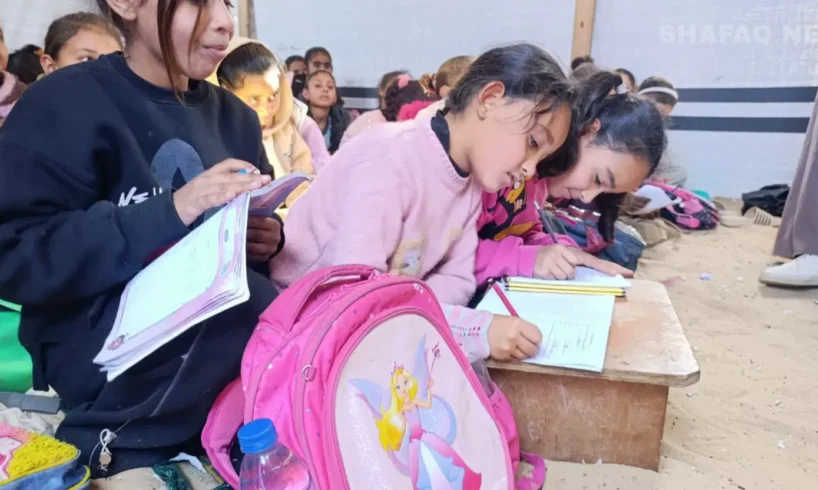
In displacement camps south of Khan
Younis in the Gaza Strip, Palestinian teachers have set up improvised
classrooms inside tents to provide basic education for children who have been
cut off from formal schooling by war and repeated displacement.
Speaking to Shafaq News, teacher
Abdulsalam explained that the tent has become more than a place of shelter,
describing it as the last line of defense against ignorance and erasure. He
stressed that losing education would mean losing everything, as teachers try to
preserve children’s ability to read and write amid widespread destruction.
Abdulsalam noted that many lessons
now begin with helping children relearn how to write their own names. “The war
has attempted to erase memory before books, turning the tent into a space of
resilience where both teachers and students reject the idea of a permanent
break from education.”
The task is compounded by the scale
of damage to Gaza’s education system. More than 97% of schools across the
enclave have been destroyed or severely damaged, according to local education
officials. Teachers lack basic supplies such as textbooks, stationery, and
desks, while children attend lessons in extreme heat or cold, often hungry and
physically exhausted.
Behind these initiatives are
teachers who are themselves displaced. They leave their own tents daily to
deliver lessons under harsh conditions. Teacher Moeen Sheikh Eid told Shafaq
News that although educators are living the same reality of displacement, their
presence with children provides them with a reason to keep going.
Teachers face acute logistical
challenges, from the absence of curricula and books to a shortage of writing
materials, forcing them to rely on rudimentary tools to convey lessons and
record notes.
Beyond interrupted schooling,
educators are also confronting what they describe as severe “learning loss.”
Signs of declining basic literacy and numeracy skills have become increasingly
evident among children, driven by psychological trauma and prolonged absence
from classrooms.
Abdulsalam said some children have
forgotten letters entirely, while others are frightened by loud sounds. He
described education in the camps as a form of therapy as much as a source of
knowledge.
What began as individual efforts has
gradually developed into broader community initiatives. Sheikh Eid said his
educational project started in a single tent before expanding to around 10
tents, now serving approximately 800 boys and girls.
The project has grown to include
lessons in reading, writing, mathematics, and English, alongside recreational
activities and psychological support designed to help children cope with the
effects of war and trauma.
Teachers also focus on restoring
daily routines and teaching discipline in an unstable environment. Sheikh Eid
said the initiative began with almost no resources, but continued because of a
shared belief that education is a right that does not disappear during war,
adding that the absence of schooling posed a danger comparable to the violence
itself.
Ahmed Al-Najjar, Director General of
Public Relations and Media at Gaza’s Ministry of Education and Higher
Education, told Shafaq News that the education sector is facing what he
described as the most dangerous phase in its history.
Al-Najjar said more than 637,000
students have been deprived of regular education for over two years, resulting
in the loss of entire academic years, sharp declines in literacy and numeracy
skills, and strong psychological effects that threaten children’s futures.
“The war has killed more than 80
school teachers and 160 university professors and academics,” he added, calling
the losses a serious hemorrhage that endangers Gaza’s social fabric and
prospects for intellectual and cultural recovery.
The ministry has responded by
establishing field schools inside tents, opening temporary classrooms in
available buildings, and launching alternative education programs, though he
said these efforts remain limited, according to Al-Najjar.
The director stressed that what is
needed goes beyond emergency solutions, calling for comprehensive
reconstruction and a sustainable education program to safeguard children’s
right to learning. He urged the international community to halt attacks on civilians
and educational infrastructure, open safe corridors for rebuilding schools, and
support education programs with essential supplies such as furniture,
stationery, and learning materials.