Axios reported that negotiations had been taking place over the past 24 hours in Abu Dhabi and the two countries were closing in on a deal to keep observing key terms of the New START treaty, which limits each side’s numbers of missiles, launchers and strategic nuclear warheads.
US President Donald Trump has not formally responded to a proposal from Russian President Vladimir Putin to stick to those central provisions for one more year, even though there is no legal option to extend the full treaty.
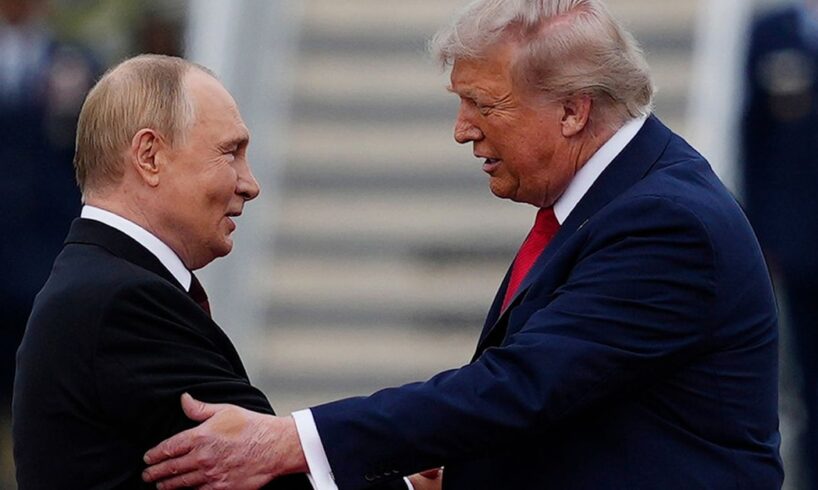
US President Donald Trump greets Russian President Vladimir Putin, Aug. 15, 2025, at Joint Base Elmendorf-Richardson, Alaska (AP Photo/Julia Demaree Nikhinson)
Kremlin spokesman Dmitry Peskov said Russia was still ready to engage in dialogue with the US if Washington responded constructively to Putin’s proposal.
“Listen, if there are any constructive replies, of course we will conduct a dialogue,” Peskov told reporters.
LAST IN A SERIES OF TREATIES
New START was the last in a series of nuclear agreements between Moscow and Washington dating back more than half a century to the Cold War.
Besides setting numerical limits on weapons, they included inspection regimes that experts say served to build a level of trust and confidence between the nuclear adversaries, helping make the world safer.
If nothing replaces the treaty, security analysts see a more dangerous environment with a higher risk of miscalculation. Forced to rely on worst-case assumptions about the other’s intentions, the US and Russia would see an incentive to increase their arsenals, especially as China plays catch-up with its own rapid nuclear build-up.
This photo released by the US Air Force shows a B-52H Stratofortress approaching a KC-10 Extender for refuelling over the Middle East, Sept. 4, 2022 (US Air Force/Staff Sgt. Shannon Bowman, via AP)
Trump has said he wants to replace New START with a better deal, bringing in China but Beijing has declined negotiations with Moscow and Washington. It has a fraction of their warhead numbers – an estimated 600, compared to around 4000 each for Russia and the US.
Repeating that position on Thursday, China said the expiration of the treaty was regrettable, and urged the US to resume dialogue with Russia on “strategic stability”.
Peskov said Russia would take a responsible approach. The White House said this week that Trump would decide the way forward on nuclear arms control, which he would “clarify on his own timeline”.
CONFUSION OVER EXACT TIMING
There was confusion over the exact timing of the expiry, but Peskov said it would be at the end of Thursday.
Former Russian President Dmitry Medvedev, who signed the treaty with then US President Barack Obama in 2010, said on Wednesday that New START and its predecessors were now “all in the past”.
Russia’s Foreign Ministry said Moscow’s assumption was that the treaty no longer applied and both sides were free to choose their next steps.
U.S. President Barack Obama, left, and his Russian counterpart Dmitry Medvedev, right, shake hands at a news conference at the Prague Castle in Prague, Czech Republic,, April 8, 2010, after signing the New START treaty reducing long-range nuclear weapons. (AP Photo/Mikhail Metzel)
It said Russia was prepared to take “decisive military-technical countermeasures to mitigate potential additional threats to national security” but was also open to diplomacy.
Ukraine, which has been at war with Russia since Moscow’s 2022 invasion, said the treaty’s expiry was a consequence of Russian efforts to achieve the “fragmentation of the global security architecture” and called it “another tool for nuclear blackmail to undermine international support for Ukraine.”
UN CHIEF SAYS NUCLEAR RISK IS HIGHEST IN DECADES
Strategic nuclear weapons are the long-range systems that each side would use to strike the other’s capital, military and industrial centres in the event of a nuclear war.
They differ from so-called tactical nuclear weapons that have a lower yield and are designed for limited strikes or battlefield use.
If left unconstrained by any agreement, Russia and the US could each, within a couple of years, deploy hundreds more warheads beyond the New START limit of 1550, experts say.
This photo taken from a video distributed on Dec. 9, 2020 by the Russian Defence Ministry Press Service, shows a rocket launch as part of a ground-based intercontinental ballistic missile test at the Plesetsk facility in northwestern Russia (Russian Defence Ministry Press Service via AP)
“Transparency and predictability are among the more intangible benefits of arms control and underpin deterrence and strategic stability,” said Karim Haggag, director of the Stockholm International Peace Research Institute.
UN Secretary-General Antonio Guterres said the dissolution of decades of achievement in arms control “could not come at a worse time – the risk of a nuclear weapon being used is the highest in decades.”
He urged the sides to resume negotiations without delay to agree a successor framework restoring verifiable limits.
NEVER MISS A STORY: Get your breaking news and exclusive stories first by following us across all platforms.