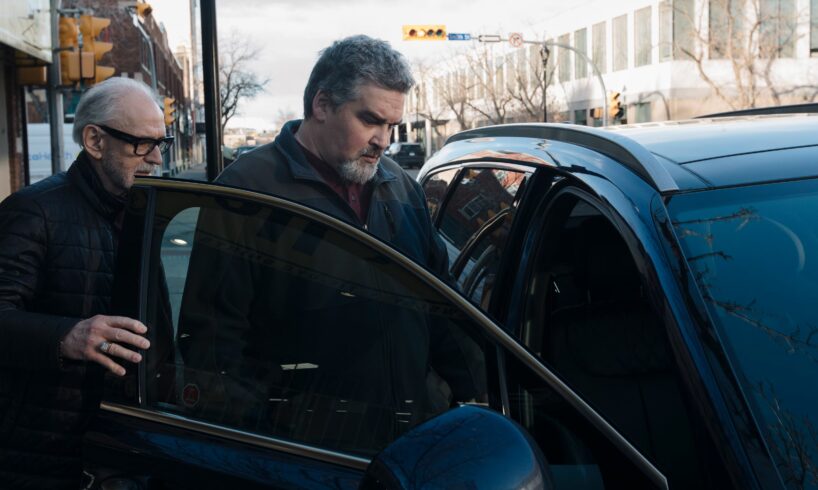
Open this photo in gallery:
Former Regina police sergeant Bob Semenchuck leaves court in November, 2025, with his father after he pleaded guilty to criminal charges of breach of trust and unauthorized use of a computer.Amber Bracken/The Globe and Mail
A former Regina police sergeant will find out on Friday whether he’s being sentenced to time in jail for luring dozens of women into intimate relationships using information from confidential police databases, and, in most cases, under false names and identities.
Robert Semenchuck, 53, has pleaded guilty to one count of breach of trust and one count of unlawful use of a computer for the offences, which date back to 2011. Mr. Semenchuck had been an officer in Regina since 2003.
Crown prosecutor Christopher Browne and defence lawyer Nick Brown have proposed a joint submission for a conditional sentence to be served in the community, with six months of house arrest followed by three years of probation.
Victims of ex-Regina officer describe feeling violated as judge weighs conditional sentence
But after listening to the lawyers’ submissions and considering 19 victim impact statements from women who have been affected by Mr. Semenchuck’s actions, Judge Marylynne Beaton expressed concern about the plea deal, saying that the “magnitude of the offending behavior” she heard in the women’s statements hadn’t come through in the lawyers’ agreed statement of facts about the case. Judge Beaton adjourned the case two weeks to consider the joint submission and look at case law.
In Canadian courts, judges are expected to accept joint submissions unless they believe the proposed sentence would be contrary to the public interest or bring the administration of justice into disrepute.
The agreed statement of facts entered by the defence and Crown says Mr. Semenchuck would obtain information about women from the police database and then contact them with what appeared to be a wrong number text. When the women replied, the accused “would take the opportunity to engage the victims in a further text conversation slowly building trust and a personal relationship.”
The man behind the wrong number
The statement says he would not use his real name or tell the women he was a police officer, and that some of the women were “experiencing difficulties in their own lives,” which he would have known from his use of the police computer system.
In interviews, women involved in the case described having been victims of domestic or sexual violence, or suffering mental health issues when they were contacted by Mr. Semenchuck.
Kerry Benjoe, a Regina journalist who filed the initial complaint against Mr. Semenchuck after uncovering his true identity, was in a domestic violence shelter when he texted her for the first time, purporting to be a contractor named Jay Robert Lewis. Their relationship spanned several years.
At least four cases involved women who knew he was a police officer, but did not know he had accessed personal information about them.
In victim impact statements, the women described extreme fear, confusion and shame. Regina Police Chief Lorilee Davies also submitted a victim impact statement, describing the effects of Mr. Semenchuck’s offences on other officers and the police service.
In arguing for Judge Beaton to accept the conditional sentence, prosecutor Mr. Browne said going to trial would have required a significant amount of court time, and that, while some of the victims were very willing to testify, others were reluctant.
He told court that Mr. Semenchuck has no prior criminal record but does have a history of improper access to information within the police service. No details of those offences were put on the record in court.
Meanwhile, the defence lawyer, Mr. Brown, said the plea deal was “something that we worked through very carefully and put a lot of thought into before presenting it to the court.”
“We’re not here before this court asking the court to consider a joint submission that was prepared on a whim,” he said.
While the lawyers agreed on the sentence, Mr. Brown argued against an order for Mr. Semenchuck’s DNA, saying it raises “significant privacy and bodily integrity interests.”