Key events
Show key events only
Please turn on JavaScript to use this feature
Badenoch says Starmer said he had full confidence in McSweeney. On Sunday he sacked him, she says. And last week he defended the cabinet secretary. Now he is being sacked too, she says.
Starmer says Badenoch claimed there would be no more defections from her party, and there were. Her party is dying.
Share
Kemi Badenoch says he said when he was leader of the opposition he never turned on his staff, and always carried the can. “What changed?”
Starmer says he has apologised for mistakes made in the Mandelson affair. And he says Morgan McSweeney delivered for him, winning the election and delivering the smallest Tory party for 100 years. And Badenoch has made it smaller.
Share
In response to a question from Toby Perkins (Lab), Starmer says the government is creating new opportunities for apprentices.
Share
Keir Starmer gets lots of cheers from Tories as he stands up. Ironic ones.
Starmer starts by saying MPs’ hearts will go out to the children injured in the school stabbing.
He also refers to the shootings in Canada.
And he says he is determined to fix the Send system.
He makes the usual point about having meetings with ministerial colleagues this week, but adds a joke about how there have been “quite a few of them this week”.
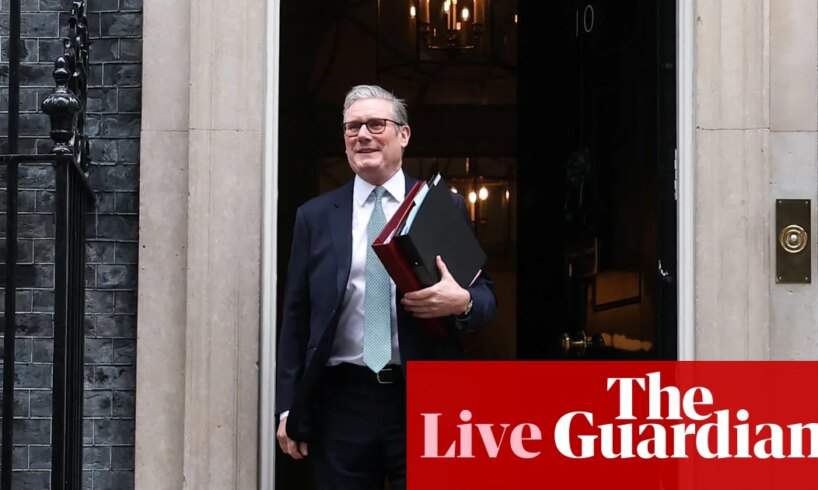
ShareKeir Starmer leaving No 10 ahead of PMQs today. Photograph: Adrian Dennis/AFP/Getty ImagesShare
Starmer faces Badenoch at PMQs
PMQs is starting soon.
Here is the lists of MPs down to ask a question.
PMQs Photograph: HoCShare
Yesterday there was an urgent question in the Commons about the government’s decision to wipe the Courtsdesk courts archive, which provides records of court hearings. Journalists, and campaigners, have described it as invaluable. Sarah Sackman, a justice minister, told MPs that the archive had to be closed because an AI company was using it to access sensitive personal data.
In a post on his Substack blog, Enda Leahy, the former journalist who set up Courtsdesk, says some of what Sackman said was “seriously misleading” or “simply not true”. He sets out his case in detail here.
Share
Georgia Gould says she was ‘shocked’ by latest revelations about family friend Peter Mandelson
In her interviews this morning Georgia Gould, the education minister, was also asked about Peter Mandelson. Her father was Philip Gould, the pollster and strategist who worked for Labour when it was in opposition in the late 1980s and 1990s, and then when it was in government. He was a key figure in the development of New Labour, right at the heart of the Tony Blair inner circle and a close friend and ally of Mandelson.
This is what Gould told Sky News about her response to the latest revelations about the peer.
[Mandelson] was a good friend of my father’s. I’ve known him my whole life. I have been completely shocked by what has come out.
I know that my dad, who’s no longer alive, would have been too.
He is someone who I thought of as a public servant. And I could not believe when I read some of the things that have come out. When the whole government needed to be focussed at that time on the huge challenge that you face, to be passing information in that way, it is deeply painful to see what has emerged.
Gould was referring to emails showing Mandleson leaking confidential government documents to Jeffrey Epstein. These are now being investigated by the police.
Georgia Gould Photograph: Anna Gordon/The GuardianShare
Stephen Bush has devoted his Financial Times Inside Politics briefing to the Matthew Doyle controversy this morning. His take is very straightforward. Here’s an extract.
As political calls go, this is not a difficult one. It’s perfectly fine in my view to believe a friend’s claims of innocence, but if they then go on to plead guilty, the obvious political reality is that you are never going to be a viable candidate for membership of the House of Lords. Frankly, if they do not plead guilty and continue to protest their innocence, unless or until they are acquitted, you are not going to be a viable candidate for membership of the House of Lords.
To grasp that you should not need to be, or employ, “a brilliant strategist, focused ruthlessly on what the voters think”, as many connected to this government keep telling me the departed Morgan McSweeney was.
If you oversee a Downing Street operation that cannot get such an obvious call right, what other mistakes are you making?
Here is Ben Quinn’s story about the controversy.
Share
Phillipson announces 10-year plan to modernise and improve school buildings in England
Bridget Phillipson, the education secretary, has announced a 10-year strategy to modernise and improve school buildings in England. The Department for Education says:
For too long, millions have been poured into sticking-plaster repairs to deteriorating classrooms that fail to meet the needs of pupils learning inside them.
The government will put an end to this cycle of patching and mending buildings that have already deteriorated, as the education secretary unveils today a 10-year plan to transform the education estate so that children and young people across the country have the high-quality classrooms that are fit for purpose and resilient to climate change from flooding and overheating.
As part of the drive to make schools more inclusive by design, the government expects that every secondary school will, in time, have an inclusion base – a dedicated safe space away from busy classrooms where pupils can access targeted support that bridges the gap between mainstream and specialist provision.
The full 52-page educational estates strategy paper is here.
As Alexandra Topping reports, all secondary schools should have specially designed areas for neurodiverse children and pupils with special educational needs under the plans.
Share
Lib Dem plan to break up Treasury – snap verdict
The Liberal Democrats have announced a new idea; it’s a rehash of one that has been kicking around for at least 60 years.
As Daisy Cooper, the Lib Dem deputy leader, acknowledged in her speech this morning (see 9.37am), people in British politics have been complaining for years about the Treasury having too much power. One prime minister who actually did something about this was Harold Wilson, who created the Department of Economic Affairs in the 1960s as a counterweight to the Treasury. It was supposed to deal with long-term economic planning, leaving the Treasury as more of a simple tax-raising department. It did not last. But prime ministers – particulary those with difficult relationships with their chancellors – have been toying with the same idea ever since.
In an article about this four years ago, George Dibb, at the time a researcher at the IPPR thinktank, now on secondment to the civil service, said:
Ultimately, Harold Wilson, Gordon Brown and Theresa May are not all wrong. A short-termist Treasury with absolute control in Whitehall will always skew policy in a damaging way. Tony Danker, director general of the Confederation of British Industry (CBI), made a similar point this month on the role of the Treasury in economic growth: “No CEO would put the finance department in charge of sales.” The Treasury has to be broken up, with long-term economic strategy the responsibility of a new ministry. That way it would be matched by an equal and opposite force with long-term vision and powers to direct the economy towards socially important goals. Whether that goal is decarbonisation or addressing regional inequality, the Treasury’s instinct to pull tight the purse strings will always be a barrier.
Today, as well as adopting these arguments, Cooper was making an argument about growth, claiming that a stand-alone growth department would do better than the Treasury at boosting GDP. Perhaps. But Rachel Reeves claimed she was turning the Treasury into a growth department when she became chancellor. Since then growth has been disappointing, but in large part that is not because of Whitehall machinery; it’s because there are political objections to the pulling the most effective growth levers (joining the customs union or the single market, increasing immigration) that would apply regardless of which department was in charge.
Still, Cooper is likely to find a lot of people agreeing with her central argument. Those who have suggested breaking up the Treasury in the past have included figures as diverse as Will Hutton, Maurice Glasman and Dominic Cummings. If a left-leaning coalition is in power after the next election, the Lib Dems could have considerable clout when this debate is being thrashed out again.
Still, dismantling the Treasuy won’t be easy. In a good New Statesman article on this topic last year, George Eaton quoted Harold Macmillan, the former Tory PM. Macmillan summed it up like this:
To reform the Treasury is like trying to reform the Kremlin or the Vatican. These institutions are apt to have the last laugh.
Share
Updated at 12.37 CET