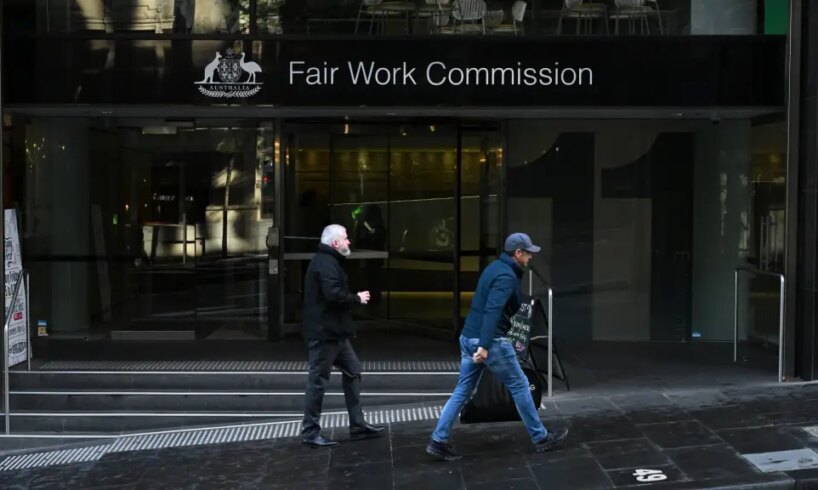
AI-generated unfair dismissal claims are clogging up the Fair Work Commission (FWC), says president Adam Hatcher, who fears weak claims using invented facts are pulling the Commission’s legal experts away from major cases.
The revelation also confirms how Australian employees are using tools like ChatGPT to stress-test their complaints against employers, lowering the barrier between workplace disputes and a formal Fair Work complaint.
Related Article Block Placeholder
Article ID: 311369
Speaking before the Victorian Bar Association on Wednesday, Justice Hatcher said claims ‘glossed up’ with the help of artificial intelligence have caused the FWC’s total workload to grow by 70% in just three years.
The number of unfair dismissal claims has grown 41% between 2022-23 and 2024-25, he said, with even greater growth among general protection claims.
“There is no sign of this growth trend plateauing out, and we have no idea what the ‘new normal’ will be,” he said.
Smarter business news. Straight to your inbox.
For startup founders, small businesses and leaders. Build sharper instincts and better strategy by learning from Australia’s smartest business minds. Sign up for free.
By continuing, you agree to our Terms & Conditions and Privacy Policy.
The trend is not connected to retrenchment rates, he said, as the statistical relationship between hiring, firing, and claims brought to the FWC has “broken down in the last couple of years”.
Instead, Hatcher argues the number of claims has increased alongside the popular use of AI tools, which can help employees build their claims without help from trained legal representatives.
The influx is so profound that the FWC is now able to spot AI-generated language in filed applications.
“Once you learn what this looks like, it becomes pretty easy to spot,” he said.
AI generating flawed claims
The surging use of AI is not wholly a bad thing, Justice Hatcher continued, saying digital systems that inform workers of their basic rights “has to be regarded as a win in terms of access to justice”.
“But when the AI tool starts inventing facts to justify a weak unfair dismissal claim or, worse, can
gloss up a general protections claim for a person who does not meet the qualifying period criterion
for an unfair dismissal claim, then the balance of benefit and detriment becomes less clear,” he said.
Justice Hatcher himself tested ChatGPT’s ability to formulate a claim, laying out a hypothetical dismissal scenario and asking the chatbot what he could do.
Related Article Block Placeholder
Article ID: 319280
The result did not instill confidence.
ChatGPT responded with a form “ready to file together with a witness statement which contained a substantially invented story about my dismissal,” Justice Hatcher said.
“It also told me that a ‘realistic scenario’ was that I would obtain in the range of $15,000–$40,000 compensation.
“This took less than 10 minutes.
“And this was for a putative case which, on the facts I provided to ChatGPT, could not be assessed as having reasonable prospects of success.”
FWC seeks reform options
Rising case numbers are now affecting internal FWC performance, making it harder for the nation’s top industrial relations tribunal to devote resources to major ongoing cases.
This includes its work on cases related to “gender-based undervaluation matters”, the interaction of awards with working from home and part-time employment, and minimum standards for digital platform workers.
“I expect further slippage in other areas as the workload continues to increase,” said Justice Hatcher.
To combat some of those rising workloads, the FWC will trial a form asking claimants to disclose if their application has been generated using AI.
In addition, it has launched a research project to better understand the way litigants use AI in their unfair dismissal and general protections claims.
It is also working to streamline case management for relatively simple disputes, with Justice Hatcher arguing further legislative reform could make it easier for the FWC to operate more efficiently.