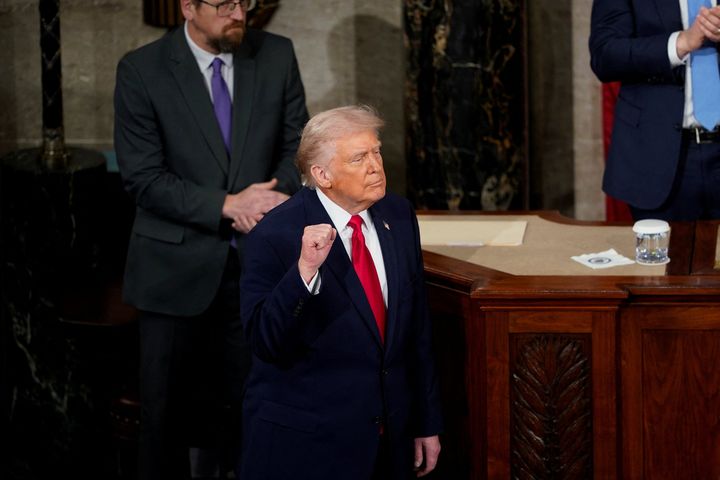
Trump’s speech comes against a backdrop of rising tensions with Iran and voter frustration with the high cost of living.
Here are some takeaways from Trump’s address:
1. Risky business
Trump put dollars and cents at the heart of his speech, suggesting his aides, who have been pushing him for weeks to speak more about the economy, have prevailed for now.
He offered a broad-based sweep of kitchen-table economic issues – housing, health care, utility bills, crime, retirement – but he again stopped short of acknowledging that many Americans are still struggling with the high cost of living, including food and house prices.
Some party strategists have warned that without a more emphatic message on inflation, Trump’s Republican Party is at risk of losing control of Congress in the November midterm elections.
In Trump’s telling, inflation, mortgage rates and gas prices are falling, while the stock market, oil production and foreign direct investment are booming along with construction and factory jobs.
But government data shows inflation ticked up last year, while the economy lost factory jobs and overall job creation was anemic. And while prices of some items – like eggs – have dropped since Trump’s return to the White House, food and other prices more broadly have continued to increase.
Voters tell pollsters they are anxious about the economy and are dissatisfied with Trump’s handling of the issue. Fifty-six percent disapprove of his handling of the economy, Reuters/Ipsos polling shows, while 36pc approve.
U.S. President Donald Trump delivers the State of the Union address in the House Chamber of the U.S. Capitol in Washington, D.C., U.S., February 24, 2026. REUTERS/NATHAN HOWARD
2. Wedge issues
Trump argued that Republicans deserved two more years of control of Congress because of their handling of the economy, immigration and public safety. But beyond those policy issues, he made a far more visceral appeal to voters to back Republicans.
“These people are crazy,” he said of Democratic politicians in the chamber who have voted against most of his legislative proposals and who view his presidency as one that has weakened democratic institutions. “Democrats are destroying this country, but we’ve stopped it just in the nick of time,” he said.
On a number of occasions, Trump took aim at Democrats as anti-American and acting against the best interests of the country, highlighting the increasingly partisan tone of the annual speech.
Democrats stayed in their seats, visibly irritating Trump, while Republicans leapt to their feet to applaud the president on issues ranging from gender politics to illegal migration and crime.
Some, like Representatives Al Green, Ilhan Omar and Rashida Tlaib, yelled at Trump during his speech. For those Democrats, Trump’s views on those issues are divisive and problematic, and upset large parts of their base.
NASA Administrator Jared Isaacman listens during U.S. President Donald Trump’s State of the Union address in the House Chamber at the U.S. Capitol in Washington, D.C., U.S., February 24, 2026. REUTERS/NATHAN HOWARD
3. Case for war
One of the most-asked questions going into Trump’s speech was whether he would finally make a detailed case for war against Iran, elaborating on the reason for the major U.S. military buildup in the Middle East.
The president did not even mention Iran until well over an hour into his speech. And when he did, he simply repeated his standard talking points, saying it was imperative to keep a bomb out of Tehran’s hands. He gave little hint about which way he is leaning on military action – a huge preoccupation at home and abroad.
During the first 75 minutes, he made only a glancing reference to Venezuela, while Russia and Ukraine were barely mentioned at all. His fixation on acquiring Greenland — a dispute that has strained transatlantic relations — did not come up at all.
While he did spend a good chunk of time later in the speech discussing conflicts that his administration has been trying to resolve, the lack of national security and foreign policy talk up front was conspicuous, given how much time and political capital he has been spending on diplomacy of late.
He has in recent weeks dispatched his closest aides to far-flung capitals to try to settle the war in Ukraine and negotiate with Iran. Last month, his administration deposed the leader of Venezuela, and much of the administration’s time and energy has been focused on managing relations with the South American country.
U.S. President Donald Trump gestures on the day he delivers the State of the Union address in the House Chamber of the U.S. Capitol in Washington, D.C., U.S., February 24, 2026. REUTERS/NATHAN HOWARD
Today’s News in 90 seconds – Wednesday, February 25
4. Tariffs
Trump has said he will continue imposing tariffs on other countries despite the Supreme Court ruling that overturned the import tax policy.
Trump’s latest trade tariffs came into effect on UK imports at 10pc on Tuesday, lower than the 15pc rate he threatened over the weekend, after he signed an executive order following the Supreme Court’s decision on Friday.
Trump said: “Almost all countries and corporations want to keep the deal that they already made.
“Knowing that the legal power that I, as president, have to make a new deal could be far worse for them, therefore, they’ll continue to work alongside the same successful path that we had negotiated before the court’s unfortunate involvement.
“Countries that were ripping us off for decades are now paying us hundreds of millions of dollars. Yet these countries are now happy and so are we. We made deals. The deals are all done. And they’re happy.”
Mr Trump said “many of the wars I settled” were because of the “threat of tariffs”.
“Tariffs, paid for by foreign countries will, like in the past, substantially replace the modern-day system of income tax, taking a great financial burden off the people that I love,” he said.
“Trillions and trillions of dollars will be pouring into the United States of America, because we finally have a president who puts America first.”
Rob Potylo, also known as Robby Roadsteamer, in a giraffe costume, reacts next to people wearing inflatable frog costumes near the White House following the “State of the Swamp,” a Democratic-led counter-programming event, and President Donald Trump’s State of the Union address in Washington, D.C., U.S., February 25, 2026. REUTERS/Leah Millis
5. War on fraud
Elsewhere in the speech, Trump announced a “war on fraud” headed by Vice President JD Vance, saying members of the Somali community in Minnesota had “pillaged an estimated 19 billion dollars (£14 billion) from the American taxpayer”.
He said: “We have all of the information. And in actuality, the number is much higher than California, Massachusetts, Maine, many other states are even worse.”
Mr Trump also called on Congress to pass a law to prevent any state from granting commercial driving licences to illegal aliens and the Save America Act to prevent “unpermitted persons” from voting.
People wearing inflatable frog costumes gather near the White House following the “State of the Swamp,” a Democratic-led counter-programming event, and President Donald Trump’s State of the Union address in Washington, D.C., U.S., February 25, 2026. REUTERS/Leah Millis
6. Trump stays on message – for the most part
In the longest State of the Union address at one hour and 48 minutes – 19 minutes longer than Bill Clinton’s final address – he described the US as “bigger, better, richer than ever before” and said “this is the golden age of America”.
By Trump’s own standards, he turned in a disciplined performance, largely sticking to prepared remarks, avoiding the sometimes-bizarre asides that often pepper his speeches, and resorting to personal attacks only rarely.
As he entered the chamber, he even shook hands with the assembled Supreme Court justices – even as he had publicly lashed out at them days earlier after they curtailed his power to levy tariffs. His performance was also light on the racial dog whistles and dehumanising rhetoric toward immigrants that have been characteristic of some of his speeches in the past.
Texas Democratic representative Al Green was escorted from the chamber early in the speech after unfurling a sign which read “Black People Aren’t Apes!” as Mr Trump entered, apparently referencing a video posted by the president on social media featuring former president Barack Obama and first lady Michelle Obama depicted as apes.
He was also heckled by Democrats after saying they should be “ashamed of yourselves” after they did not stand to support his statement that the government’s duty was “to protect American citizens, not illegal aliens”.
Mr Trump repeatedly asked why they did not stand, called them “crazy”, and said “Democrats are destroying our country” over young people transitioning gender.
By the standards of most politicians, it would have been a dark performance. He described the murder of a Ukrainian immigrant in extremely graphic terms. But for Trump, the speech counted as an “on message” performance.
His advisers, some of whom have long pushed him to dial down his rhetoric so as not to turn off middle-of-the-road and independent voters, were likely relieved.
The Winter Olympic gold medal-winning US men’s ice hockey team and Erika Kirk – widow of murdered activist Charlie Kirk, who Trump said had been “martyred” – were among the invited guests.
Additional reporting by PA