Wood also indicated ratepayers were paying.
“There is a budget of just over $1 million in Auckland Council coffers to fix this grove of pōhutukawa trees. Seems it has been 50% used up already. Not a good outcome,” he wrote.
But local board chairwoman Trish Deans said that was incorrect.
The bill for the fallen tree had gone to the apartment owners directly, she clarified, because the tree was on their land.
Trish Deans said apartment owners paid. Photo / Greg Bowker
“The work is paid for by the owners/body corp for the removal of the fallen pōhutukawa at The Sands. This is part of the conditions of the hearing. It’s such a long saga,” she said.
Eloi Fonseca, Devonport-Takapuna area operations manager said any suggestion the council spent $560,000 on a single tree was incorrect.
The costs involving tree work and boardwalk removal at Takapuna. Source / Devonport Takapuna Local Board member George Wood
Dealing with the fallen pōhutukawa tree at The Sands apartments was at no cost to Auckland Council or the Devonport-Takapuna Local Board.
All costs associated with the removal and management of that fallen tree were borne by the apartment owners, Fonseca said.
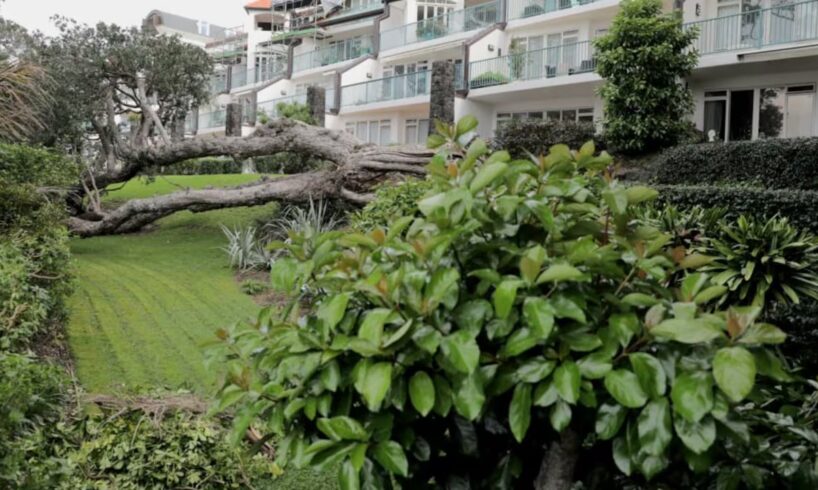
The fallen pōhutakawa at Takapuna, which cost The Sands’ owners $130,000. Photo / George Wood
The $560,000 figure related to the broader Esplanade Reserve – Te Uru Tapu (Sacred Grove) development project.
That has many components and was approved by the local board, Fonseca said.
That project included a range of works focused on environmental protection, public access improvements, heritage considerations, and coastal resilience – not a single tree, Fonseca said.
Construction of a modernist four-level beachfront mansion is now completed. Behind is shown The Sands apartments with pōhutukawa to the right. Photo / Jason Dorday
As part of the already-approved scope of works within that project, Auckland Council’s parks and community facilities wing recently co-ordinated the removal of the boardwalk running along the waterfront.
“The placement of the cut logs from the fallen pōhutukawa into the esplanade reserve was supported by the council so that the tree could remain within Te Uru Tapu grove as part of the wider landscape restoration approach,” Fonseca said.
Other media have reported that the tree had fallen across the lawn of the apartments in 2022.
This month, cranes operating from the beach lifted it into the grove. At around the same time, the boardwalk was removed.
The saga involving trees in the area has been drawn-out.
Conditions were placed on removing the tree. Cuttings had to be taken from the still-living but prone tree. Temporary fencing was erected while works were carried out.
The boardwalk closed in 2019 because of safety concerns about falling tree branches. It has been removed to protect the trees and restore the wāhi tapu site.
Simon Court, an Act MP, said the apartment residents lost use of their lawn for three years.
That tree was one of 19 pōhutukawa in a sacred grove where the council has about $1.1m budgeted for pruning and safety works, Court said.
“So far, $82,000 and counting has been paid to mana whenua for consultation services,” he said.
“This is Auckland’s planning culture in action. Minor problems go unsolved, property rights are disregarded, consultants get rich and ratepayers get ripped off.
“It’s all downstream from the failed Resource Management Act, which invites councils to consult every Tom, Dick and Hone on minor projects.”
Anne Gibson has been the Herald’s property editor for 26 years, written books and covered property extensively here and overseas.
Stay ahead with the latest market moves, corporate updates, and economic insights by subscribing to our Business newsletter – your essential weekly round-up of all the business news you need.
Source
Visited 1 times, 1 visit(s) today