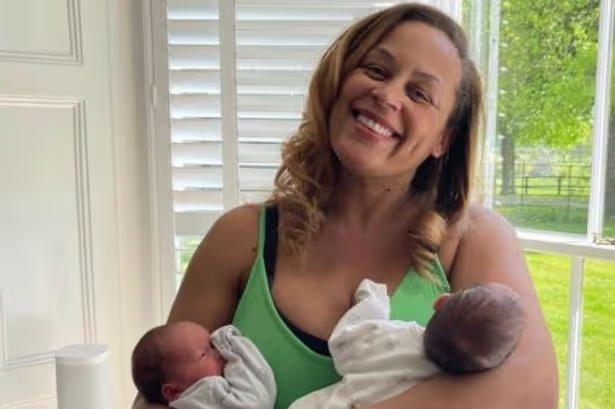
Caroline Morgan gave birth to twins after she underwent years of IVF at Royal Derby Hospital. Here, she shares her inspiring story – describing the physical and emotional struggle and joy upon seeing her children thrive
Caroline Morgan pictured with her twins
Caroline Morgan, who lives in Derbyshire, became the proud mum of twins at the age of 51. Here, she tells of the struggle she and her partner, Richard Burnett, who was 58 when they were born, had to conceive when she first realised she wanted a child at the age of 44 but discovered she was infertile.
I didn’t realise I was infertile until I met the man I wanted to have a child with.
I was 44 when I met my partner — old enough to have lived a full life, young enough to still believe there was time.
We assumed getting pregnant might take a little longer. But when it didn’t happen at all, I went to the clinic expecting answers. Instead, they found nothing wrong.
I was told to keep trying, as if persistence alone might be the missing ingredient. What followed were years measured out in cycles and hope.
I took Clomid. I did IUI. I had my eggs retrieved. Each stage came with a quiet, private optimism, followed by the same familiar disappointment. By the time I was approaching 47, the word ‘hope’ had started to feel dangerous.
I remember thinking, with a clarity that frightened me, this is never going to happen for me. I have always wanted to be a mother, and I am running out of time.
When my doctor finally said IVF was my only option, it didn’t feel like a decision so much as a reckoning.
The medication was brutal. I gained two stone. My body felt unfamiliar — swollen, sore, volatile. I was on steroids and hormones whose names blur together now, but I remember exactly how they made me feel – brittle, emotional, permanently braced for bad news.
My partner told me I became a different person. I didn’t argue with him. I could feel it too.
The twins playing outdoors(Image: Submitted)
No one really talks about what IVF does to partners. The focus is on the woman’s body — the injections, the scans, the losses — but the strain settles between you as well.
The waiting, the hope, the disappointment. The financial pressure. The careful way you begin speaking to each other, as if one wrong word might tip everything over.
There were moments when it felt as though the process might quietly undo our friendship, our love, even our shared sense of hope.
We were both grieving something we couldn’t fully articulate, and neither of us quite knew how to carry it for the other.
There were three chemical pregnancies. One miscarriage.
Each loss was invisible to the outside world but cumulative inside me. I didn’t tell friends. I didn’t tell family.
Only my partner knew what we were going through. I carried the grief quietly, convinced that speaking it aloud would make the failure more real — or invite pity I didn’t know how to handle.
Then my mother died. I was still in the middle of IVF when it happened, and somehow that grief folded itself into the other.
I showed up to appointments numb, injected myself on autopilot, and wondered how much more my body and mind were expected to absorb.
Looking back now, I can see how grief collapsed time, making everything feel urgent and unbearable at once.
As I approached 50, I began to think about stopping. Not because I didn’t want this anymore — but because I wasn’t sure how much of myself I could afford to lose.
But with medical support, I eventually became pregnant.
At 50, when most of the women around me were talking about menopause or empty nests, I was learning to read scan reports and hold my breath in waiting rooms.
When I was told I was carrying twins, my reaction was not uncomplicated joy. It was disbelief, fear and a sense of vertigo. I had spent so long preparing for loss that success felt almost harder to trust.
Snuggling the twins after their birth(Image: Submitted)
I gave birth at fifty-one.
Motherhood arrived not as a soft landing, but as a reckoning with my body, my stamina and my assumptions about age. I was the oldest mother in the room more often than not.
I felt conspicuous pushing a twin pram, fielding well-meaning questions that sometimes edged into disbelief. Occasionally, someone would ask if they were my grandchildren. I learned to answer calmly, even when it stung.
The exhaustion was real. So was the joy. Both things can be true.
I did not feel too old to love my children fiercely, to marvel at them or to delight in their emerging personalities. But I did feel acutely aware of time — of how hard-won this chapter had been, and how close I had come to believing it would never arrive.
Now my twins are twenty months old. They are thriving — loud, curious, determined. They move through the world with the unearned confidence of the very young, unaware of the years of longing and loss that preceded them.
When I watch them, I don’t feel like a miracle. I feel like a woman who endured. Late motherhood is often framed as a gamble or a cautionary tale. But for me, it has been an education in resilience and humility.
I no longer apologise for the timing of my life. I no longer believe there is a single, correct narrative for womanhood.
What I know now is that wanting something deeply — and continuing even when it hurts — can coexist with doubt, grief and fear.
Becoming a mother in my fifties did not erase the years of struggle that came before it. But it gave them meaning.
And if there is one thing I have learned, it is this – time does not always take from us. Sometimes, quietly, unexpectedly, it gives.