Many people may not know about an important DWP change coming up
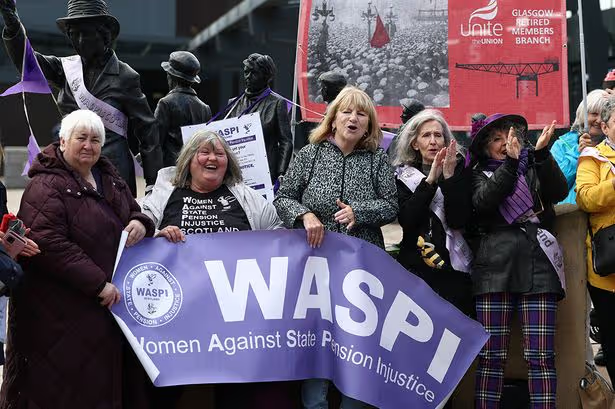
WASPI campaigners have fought for years to get DWP compensation(Image: Getty)
WASPI campaigners were left devastated after being informed they would not receive DWP compensation recently. Now, a financial expert has issued a fresh warning about the debacle, as some people may be unaware of certain looming changes.
The Labour Government recently confirmed it would not be awarding compensation to the 1950s-born generation of women represented by WASPI and other campaign groups. The long-running dispute centres on the women affected by the state pension age rising from 60 to 65 and subsequently to 66.
The campaigners argue they were not adequately notified of the changes by the DWP, with many only discovering the shift at the last minute, devastating their retirement arrangements. However, the Government has determined that no compensation will be provided to them.
In delivering the decision, Work and Pensions Secretary Pat McFadden informed Parliament: “The evidence shows that the vast majority of 1950s-born women already knew the state pension age was increasing thanks to a wide range of public information, including through leaflets, education campaigns, information in GP surgeries, on TV, radio, cinema and online. To specifically compensate only those women who suffered injustice would require a scheme that could reliably verify the individual circumstances of millions of women.”
People should be told well in advance
Tax accountant Grace Hardy, from Hardy Accounting, believes there are crucial lessons to be drawn from this controversy. She said: “Whenever the state pension age changes for any one individual, proactive written notification should be mandatory well in advance, not dependent on people checking Government websites or seeing general media campaigns. The DWP knew exactly which cohorts would be affected and had their addresses; there was no technical barrier to writing to them.”
A probe by the Parliamentary and Health Service Ombudsman determined that there was ‘maladministration’ on the part of the DWP, as they should have sent letters to the women sooner. The watchdog recommended compensation payments ranging from £1,000 to £2,950.
Labour acknowledged the finding of maladministration and issued an apology for the past failings, but ruled out providing financial compensation. Ms Hardy argued the DWP needs to step up its game moving forward.
Minimum notice period
She said: “Changes of this magnitude should have a minimum notice period enshrined in legislation for perhaps 10 years to allow genuine financial planning. The 2011 acceleration of timetable for women, giving some affected women as little as 18 months’ additional notice, was the specific step the Ombudsman found most problematic.”
She also called for a formal process to evaluate communication breakdowns and propose solutions, where the Government is required to respond within a fixed period, rather than allowing ministers to delay making a decision.
The Ombudsman’s final report, which included compensation recommendations, was published in March 2024 during Rishi Sunak’s tenure as Prime Minister under the previous Conservative Government. Labour issued its initial decision in December 2024, ruling out compensation.
Ministers subsequently reversed course and issued a second decision in February 2026, once again rejecting any payouts. Looking ahead, Ms Hardy warned that many people are likely unaware of another impending change to the state pension system.
Looming DWP changes
The state pension age, presently 66 for both men and women, is set to rise from April 2026. The qualifying age will increase gradually to reach 67 by April 2028. Legislation has also been passed for the age to climb from 67 to 68 between 2044 and 2046.
Ms Hardy said: “The first of those changes starts this April and it is reasonable to assume a significant proportion of those affected have not actively registered it.” The expert warned: “These dates could change again, which is precisely the problem the system depends on people actively monitoring Government policy, rather than the government actively informing those affected.”
There has already been discussion of potentially accelerating the transition from 67 to 68. A prior Government-commissioned report on the matter recommended bringing forward the timetable, but the then Conservative administration chose not to adopt the proposal.
Labour announced last year there would be another review of the state pension age, so this idea may be put forward again. In light of the WASPI controversy, Ms Hardy shared some broader guidance for anyone looking over their finances.
She said: “The overarching lesson is that the UK tax and benefits system is genuinely complex, changes frequently, and does not reliably notify those affected by changes. Treating your own financial position as something to actively and periodically review rather than something that will look after itself is probably the most valuable single habit anyone can develop.”
Ensure our latest headlines always appear at the top of your Google Search by making us a Preferred Source. Click here to activate or add us as your Preferred Source in your Google search settings.