An officer also said patient confidentiality concerns got in the way of further understanding the eventual killer
Bodycam footage show Valdo Calocane’s arrest
Mental health workers were scared to “take sides” by giving statements to police after triple-killer Valdo Calocane brutally attacked a police officer.
The Nottingham Inquiry, which is looking into how Calocane came to kill students Barnaby Webber and Grace O’Malley-Kumar, both 19, and grandad Ian Coates, 65, in Nottingham on June 13, 2023, today heard that mental health professionals did not want to provide evidence after he assaulted a police officer in 2021 as they feared this would make their job harder in the future.
On Wednesday (March 4), the judge-led inquiry heard from PC Barnaby Pritchard, who was attacked by Calocane on September 3, 2021, as police helped to section the paranoid schizophrenic.
Although Calocane had initially seemed calm, he took his glasses off before repeatedly punching PC Pritchard, who had followed him to his bedroom.
PC Barnaby Pritchard was attacked by Calocane on September 3, 2021, as police helped to section the paranoid schizophrenic(Image: Nottingham Inquiry)
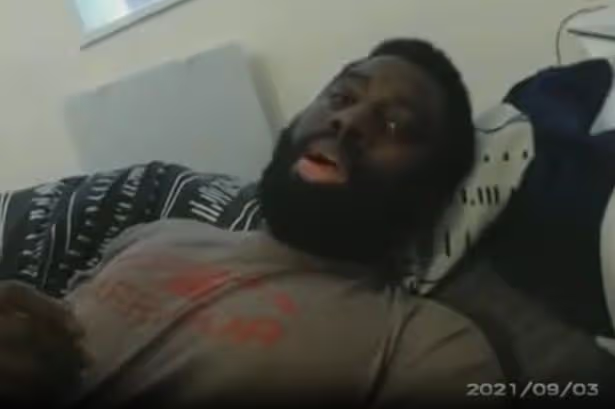
Calocane was pepper sprayed and Tasered twice to bring the attack under control, with the entire incident captured on bodycam – including his strange remarks that the punched officer “did good”.
Mental health professionals had asked for the police to attend after Calocane refused to come with them, but the inquiry heard that healthcare staff later were reluctant to give statements on the attack that left the constable with a bruised and swollen cheek.
The inquiry heard those trying to treat Calocane did not want to make their job more difficult by appearing to side with the hurt police officer.
Calocane was subject to a warrant, which was issued after he failed to turn up to Nottingham Magistrates Court over the assault of PC Pritchard, when he carried out his violent spree on June 13, 2023.
The judge-led process also heard evidence on Wednesday from PC Pritchard’s colleague, Police Sergeant Louise Ellis, who said that she had difficulty getting information about Calocane’s mental health from his doctor, owing to patient confidentiality concerns.
When questioned on how hard it was to get information from health services generally, Sgt Ellis said: “I find it really difficult.”
The officer said that hypothetically an NHS staff member could ring her up and say someone had a gun, but would then “insist on getting a data protection form before they will provide me with any kind of body worn video or CCTV”.
She said that professionals were scared of over disclosing information, but said in her opinion that people only really get in trouble when they do not disclose enough.
Calocane was arrested following the attack on the officer(Image: Nottingham Inquiry)
On Tuesday (March 3), the inquiry heard evidence from Calocane’s former flatmate, Sebastian, who was forced to leave his student accommodation due to the fellow mature student’s actions in 2021.
He was later stalked twice by Calocane in 2022, which he recalled to the inquiry yesterday afternoon.
Earlier on Tuesday, police officers from the Metropolitan Police gave evidence on the killer’s visit to MI5’s headquarters in London, where he had rang the intercom and asked to be arrested on May 31, 2021.
Monday’s hearing (March 2) at the Inquiry centred on the actions of officers tasked with investigating Calocane’s impact on residents of Brook Court in Radford.
Calocane had tried to break into rooms there, causing one young woman to jump from her window to try to escape him, fracturing her spine.