While there is more awareness around addiction nowadays, gambling is one addiction that many people either don’t know about, or they completely underestimate the damage it causes.
Problem gambling is a compulsion to continue gambling despite it causing negative outcomes as well as the person wanting to stop.
It can have a serious impact on the person and their loved ones and can also cause severe financial and mental health issues.
ERSI research estimates that 1 in 30 people in Ireland are problem gamblers, and it may be even higher due to its hidden nature.
Here, we speak to a former gambling addict and the wife of one to find out more about this devastating addiction…
Oisín McConville
When everyone was watching GAA legend Oisín McConville winning All-Irelands, they assumed he was at the top of his game, but inside, he was seriously struggling.
At the height of his sports career, the Armagh man was battling a devastating addiction to gambling, which he says was slowly destroying him, his family and his friendships.
What started off as a casual bet as a teenager spiralled into something out of Oisín’s control. His introduction to gambling was similar to most people in Ireland: the Grand National horse race. “Everybody was having a bet. It was very acceptable. I remember walking to the bookies that day, 14 years of age,” Oisín tells RSVP .
At that time, the bookies was a smoke-filled room at the back of a pub, with a black and white TV in the corner, and Oisín was immediately drawn to it. “My first bet was 50p on a horse. I don’t remember if the horse won or lost. I just remember thinking, ‘This is a world that I want to be part of.’ I could sense the excitement, when I went to sleep that night, I closed my eyes and all I could hear was the noises: the commentary, the excitement, anticipation, all that. It snowballed from there.”
Over the next couple of years, Oisín fell further and further into a gambling addiction, and by the time he was 18, he was gambling every single day, with every single penny he had.
Was there a moment where he realised that his gambling was out of control? Oisín says there were many times when he knew things were not good, but that didn’t stop him. “I was always able to tell myself I was one big bet away from solving all my problems. There were spells where it got particularly bad, with letters coming through the door.”
He adds that gambling addiction is different to alcohol and drug addiction in that there are no physical signs. “I was playing football at a really high level, winning All-Irelands, winning All Stars. People take it for granted that everything in your life is fine.”
Oisín himself bought into this, putting on a persona so people wouldn’t look too closely. He was the happiest person in the changing room, the joker, he was full of life. However, when he was at home, he went into his bedroom and crawled under the covers, not wanting to come out. “Gambling was affecting every aspect of my life and causing untold angst to the people around me as well, it has a knock-on effect. But when you’re in the addiction, you see very little of that. You don’t think it’s affecting anybody else, as far as you’re concerned, you are just hurting yourself.”
Oisín looked around him and saw all of his friends settling down, getting married and having children, but he says he wasn’t able to have those things because of addiction. He added that he no longer wanted the material things, like a big house, money and a fancy car that he used to crave – he wanted normality.
The Armagh man admits as a compulsive gambler, he was also a compulsive liar, and he managed to hide the truth from his family until it got to the point where that wasn’t possible. “When I eventually did ask for help, my family was stunned as to the extent of it.”
Aged 29, Oisín went into residential treatment. He spent 13 weeks in the treatment centre and he learned more about addiction. He had believed that he couldn’t be an addict because he was healthy, he was playing football at a high level and was, at times, holding down a job. “The only image of addiction I had was the guy laying on the park bench with a bottle of wine inside a brown bag. I soon learned I fitted the bill of addiction like a glove.”
For Oisín, the hardest part was admitting that he had an addiction and that he couldn’t sort it by himself. He says he came from a world filled with bravado. “It was stick your chest out and move on, stiff upper lip, don’t let anything affect you and don’t feel weakness. For the first time ever I had to show vulnerability and once I did that, I got help.”
In treatment, Oisín realised he had to take practical steps to change, and part of this included allowing himself to feel and talk about his emotions. “I was pretty shut off emotionally. I had to try and get those emotions back and mature them.”
He also learned that gambling was not something he could be ‘cured’ from, it was going to be an ongoing process. It’s now been 20 years since his last bet, but he still considers himself to be in recovery. “Gambling will always be the monkey on my shoulder and it’s up to me to make sure that it stays on my shoulder. There are certain actions I take every day to make sure that happens. You never beat it, but at the moment, I’m winning.”
A common misconception people have about gambling is that it’s just a financial issue, not an addiction. “Even after I came out of treatment, people would ask me if I wanted 20 quid on a few teams, or could we play a game of pool or golf for money.”
Oisín says other people can’t understand why gambling addicts don’t just stop – but Oisín says the same question is usually not posed to alcohol or drug addicts. “It’s not as simple as just stopping. I chose to stop loads of times, I stopped for a day, two, but the addiction wouldn’t let me stop. There has to be a process to make sure the recovery is long-term.”
The hidden element makes it even tougher to get help, and Oisín says loved ones should be aware of the signs. “Look out for financial stuff. Are they claiming they lost their card, wallet, or got paid late? Also look for a huge change in behaviour or mood.”
Since getting help, Oisín’s life has totally changed – he’s now free. “When you’re in addiction, you’re a slave to it. I had to beg, borrow, steal, scam and scheme every day to make sure I was able to feed my addiction. Then, you’re a slave to the actual gambling as well. You’re a compulsive liar, you’re unable to hold down a job or a relationship. I was bouncing from one relationship or job to another. I was in a relationship with gambling from 14 years of age, and there wasn’t really room for anybody else.”
Oisín’s father sadly passed away in 1999, back when Oisín was still in addiction. At the time, he didn’t cry for his dad. “I had no tears, I couldn’t bring myself to express the sadness.”
The day Oisín walked out of treatment in 2006, the first place he went to was his father’s grave, where he cried.
Now, Oisín is happily married with three wonderful children. “I did not see myself ever having the life that I have now. I hug my children every night and I tell them I love them. If I had continued to gamble, I wouldn’t have been able to do any of that.”
Nicola Keating
While we often hear about the perspective of former gambling addicts, it’s rarer to hear from their family and the devastating effect the addiction can have on them.
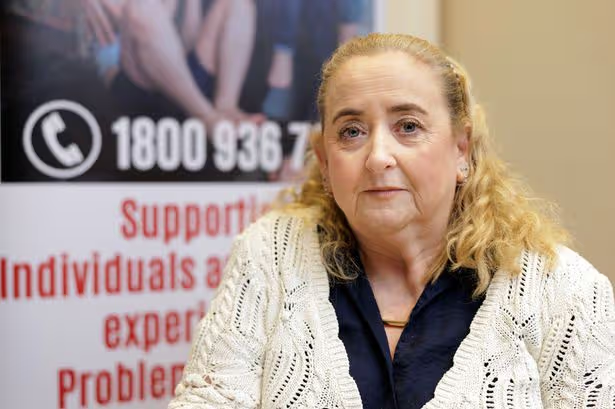
Dublin woman Nicola Keating lived with her husband’s gambling addiction for 16 years, and it severely affected her own mental and physical health. “It was 16 years of living with hopes, dreams and false promises.”
She says it’s equally important that the addict’s family members are supported, as oftentimes they feel invisible.
When Nicola met her husband, she was not long out of rehab for an alcohol addiction, and he had just come out of rehab for gambling. “Our paths crossed, it was a whirlwind. We were married within 12 months of meeting each other.”
Nicola didn’t know much about gambling at this stage, associating it with horses and the Grand National. “I knew you went into a bookies, I knew you’d bet on a horse. I didn’t know anything about poker machines, I would have never really heard of them.”
Since Nicola never saw any betting slips, she didn’t realise her husband was back gambling. He also went through a period of alcohol addiction, and would gamble on poker machines in casinos in between his drinking.
“A year into marriage, I knew something was not right. I knew he was hiding stuff. He had stopped drinking at this stage, so he wasn’t coming in drunk. He wasn’t coming in on drugs.”
Initially, Nicola thought he might be having an affair. After asking her husband outright, he agreed. “It was easier for him to say that he was having an affair than to tell me it was poker machines. Eventually, he confessed.”
Suddenly, things started to make sense to Nicola. She could never understand why they had no money when the two of them worked. “We started our marriage off old school, the way that my mother taught me. Your husband came in and he gave you your wage and you never questioned it.”
Nicola adds that people often blame the family members, wondering how they could not see the truth. “When somebody convinces you into thinking you’re going mad over things going missing, you start to believe their lies. You start to doubt yourself.”
Her husband was a binge gambler and drinker, and there were spells where everything was good. However, oftentimes he’d go missing for a few days on a gambling spree. “He’d go missing on a Friday when he got paid.”
Her husband would then come back and apologise profusely, promising not to do it again. A vicious cycle ensued: Nicola would take him back, he’d gamble, and she’d throw him out again.
Her husband’s mother used to take him in when he wasn’t welcome in the family home. “We were his two biggest enablers. He had her convinced that I was mad, that I was the problem. I don’t blame her, that’s her son, she didn’t want to believe he’d do something like this.”
For years, Nicola’s husband was in and out of AA and GA and did two stints in rehab. “We had good periods, and they were amazing, but I always lived on eggshells. I was always wondering when was the next time?”
He gambled around the time of special events like weddings, birthdays and Christmas, knowing that Nicola would be quicker to forgive him so he wouldn’t be missing at family gatherings and she wouldn’t have to explain where he was.
“I would never let him know how bad bills were. I worried he’d feel like he had to get the money and that would give him the excuse to gamble again,” she adds.
The cycle continued for 16 years, with Nicola’s mental and physical health deteriorating. “I was so vulnerable, isolated and lonely. I was so messed up in the head. I never wanted anybody to think bad of him because I still loved him.”
One day, a good friend of Nicola’s arranged for her to start counselling, which really helped her. She also managed to lose weight, adding that she had been overeating to cope with her emotions. “I realised that it was me that had to change. I was never going to fix him, I had to fix me.”
Nicola came home from counselling one day and told her husband that despite the fact they loved each other, they couldn’t live like this anymore and it was over.
Her husband went into residential treatment in the Rutland Centre, and Nicola joined the Concerned Persons group there for support.
After coming home, her husband stopped gambling and life was ‘amazing’, Nicola says. Sadly, after two years, he had a relapse, which devastated Nicola. They went back to the Rutland Centre, where she finally felt able to confront her husband with the truth. “He was sitting there and saying, ‘Our life is wonderful’.
“I said, ‘We’re not living in a happy house. What fantasy world is he living in?’. I was going through bankruptcy and solvency at the time. The pressure of constantly having to turn up to court.
“For another year and a half, the two of us sat in an aftercare group confronting each other every week. I was no longer afraid to say what I had to say.”
Nicola is now 33 years married, and her husband is 17 years free of a bet. “It’s amazing, the adventures the two of us have been on. We saved the house. I’ve three beautiful children and two beautiful grandchildren.
“The kids go to him for advice. He sits down and listens to each and every one of them and will help them through their stress or anxieties. He’s done well in his job.”
Nicola says she’s speaking out now after so many years as she’s no longer afraid of the guilt, shame or stigma. “If I can help one other family member out there by saying it’s okay not to be okay. We are great at putting these masks on, hiding the problem, when inside we’re dying. Don’t be afraid to get help for yourself too.”
This article first appeared in the February issue of RSVP.