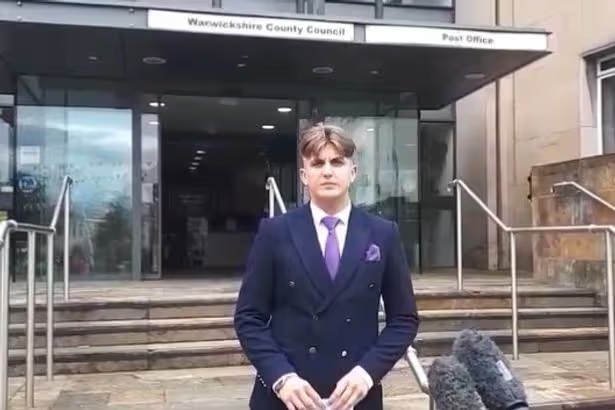
Independent investigation found council leader breached confidentiality by publishing information about live criminal case that could have jeopardised proceedings
Coun George Finch at Shire Hall. He has been found to have breached the code of conduct(Image: @WarwickshireLDR on Twitter)
An investigation has determined that leader George Finch violated Warwickshire County Council’s code of conduct by releasing information that “could have jeopardised” a child rape case.
The council pursued eight complaints alleging that Councillor Finch (Reform UK, Bedworth Central) breached the code by disclosing correspondence he had sent to the Home Secretary concerning what was then, and remains, an ongoing criminal case.
These complaints pertained to four distinct aspects of the code. Whilst solicitor Claire Ward, engaged by Warwickshire County Council to carry out an independent investigation, exonerated Cllr Finch on three counts, he was found to have broken confidentiality by revealing details he had access to as leader of the authority.
Read more: Warwickshire Conservatives confirm which way they will vote in knife-edge bid to topple Reform UK leader
Read more: Heartfelt tributes paid to ‘devoted’ Coventry dad and rugby player who had ‘extraordinary courage’
What is this about?
Cllr Finch shared his correspondence, which bore the Warwickshire County Council logo and was signed off with his title as leader, on social media platforms in early August, before the defendants entered pleas.
A subsequent trial resulted in Ahmad Mulakhil, 23, being convicted of rape, abduction, sexual assault and taking an indecent video of the girl. However, co-defendant Mohammad Kabir, 24, was acquitted of strangulation, attempted child abduction and attempting to commit a sexual offence.
Mulakhil is set to be sentenced on March 27, 2026.
The investigation report outlines how Cllr Finch contended that the information had already been suggested by local and national media, asserting that it was in the public interest to highlight it and invoking his right to free speech under Article 10 of the European Convention on Human Rights.
Ms Ward agreed that privately addressing issues with the Home Secretary would have met the public interest criterion, and that announcing he had written to her would have been acceptable. However, she deemed the publication of the correspondence itself, given its detailed content, a breach of confidence.
She also determined that Cllr Finch’s rights under Article 10 were overridden by the necessity to uphold confidentiality due to the sensitive nature of the matter.
Ms Ward’s report mentions how “Cllr Finch accepts that the information… had been told confidentially to him in his capacity as leader” and later indicates that Warwickshire Police had provided the information to the council “expressly with an obligation of confidence given community tension”.
Subsequently, it is noted that Cllr Finch “did attempt to obtain permission” to disclose the information during discussions with the council’s chief executive Monica Fogarty and Warwickshire Police’s chief constable Alex Franklin-Smith, but she concludes that “this did not amount to formal compliance”.
In weighing up public interest against maintaining confidence, Ms Ward concluded: “Although principles of openness and the need to build public trust are significant, the particularly sensitive nature of the information meant that broadcasting it… was unwarranted.
“Publicly releasing such details could have jeopardised the ongoing prosecution, caused undue distress to the victim and undermined community cohesion.
“Whilst transparency remains vital for public confidence, in this instance a more measured and confidential approach was required.”
Ms Ward went on to state: “The information shared by Cllr Finch was not trivial. It concerned matters that could have a direct impact on the effectiveness of a police investigation and the stability of the community.
“Had this information remained confidential, it would have helped to protect the anonymity and wellbeing of a victim, ensured that the prosecution would not be compromised and prevented unnecessary escalation of public concern and unrest.”
Keep up with the latest news from across Warwickshire with our FREE email newsletter.
Additional considerations focused on Cllr Finch’s responsibilities as a councillor to represent the entire community’s interests, show respect for colleagues and staff, and demonstrate leadership in dealings with external organisations alongside the council.
Ms Ward acknowledged potential shortcomings in these aspects but found no clear connection between Cllr Finch’s conduct and the subsequent demonstrations and counter-demonstrations that took place. “Whilst the evidence does not conclusively support that Cllr Finch’s post was the catalyst for the unrest in Nuneaton, it is important to consider whether his actions fell short of the standards expected of a councillor,” she penned.
The report suggests that he “may have contributed to heightened community anxieties and placed additional pressure on council staff and partner organisations; the police”, leading to a “possibility that staff at the council and police did not feel adequately valued or supported”.
However, Ms Ward stated that “the unrest cannot be directly attributed” to Cllr Finch, concluding it “more likely that the situation was a result of a combination of factors”.
What’s next?
The report was forwarded to the council’s monitoring officer Sarah Duxbury – the authority’s top legal official – who will decide the next steps.
According to Warwickshire County Council’s website, Ms Duxbury “will consult an independent person” before finalising any recommendations. It adds: “If the member concerned does not accept the recommendations in the finalised report, the matter will be referred to a hearing sub-committee for consideration.”
The site then outlines some fairly limited options for dealing with breaches. These include writing to the councillor involved, issuing a formal censure – reprimand – by motion, removing the councillor from committees or issuing a press release or other suitable publicity.
Join the FREE Coventry WhatsApp community to get the latest news straight to your phone. Find out more here.
Warwickshire County Council was contacted to confirm the status of Cllr Finch’s case, including whether he had accepted the decision, whether any hearings are scheduled or have occurred, whether any penalties have been imposed, whether the council has opted against imposing penalties and whether the matter has been resolved.
A council statement said: “The council does not provide details or comment on individual complaints that have been made against councillors.
“It would not be reasonable for any such details, wherever they exist, to be released whilst any matters were being considered or investigated. This is in accordance with data protection law and is consistent with decisions made by the information commissioner.
“In addition, we would advise against publishing anything that is speculation.”
Cllr Finch, who is understood to be subject to two other code of conduct complaints, has been contacted for comment.
Make sure our latest stories always feature at the top of your Google Search by setting us as a Preferred Source. Click here to enable or add us as your Preferred Source in your Google search settings.