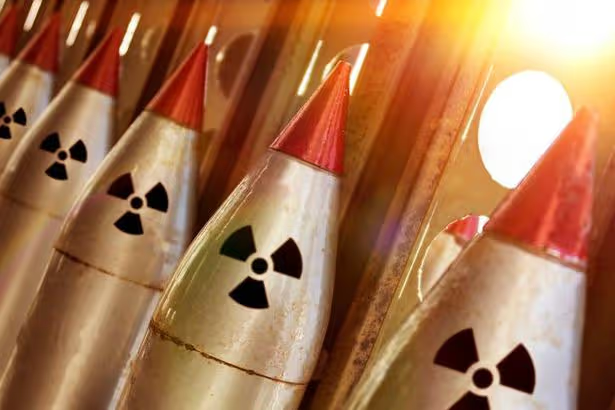
The UK government has issued advice on the safest place to be in your home and what to do in the very unlikely event of a nuclear strike
There’s a few simple steps you should follow(Image: Getty Images)
With uncertainty on the horizon and many feeling anxious following recent developments in Iran, it’s important to understand the recommended safety measures to protect yourself at home here in the UK, should the highly unlikely worst-case scenario occur.
The British Government recommends a three-step approach in the event of a nuclear incident on British soil – go in, stay in, tune in.
Should a radiation emergency arise, there are several straightforward actions you can take to maximise your and your loved ones’ safety.
The ‘go in’ instruction means that if you become aware of a radiation emergency in your vicinity, you must get indoors immediately.
To improve your protection, ensure all windows and doors are shut, and position yourself as far from external walls as possible.
The most secure location is in the centre of the building, away from external doors, windows and walls. This helps to “avoid exposure from any radioactive material that has collected on the outside of the building.”
According to gov.uk, remaining indoors significantly reduces your radiation exposure. Once inside, you should switch off all fans and air conditioning units, seal all exit points and windows, and block any air vents.
We could live to 200, men in danger of dying out, ‘Conan the Bacterium’ can’t be stopped, and woolly mammoths will be back in 2028 – all this and more in our latest science newsletter
If instructed to shelter at home, you may need to remain indoors for up to one or two days. The Government advises citizens to ‘tune in’, meaning staying informed by monitoring news outlets and adhering to official UK Government guidance on appropriate actions.
Updates can be accessed through television, radio, online platforms, social media, or direct communications from police.
We could live to 200, men in danger of dying out, ‘Conan the Bacterium’ can’t be stopped, and woolly mammoths will be back in 2028 – all this and more in our latest science newsletter
A nuclear strike would trigger an instant radiation emergency due to the discharge of radioactive materials. Individuals may be exposed through various channels.
According to the Government website: “Breathing in radioactive materials. Direct exposure to radioactive material carried in the air and deposited on surfaces, clothing or skin. Eating or drinking food or water contaminated with radioactive materials.”
While taking protective measures is essential, being caught within the immediate zone of a nuclear detonation leaves virtually no chance of survival.
The extreme temperatures would incinerate human tissue instantly, whilst those at greater distances could still face a prolonged and agonising death from radiation exposure.
Acute Radiation Syndrome results from such exposure, with initial survivors potentially experiencing nausea, vomiting, headaches and catastrophic multi-organ failure. This would ordinarily prove fatal within days or weeks.
The Campaign for Nuclear Disarmament website notes: “If a nuclear bomb were detonated, the heart of the nuclear explosion would reach a temperature of several million degrees centigrade. The resulting heat flash would literally vaporise all human tissue over a wide area.
“At Hiroshima, within a radius of half a mile, the only remains of most of the people caught in the open were their shadows burnt into stone.”
Experts predict that to remain safe from radiation and survive a significant nuclear strike, you would need to be at least 10 to 20 miles distant from the blast.
For instance, if an attack occurred in central London, locations such as St Albans, Brentwood and Windsor would likely experience reduced radiation exposure.