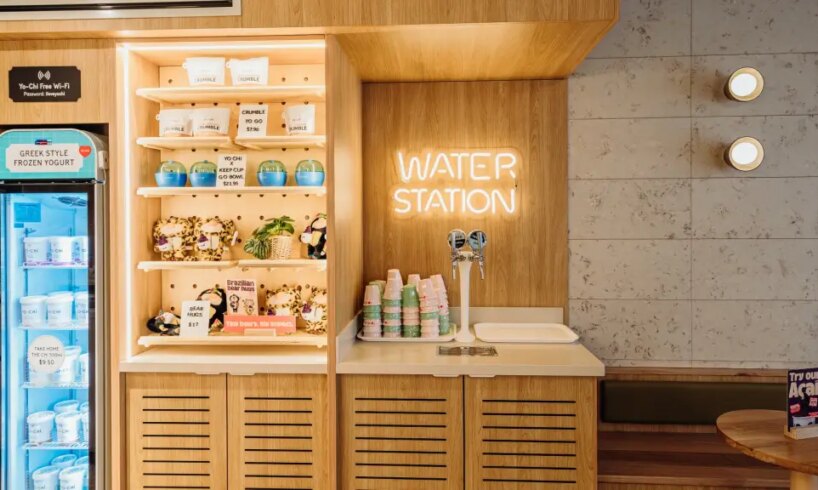
Melbourne frozen yoghurt chain Yo-Chi has taken a sweet stand against plastic water bottle sales in Australia by removing bottled water from all 69 of its stores, in a move the brand estimates could cost the business up to $10 million per year in lost sales.
However, despite potentially losing millions a year in foregone bottled water revenue, Yo-Chi’s co-owner and brand director Oliver Allis told SmartCompany the decision was focused on the environment — and the self-serve-style business is putting its money where its mouth is.
Instead of bottled water, its stores now offer free still and sparkling refill taps that anyone can access, from tradies who fill up their drink bottles in the morning or people out on a jog, and even those who don’t make a purchase.
The chain estimates its policy avoids the equivalent of approximately 5.7 million single-use plastic bottles across its network annually, equating to more than 100 tonnes of plastic each year.
Yo-Chi, which opened its very first venue in Melbourne in 2012, has been owned by the Allis family since 2020.
Smarter business news. Straight to your inbox.
For startup founders, small businesses and leaders. Build sharper instincts and better strategy by learning from Australia’s smartest business minds. Sign up for free.
By continuing, you agree to our Terms & Conditions and Privacy Policy.
The brand is led by both Oliver and Riley Allis, who are the sons of Boost Juice founder Janine Allis.
Refill stations take over
Yo-Chi has called on other businesses, retailers, and fast food giants to follow in their footsteps and replace bottled water with refill stations.
Allis hopes making a big noise about the decision could influence other businesses to follow suit.
“The actual goal of this campaign that we’re doing is to reduce plastic water bottle sales in Australia,” Allis says.
“We’re shouting out about our environmental decision, but we want to be the pioneer or a loud voice in this space to actually encourage our massive community of fans to reach out to their other favorite businesses and just question them and say, ‘Why are they still selling plastic water bottles?’”
Allis wants to grow Yo-Chi’s water bill, and the revenue foregone by avoiding bottles water sales, to lessen the brand’s impact on the planet.
Related Article Block Placeholder
Article ID: 328145
Across its 69 stores and headquarters, Yo-Chi has around 1,500 staff members.
Allis confirmed Yo-Chi is aiming to open another 15 to 18 stores in Australia this year and expects to open its doors in four international markets.
Currently, Yo-Chi’s number one topping is fresh strawberries and the brand goes through over 35 tonnes of strawberries in an average month.
The brand’s free still and sparkling refill taps initiative has also seen Yo-Chi strengthen its stores as a “third space”, offering people a chance to head to a familiar spot, other than home or work or school, which increases dwell time and encourages repeat visits for the brand.
A broader sustainability plan
Yo-Chi co-owner Oliver Allis. Source: Supplied
When asked about Yo-Chi’s broader sustainability efforts, Allis says the brand always wants to do more.
“I just want to preface that we’re not a perfect company, and we’ll never pretend we are perfect, but we do pride ourselves on improving every year and introducing new initiatives every year,” he says.
In 2025, Yo-Chi partnered with Perth-based cutlery startup Edible Cutlery to offer edible chocolate spoons as a sweet alternative to wooden spoons.
The spoons were available on topping bars of all Yo-Chi venues and prevented more than 100,000 single-use spoons from ending up in landfill.
Yo-Chi has partnered with KeepCup in 2025 to launch reusable bowls, the Yo-Chi x KeepCup Go Bowl.
It also launched a campaign with litter prevention organisation Keep Australia Beautiful, which saw the brand raise awareness in its venues and social media accounts. Yo-Chi hosted donation boxes for the cause.
Allis says other Yo-Chi sustainability efforts include ongoing waste reduction initiatives, operational efficiency improvements, and partnerships with suppliers to reduce single-use packaging across the business.
“In the future for Yo-Chi, we want to double down on our environmental and socially responsible initiatives. We actually want to become a positive action company,” Allis says.
“A company that continues to do good in the world, to influence other businesses to be better, and to lobby governments to be better.”