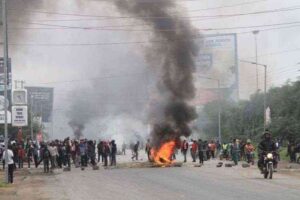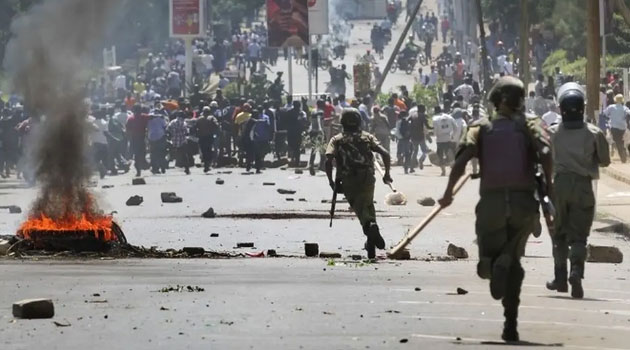
NAIROBI, Kenya Mar 25 – A High Court in Kisumu has ordered the government to pay millions of shillings in compensation to the families of people killed and injured by police officers during protests in Kisumu and Migori in 2023.
Justice Alfred Mabeya ruled that the National Police Service used excessive and unlawful force against civilians many of whom were not even taking part in the demonstrations hence violating their constitutional rights.
“The members of the 2nd respondent used excessive force in dealing with the demonstrators in Migori and Kisumu,” the judge said in his ruling. “They used lethal weapons against the petitioners that resulted in the violation of the petitioners’ rights.”
The judgment covers 28 victims, nine of whom died and orders the Inspector General of Police, the National Police Service, and the Attorney General to pay compensation jointly and severally.
The court heard stories of ordinary Kenyans whose lives were shattered during the so-called “Azimio Maandamano” protests against the high cost of living that ran from March to July 2023.
“All that is narrated above is not from any blockbuster movie or any warfront,” Justice Mabeya wrote. “It is actual events that took place in Migori, Kisumu and Ahero.”
The judge found that police officers violated multiple constitutional rights, including the right to life, the right to security of the person, the right to dignity, and the right to privacy with some victims dragged from their own homes before being beaten.
The court also found that the police specifically targeted poor, informal settlements.
“The officers of the 2nd respondent unfairly targeted the residents of Nyalenda, Kondele and Obunga,” the ruling noted, observing that wealthier areas of Kisumu such as Milimani and Riat were left untouched.
The judge emphasised that none of the 28 petitioners were demonstrators.
“They were either shot at or clobbered while going on with their daily chores,” Mabeya ruled.
– Why Was the Police Inspector General Held Responsible? –
The Inspector General of Police was held responsible under the international law principle of command responsibility meaning a senior commander can be held accountable for the unlawful acts of those under his command, even without a direct order to commit those acts.
“Here, the subordinates of the 1st respondent ran amok,” the judge said. “They were under his control and direction. They perpetrated heinous acts. Someone has to take responsibility.”
The court awarded varying amounts depending on the severity of injury or loss.
Among those killed, families received between Sh910,000 and Sh1,400,050.
Among the injured, awards ranged from Sh300,000 for minor injuries to Sh4,870,000 for a petitioner who will require lifelong nerve medication and physiotherapy.
The court also directed the Independent Policing Oversight Authority (IPOA) to complete its investigations and report back within 90 days, after finding it had sat on complaints for over two years without meaningful progress.
“There is no investigation that can be too complex as to take forever to be undertaken,” the judge said bluntly. “It is an attitude problem. This must not be encouraged.”
IPOA had argued the investigations were complex and sensitive, and that officers under investigation were still in active service. The court was not sympathetic.
“Just because there were no timelines fixed for undertaking investigations, IPOA took unto itself the opportunity to take forever,” Justice Mabeya said, warning that if it failed to report within 90 days, the court would consider issuing compensation orders against IPOA itself.
– Police ordered to write new rules on protests and use of force –
The court at the same time directed the government to develop and publish clear regulations on how police should handle public demonstrations and when force may be used within 90 days.
The judge expressed concern that despite Kenya’s 2010 Constitution guaranteeing the right to peaceful protest, there appeared to be no proper training or guidelines for officers on how to handle such situations.
“The level of violence meted out to the petitioners in this case gives credence to doubts as to the existence of a set of rules and regulations to govern public order,” he wrote.
The case was brought together by Dorcas Akinyi Oluoch, the chairperson of the Law Society of Kenya’s Kisumu chapter, who coordinated the legal effort pro bono, collected testimonies, helped victims access medical assessments, and appeared as a witness.
The case was filed in August 2024. No order as to costs was made, given that it was public interest litigation.
The court will sit again on July 7, 2026, to confirm compliance with its orders.