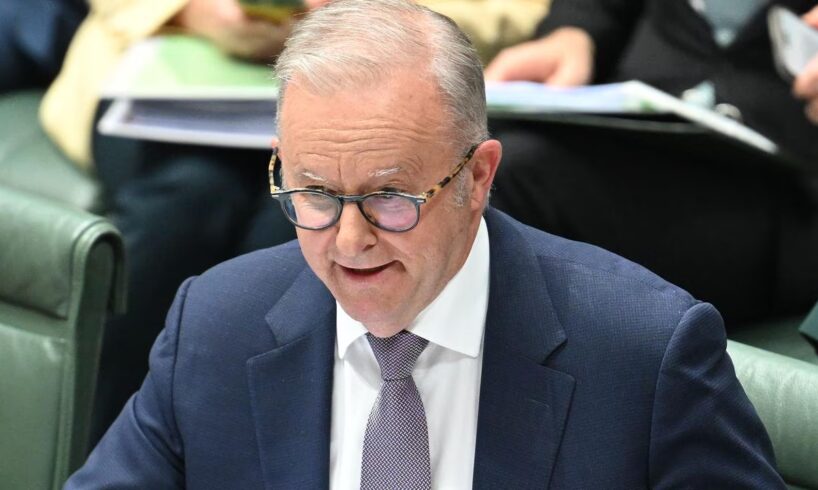
Anthony Albanese has called a national cabinet meeting with state premiers for Monday to consider new emergency measures to conserve fuel including carpooling, working from home when sensible and public transport discounts.
While stressing that these measures are not yet required, the government wants contingency plans in place to dampen demand if necessary.
Until now it has remained steadfastly focused on measures to boost supply, with the Prime Minister previously suggesting fuel rationing was a matter for the states.
The Prime Minister is adamant that at this stage there is no need to start rationing fuel supplies as One Nation leader Pauline Hanson suggested.
MORE: How petrol price spike could hit home values
However, he has bowed to pressure from state premiers to adopt a national approach to what may come next.
News.com.au understands the measures being examined include public transport discounts, carpooling, and encouraging voluntary work from home where sensible.
South Korea’s drastic measures
It follows South Korea’s decision to launch a public campaign asking people to cut shower time, charge phones and electric vehicles during the day and run vacuums and washing machines on weekends.
South Korea, one of Australia’s major sources of refined oil, announced a nationwide energy-saving campaign, warning that a plan was necessary if fuel shortages continued.
Philippine President Ferdinand Marcos Jr has declared a national energy emergency that could last for a year.
PM changes gears
Just this weekend, Mr Albanese said petrol rationing was “not a question for me – that is a decision for state and territory governments.”
However, the NSW Premier warned he did “not want to see a situation where states are having to make their own decisions and potentially come up with different answers about rationing, work from home and other questions”.
MORE: Best WFH jobs in Australia revealed
“If demand management procedures are required, that might be rationing, that might be working from home, it might be other programs or remedies that we can introduce into the marketplace … it should be a nationally consistent approach,” Mr Minns said.
“We need a nationally consistent approach if and when the time comes when we need to introduce those demand management measures – a clear signal of what might be to come.”
500 petrol stations without fuel
Australia’s fuel shortage crisis is worsening with 500 service stations across Australia now out of one form of fuel.
NSW Premier Chris Minns outlined the latest hotspots in state parliament on Wednesday, stressing the government was working to ease the shortages.
“As of the latest count, there are 32 petrol stations in New South Wales without any kind of fuel,’’ he said.
“That’s down from 51 stations yesterday but worryingly, 187 stations are out of diesel.
“The split of regional and metro stations are 78 stations in regional New South Wales and 109 in metropolitan Sydney.
“So whereas earlier in the crisis, we saw more regional stations having a lack of diesel, now we’re seeing more Sydney stations.”
Mr Minns stressed he was not planning to “introduce Covid-style emergency measures – that’s not the case.”
However, he did want a national response, as was the case with Covid.
“I’m not going to be in a situation where we’re bringing back home schooling or lockdowns or any of these kind of preposterous interventions,” he said.
“This is not that kind of emergency, and I don’t think that hyperventilating about emergency measures is going to help the process.
“That doesn’t mean we’re not taking emergency measures, and it doesn’t mean that we’re not preparing for a situation that could get gradually worse in the weeks ahead.
Petrol prices surge
As the price of fuel skyrockets across Australia, reaching almost 3 dollars a litre at some stations in Sydney and Melbourne, there are fears it could hit 4 dollars.
According to the latest figures released by the Australian Institute of Petroleum on Monday, the national average retail petrol price rose by 18.5 cents last week to 238.0 cents per litre.
The national weekly average regional retail petrol price rose by 22.0 cents last week to 239.6 cents per litre.
With petrol now averaging 238.0 cents per litre, a typical 50 litre tank costs about 119 dollars to fill – roughly 9 dollars more than a week ago.
For drivers of larger vehicles, that weekly jump can push the extra cost closer to 13 dollars.
The surge in fuel costs follows US and Israeli strikes on Iran that led to the closure of the Strait of Hormuz, through which around 20 per cent of the world’s oil supply passes.
Read related topics:Anthony Albanese
Source