Prime Minister Narendra Modi on Tuesday said that India has sufficient crude oil reserves and robust arrangements for continuous supply amid the ongoing West Asia conflict. He also said that the government is in constant touch with many countries including US, Israel and Iran.
PM Modi spoke at length on West Asia conflict in Rajya Sabha
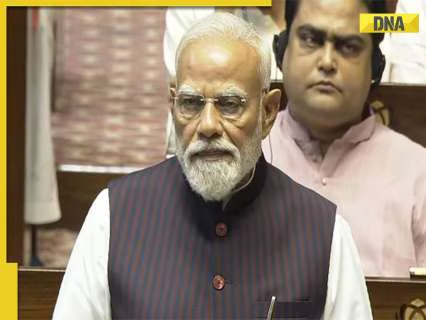
Prime Minister Narendra Modi on Tuesday addressed the Rajya Sabha over the ongoing West Asia conflict. He called for a united voice promoting peace and dialogue globally, as the ongoing West Asia conflict disrupts trade, energy supplies, and affects the safety of millions of Indians in the Gulf.
PM Modi in contact with Gulf, other nations
PM Modi said, “It has been more than 3 weeks since the war in West Asia started. The war has caused a serious energy crisis in the world. For India, too, this situation is concerning. The war has impacted our trade routes. With this, the routine supply of petrol, diesel, gas and fertilisers has been affected.”
The Prime Minister informed that since the outbreak of the war, he has held multiple phone discussions with leaders of the region and confirmed India’s continuous engagement with all Gulf countries, Iran, Israel, and the United States. “Since the start of the war, I have held two rounds of phone conversations with the heads of state of most countries in West Asia. We are in continuous contact with all the Gulf countries, and we are also in touch with Iran, Israel, and the United States,” PM Modi said.
India’s oil reserves
He also said that India has sufficient crude oil reserves and robust arrangements for continuous supply amid the ongoing West Asia conflict. He highlighted the expansion of strategic petroleum reserves and increased refining capacity, as global trade through the Strait of Hormuz faces disruptions.
PM Modi said, “…In the last 11 years, strategic petroleum reserves have been developed to more than 53 lakh metric tonnes, and work is underway to expand them to over 65 lakh metric tonnes. Additionally, India’s refining capacity has also been significantly increased in the last decade. I want to assure the House and the country through you that India has adequate crude oil storage and arrangements for continuous supply.”
“The Hormuz Strait is one of the largest routes for global trade. A significant amount of transport related to crude oil, gas, and fertilisers takes place through this region… Our endeavour is to ensure that oil and gas supplies reach India from wherever possible. The country is witnessing the results of such efforts. In the past few days, ships carrying crude oil and LPG from several countries have arrived in India. Our efforts in this direction will continue in the coming days as well,” PM Modi said.
The Prime Minister said that India has expanded its energy import sources from 27 to 41 countries over the past decade and is working to reduce dependence on any single fuel, while accelerating domestic gas distribution, including piped natural gas and LPG, across the country.
US-Israel-Iran war update
The ongoing conflict in West Asia has entered its fourth week, disrupting trade routes through the Strait of Hormuz. Tensions escalated following the killing of 86-year-old Iran’s Supreme Leader, Ayatollah Ali Khamenei, in joint military strikes by the US and Israel on February 28.
In retaliation, Iran targeted Israeli and US assets across several Gulf countries, causing further disruptions to the waterway and impacting international energy markets as well as global economic stability.
Meanwhile, today, Arab News has cited Israeli Media outlet Yedioth Ahronoth to report that Iran’s Supreme Leader, Mojtaba Khamenei, was prepared to negotiate with the Americans.