Listen to this article
Estimated 4 minutes
The audio version of this article is generated by AI-based technology. Mispronunciations can occur. We are working with our partners to continually review and improve the results.
The president of the Métis National Council says the RCMP’s response to an extensive spying program that targeted hundreds of Indigenous people falls short.
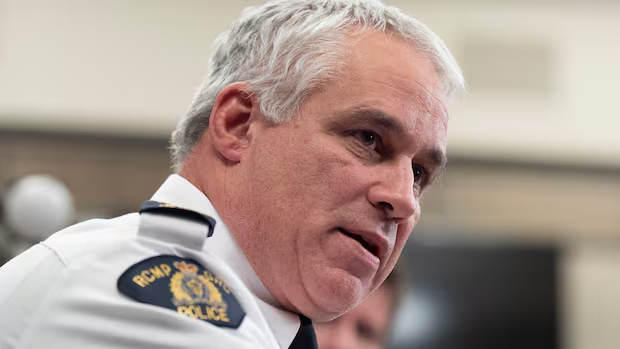
RCMP Commissioner Mike Duheme released a written statement of regret on Wednesday in response to a CBC Indigenous investigation that uncovered nearly 6,000 newly declassified documents detailing widespread surveillance activities by the Mounties against Indigenous leaders and the organizations dating back to the late-’60s.
Métis National Council (MNC) president Victoria Pruden called the espionage program disturbing, but not deeply surprising given the historically complex relationship the Métis Nation has with the RCMP, which is fraught with violent conflict.
Pruden said she sees Duheme’s statement as an interim step, which will require a formal public apology matched with action.
“Hopefully that’s a precursor to a meaningful, authentic and legitimate apology,” Pruden said. “This news is yet another rupture of trust between Métis and the government of Canada and RCMP.”
WATCH | Indigenous leaders react to CBC News investigation:
Indigenous leaders demand accountability over RCMP spying
After a CBC News investigation revealed extensive spying by the RCMP on Indigenous leaders in the 1970s, several current leaders are calling for accountability, including an investigation and an apology.
The RCMP told CBC News the commissioner is committed to meeting with Indigenous leadership to listen, and discuss work towards healing and stronger relationships. But did not commit to a public apology.
“The RCMP will continue to confront the difficult truths of its past and to building trusting relationships with Indigenous Peoples,” the RCMP said in a statement Friday.
Pruden said the Canadian government, which funds the RCMP, needs to participate in restitution efforts and a formal apology by the prime minister would also be welcomed.
“Métis are not a threat to Canada,” Pruden said. “We need absolute transparency about what has happened, but equally importantly we need clear assurance about what’s happening now.”
Public safety minister discussing potential PM apology
Prime Minister Mark Carney said on Thursday that there should be a public apology for the Indigenous spying program. CBC News then asked the prime minister’s office if Carney would issue one.
In response, Public Safety Minister Gary Anandasangaree’s office sent a statement saying the minister has been in contact with national Indigenous organizations to discuss the matter.
It also said the minister and RCMP commissioner are planning to sit down with Indigenous leadership, elders and potentially some of the individuals who were subjected to surveillance to discuss next steps and ensure accountability.
“This serves as a reminder of the continued work that lies ahead on Canada’s path towards reconciliation,” Anandasangaree’s office said.
“Our government will always remain committed to that work, including strengthening oversight, ensuring non‑discriminatory public safety practices, and rebuilding trust with Indigenous communities through honesty, transparency, and a sustained partnership.”
Métis National Council President Victoria Pruden is calling for the release of all files related to RCMP and CSIS Indigenous surveillance, along with an inquiry and public apologies. (Métis National Council)
The years-long CBC Indigenous investigation revealed the RCMP Security Service ran covert surveillance, had informants and engaged in countersubversion against the First Nations, Inuit and Métis rights movements.
The RCMP Security Service was Canada’s domestic intelligence agency until 1984, and has since been replaced by the Canadian Security Intelligence Service (CSIS), which took over the Indigenous espionage program in 1988.
CSIS told CBC News the service doesn’t investigate lawful protest, advocacy or dissent, but also acknowledged there is a trust gap with many Indigenous people.
In addition to public apologies, Pruden and Assembly of First Nations National Chief Cindy Woodhouse Nepinak are calling for an inquiry into Indigenous surveillance and the disclosure of all remaining records.
Library and Archives Canada estimates there are 300 to 400 files that may relate to the program, containing potentially up to 100,000 pages.
“This happened to my predecessors, and I am concerned that it could be happening to myself and to other First Nations leaders at this very moment,” Woodhouse Nepinak said.
WATCH | Behind the scene details of CBC Indigenous investigation:
How CBC Indigenous uncovered proof of RCMP spying
Reporter Brett Forester explains how CBC Indigenous obtained over 6,000 pages of newly declassified “racial intelligence files,” revealing proof of an RCMP spy program that infiltrated Indigenous organizations in the 1970s.
Inuit Tapiriit Kanatami (ITK), the national representational organization for Inuit, said it is committed to working with the RCMP to implement shared priorities from their 2023 work plan aimed at restoring trust in the RCMP by Inuit.
“We will work through that process with the RCMP and with Inuit treaty organizations to identify ways to address the harm to Inuit whose rights were violated,” ITK said in a statement to CBC News.