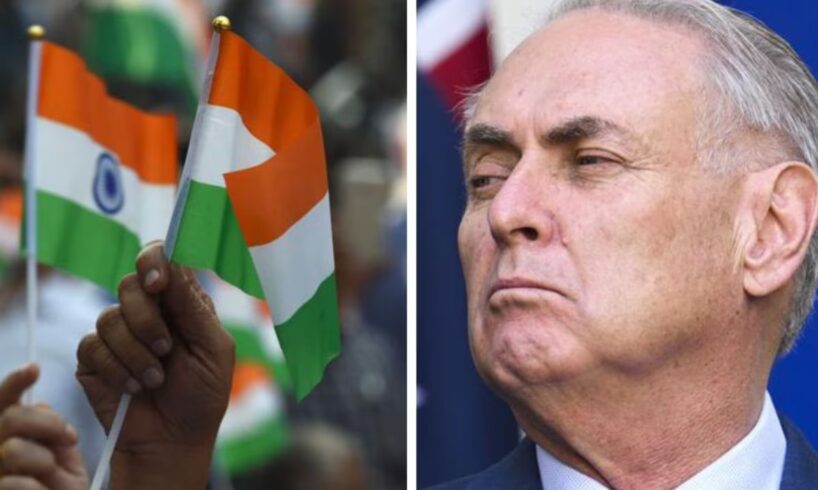
One week after clinching a free-trade deal with Europe worth billions, Anthony Albanese’s chief negotiator has revealed he is eyeing deeper access to India’s $4.13 trillion economy.
Australia already enjoys tariff-free access on 85 per cent of goods exported to India, from lamb and lobsters to critical minerals and metals.
Those terms were locked in under deal that entered force in late 2022, with both Canberra and New Dehli agreeing to keep building toward a bigger free-trade pact.
Trade Minister Don Farrell said on Monday he was “going to have another crack at India in the next few weeks”.
“Our agreement with India has seen trade increased by 17 per cent, giving more Australian exporters access to the world’s largest country by population, which is experiencing rapid expansion of the middle class, primed to enjoy the best of Australian agricultural exports,” he told the National Press Club.
He was asked later if he thought talks with India would be as hard as talks with the EU, which took eight years and a generation of trade negotiators to close.
With the idea of an Australia-India free-trade agreement first flagged in 2011, Senator Farrell said he “wouldn’t anticipate an easy set of negotiations”.
“They have great ambitions,” he said, noting that India had a population of 1.4 billion to Australia’s 30 million.
“India represents great opportunities. They have the ambition that by 2030, 900 million Indians will be in what they define as the middle class.
“What do we know about people when their incomes rise? Well, they want better food and better wine. So here’s a wonderful opportunity.”
He nominated wine from Clare Valley in his native South Australia as a good drop to meet that demand.
EU ‘naturally suspicious’
Senator Farrell also opened up about “tense meetings” with the EU.
He walked out on a deal in 2023 at the final hurdle over red meat access for Australian farmers.
In doing so, he infuriated negotiators who had travelled to Tokyo to meet him.
But both sides decided to try again after US President Donald Trump launched his global tariff assault.
Senator Farrell said he thought “there was an expectation that we weren’t fair dinkum about negotiating an agreement” when he first met EU trade chief Maros Sefcovic.
“When I had my first reading with him, I think they were naturally suspicious that here’s a bloke who leads them along, makes them think that they’re going to get an agreement, and then refuses to do the deal,” Senator Farrell said.
“And so I think I had to convince him that we were, in fact, fair dinkum about reaching an agreement, and bit by bit, we managed to do that.”
He went on to say that when he met with Mr Sefcovic on the eve of finalising the deal, “I was supposed to meet him, take him in a car to Admiralty House, where we would greet the European (Commission) President”.
“I said, ‘Look, how about we cancel the car? Why don’t we walk down to Circular Quay, catch the ferry over to Milson’s Point and make our way to Admiralty House?’” Senator Farrell said.
“And so he got to see first-hand the Opera House, go under (Sydney Harbour Bridge), and it gave us a terrific opportunity to continue to build the relationship.
“And I think … there is now a trusting relationship like I have with just about every other trade minister around the world.
“I think we’ve now got and rebuilt that trusting relationship with the Europeans.”
European diplomatic sources familiar with negotiations told NewsWire throughout the latest talks that Senator Farrell’s relationship with Mr Sefcovic was far better than with the former European Commission trade chief.
Read related topics:Anthony Albanese
Source