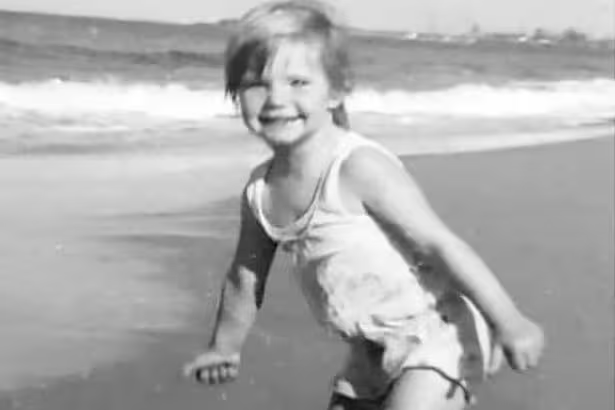
He said the guilt of leaving his sister has been intensified by the “mismanaged” case
Ricki Nash whose sister Cheryl Grimmer disappeared in Australia(Image: Submitted)
The older brother of a toddler who was kidnapped during a family day out at the beach has said his life has been “a living hell”.
On January 12, 1970, mum Carol Grimmer took her four young children to Wollongong’s Fairy Meadow Beach, an hour south of Sydney.
The family had moved to Australia from Bristol the year before youngest child, Cheryl Grimmer, 3, went missing.
Around 1.30pm the family began packing up to leave the beach, and Carol asked her eldest son, Ricki Nash, to take his three siblings, Stephen, 5, Paul, 4, and Cheryl, to the men’s shower block to rinse off the sand.
However, during that time Cheryl ran into the women’s changing rooms and it would be the last time that Ricki would see his sister.
Ricki went to tell his mum that Cheryl was refusing to come out of the shower block, but she never returned to her family.
Cheryl’s family spent five decades in a state of limbo, waiting for answers that never came, but finally it is believed some justice could arrive for the family.
Shortly after Carol, then 26, raised the alarm that Cheryl was missing, a huge search began with 1,000 locals gathering to scour the area hoping to find Cheryl, who was in a royal blue bathing suit, alive and well.
Her description was given as “height 3 feet 9 inches, small build, blonde short hair cut square around the back of the head, full fringe in front, fair complexion and blue eyes”, but despite efforts to locate her, her body has never been found.
Speaking to the Daily Mail, Ricki said: “The guilt I have carried for leaving Cheryl alone that day has only been intensified by the knowledge that the case was mismanaged.
“That burden is something I’ve lived with for decades, and the failures that followed made it far heavier than it ever should have been. I’ve lived a life of hell.”
Cheryl Grimmer(Image: PA)
In the days after Cheryl’s disappearance, witnesses told police they saw a “swarthy, small man” wearing a floppy hat carrying a little girl under his arm.
At the same time, police received a ransom note, demanding 10,000 Australian dollars for the toddler’s return.
But it was one testimony that now sticks out, all these years on, from the girl’s alleged killer, a then-teenager known only as “Mercury”.
Around 15 months after Cheryl disappeared, ‘Mercury’ told police: “Some of the children started to walk away, and this little girl hung back. I came around from the back of the shower block and grabbed the little girl.”
‘Mercury’ told police that he had hidden with the child in a nearby drain for approximately 35 minutes, as the beach descended into scenes of utter panic. It was here that the then 17-year-old allegedly gagged her with a handkerchief and tied her hands behind her back using a shoelace.
In a written confession, ‘Mercury’ said: “I tied a handkerchief and a shoelace around her mouth to stop her screaming and with the other shoelace I tied up her hands. There was some bloke sitting on the wall in front of the pavilion, so I had to put my hand over her mouth to stop her screaming. Because if she had of screamed [ sic ], he would have heard it.”
‘Mercury’ then headed towards the suburb of Balgownie, roughly 3km away from Fairy Meadow Beach where, as the Wollongong local court would later hear in 2018, he was “intending to have sexual intercourse with her”.
Prosecutor, Emilija Beljic, told the court how Cheryl “started to scream as soon as he took the gag off her” and that Mercury had “put his hands around her throat and told her to shut up”. She added, “She stopped crying and stopped breathing.”
At the end of his confession, ‘Mercury’ said: “I guess I must have strangled her. I did that to the little girl; I didn’t mean to do it.”
Cheryl Grimmer, aged three, (centre), with her brothers(Image: PA)
It was then that, as claimed by ‘Mercury’ in the signed police record of an interview dated April 29, 1971, he concealed Cheryl’s body beneath bushes and dirt at Bulli Pass, a steep mountain path close to Fairy Meadow Beach that connects the Illawarra coast to the highlands.
While he claimed he had wanted to bring Cheryl’s towel and swimming costume home as sick trophies, he ultimately opted against this, explaining: “I decided not to because I thought my mother might find them, so I burnt them in an incinerator on a beach.”
‘Mercury’ was later charged, but the case was dismissed after a judge ruled the confession inadmissible because he was a minor at the time and the interview was conducted without a parent, guardian, or legal advisor present.
Police noted that ‘Mercury’, had on occasion, made a false confession to an unrelated murder, and that he had a history of absconding from detention centres, as well as issues with drugs.
‘Mercury’ has since denied responsibility for the disappearance of Cheryl.
As the years went by and the case remained unsolved, an inquest was held in 2011, bringing Cheryl’s story to the forefront.
The coroner ruled that the little girl had died shortly after she vanished, recording an open verdict on the “manner and cause” of death. Mercury’s confession was scarcely mentioned.
Cheryl’s dad, Vince, a soldier in the Australian army, died in 2004, but mum Carol attended the inquest where she said she believes her missing daughter was still alive.
Bristol toddler Cheryl Grimmer(Image: @TarkId=34643968)
Ricki has previously told CNN: “She was old and frail at the time and quite ill. I don’t think it totally computed with her, because it was rushed over so fast.”
Three years later, in December 2014, Carole died, without ever learning what had happened to her child.
With police urged by the coroner to reopen the case, New South Wales Police Detective Sergeant Damian Loone and Senior Constable Frank Sanvitale were given the task of re-examining the decades-long evidence, with Mercury’s unearthed confession, which had been left in a box all those years, standing out as “explosive”. DS Loone stated: “It was explosive… I was at a loss as to why he hadn’t been charged.”
And so it was that in March 2017, the by then 63-year-old Mercury was arrested and extradited to New South Wales to face a charge of murdering Cheryl.
Two years later, the prosecution abruptly ended when Supreme Court judge Justice Robert Hulme ruled the confession was ‘inadmissible’ as no responsible adult had accompanied the then teenager in the interview room.
Believing this to be a hopeless case in light of these legal technicalities, the Office of the Director of Public Prosecutions (ODPP) dropped the charge. But this was far from the end of the story, and recent developments have given Cheryl’s surviving relatives hope that they could live to see answers at last.
Back in October of last year, New South Wales Legislative Council member Jeremy Buckingham used parliamentary privilege to reveal Mercury’s real name and details of his confession.
Mr Buckingham said he was pleased to have this name entered into Hansard, the official report of proceedings of the Australian parliament, plus its committees, as he continued to pile pressure on the government to secure long-awaited justice.
Although Mr Buckingham was able to name the suspect in parliament under parliamentary privilege, the media and public are unable to do so, as confirming his identity would breach legislation protecting those who were minors at the time of an offence.
Then, in February of this year, Mr Buckingham returned to parliament to deliver a personal address to “slug” Mercury, telling him: “You are a coward, a slug and a murderer and you should do the right thing now, explain that confession you made in 1971 and admit to your egregious crime. You have not gotten away with anything.”
New South Wales Director of Public Prosecutions. Sally Dowling has recently written to Cheryl’s relatives, igniting fresh hope following reports that the cold case was to be dramatically reopened. Cheryl’s brother Paul previously told Mirror Online: “It’s looking positive, we are keeping going, despite never losing that gut-wrenching feeling inside us.”
In a letter addressed to the Grimmers, Ms Dowling said: “I also note your reference to fresh information received by your family from potential witnesses which you consider relevant or potentially relevant. I would invite you to consider whether you wish to progress with a review … which would be based on the brief of evidence available at the time of the initial decision to discontinue proceedings, or whether you would prefer to refer the fresh information that your family has received to the NSW Police for investigation.”
According to Paul: “The focus should be on Cheryl instead of poor old him.” He went on: “When he was jailed, he didn’t say a word for two years. When he was extradited from Victoria to NSW and jailed in 2017, there were waiting media and TV crews, and he never said a word to defend himself.
“We know he’s guilty, the courts know he’s guilty, and the justice system knows he’s guilty. Letters have been drafted, and Chief Inspector David Laidlaw – from NSW Police – has got the documentation. We are giving him three months; it’s got to be sorted before the inquiry starts. The DPP is waiting on the police response, so they have to act. The authorities have covered something up all of these years.”
He continued: “We are going to keep fighting, and we will never give up the fight for justice for Cheryl. The failure of the justice system can be attributed to a cover-up, incompetence, and a ridiculous law. It’s mind-boggling that the law was applied retrospectively to the man known as “Mercury” when he had already confessed to murdering Cheryl. When he was rearrested and charged with Cheryl’s murder in 2017, his confession was thrown out of the court, and he was let go, despite signing every page of his confession.”
Ricki, too, will never give up, declaring: “I think I’ll still be scratching at the lid of my coffin as they’re putting me in the ground, saying ‘have you checked this?’ or ‘have you done that?’ We can’t live with ourselves without doing everything we can.”