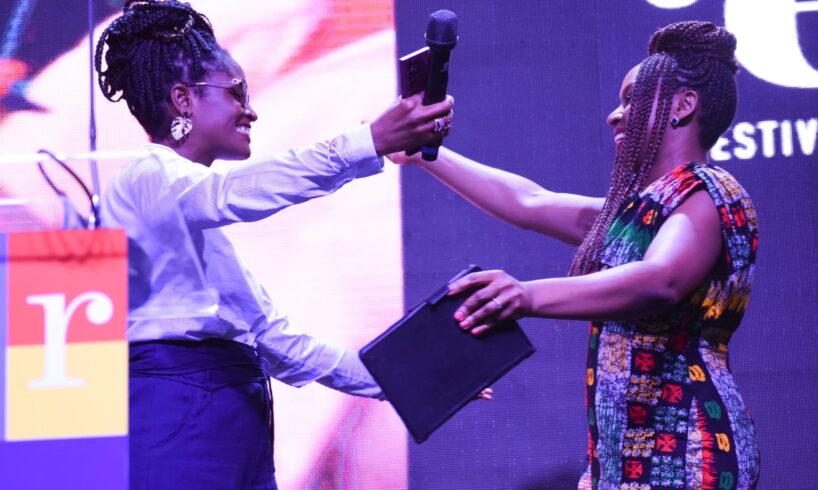
Djamila Ribeiro embraces Nigerian writer Chimamanda Ngozi Adichie Photo credit: Alexandre Brum/Agência Enquadrar/Folhapress
In March 2005, I rocked my baby girl’s chair with one foot while calling every newsroom in São Paulo to announce an unlikely soccer match: the Boston Braves veterans’ team was flying south to face the masters squad of Santos Futebol Clube, home of Pelé.
At that time, journalism school had become financially impossible. I worked as a cleaning assistant, often arriving in class still smelling of hydrogen peroxide, but could not keep up with tuition. Eventually, accumulated debt forced me to leave the university—fully aware of what that meant for a young Black woman in Brazil, where access to higher education has long been the exception rather than the rule. On weekends, I taught preparatory courses for students from the city’s outskirts, helping them study for college entrance exams that I myself could no longer afford to take.
I became pregnant during that period, and with no clear horizon ahead, life seemed to narrow to a single role: motherhood. Then, unexpectedly, that team from Boston arrived like a gust of fresh air. I joined my then-husband in what would become the boldest venture of his small sports company.
I was young, married and Black. Both my parents had already passed away. Doing everything and nothing at the same time, that match felt like everything. Hope came stubbornly, fueled by a childhood habit of looking at the stars and dreaming big. Still, it would have been impossible to imagine that, two decades later, my life would unfold in Cambridge—as a visiting professor in the Dr. Martin Luther King Jr. Scholars Program at the Massachusetts Institute of Technology (MIT).
Growing up in Brazil, the United States did not occupy a place of admiration. My father was a founder of the Communist Party in Santos and took my siblings and me to the Brazil–Soviet Union Cultural Center, where we learned to play chess. Yet Joaquim Ribeiro dos Santos, my father, understood that revolution also required pragmatism: he insisted that his four children learn English. I was able to complete my studies in the language at a school near our home. By the end, I was the only Black student there. In Brazil, learning a second language is a marker of social status—one largely inaccessible to the disproportionately Black working class.
From within Brazil, the United States appeared as a distant power, shaped by films, news broadcasts and global hierarchies in which Brazil and Brazilians were constantly measured— usually unfavorably.
I often recall a moment in 2011, when the U.S. astrophysicist Neil deGrasse Tyson asked a university audience, “What comes to mind when you think of Brazil?” Someone answered, “Bikinis,” prompting laughter. Tyson responded sharply: “Bikinis? That blinds you to the fact that Brazil has a thriving aerospace industry. Most of the regional planes you fly on are made there.”
That exchange exposed a misogynistic stereotype that reduces Brazil to the sexualization of women. This image did not emerge by chance. For decades, it was actively promoted by the Brazilian state itself, with devastating consequences: sexual exploitation, trafficking and violence against girls and women. These narratives produce concrete harm. Brazil ranks among the countries with the highest rates of child marriage, and according to a study by the Federal University of Pelotas, one in every 23 teenage girls becomes pregnant each year.
For Black women, these stereotypes are further entangled with the figure of the mulata, so often fetishized in Carnival imagery. Intellectuals such as Lélia González offered a powerful critique of how racism and sexism converge to reduce Black women’s bodies to symbols while erasing their intellectual and political agency.
Perhaps that is why, when I tell some U.S. Americans that I am Brazilian, the response is still sometimes a knowing “hmm, Brazil,”as if samba were about to erupt on cue. For years, encounters like this made me defensive—and, dialectically, forced me to confront my own internalized assumptions as well. Over time, I began to challenge these stereotypes in literary and academic spaces, becoming increasingly aware of how they shape power relations within the global publishing world itself.
Over the past decade, I have been part of a pioneering movement of Black Brazilian feminists who worked to publish dozens of books in Portuguese by African American women authors—including Black liberationist Angela Davis—in Brazil. This editorial labor has helped transform reading publics, academic syllabi, and political debate in the country. Yet this exchange has rarely been reciprocal. Structural and economic barriers mean that a Black Brazilian woman still faces enormous obstacles in persuading a predominantly white publishing industry to translate and publish her work abroad.
My own trajectory illustrates both the possibilities and the limits of this asymmetrical exchange. As a curator for Brazil’s largest book club, I selected The Bluest Eye as my favorite novel. With Toni Morrison’s authorization, and only a few months before her death, I wrote the foreword for the Brazilian edition—an intervention that played a significant role in the subsequent republication of her complete works in Brazil. I was also the person who first contacted Angela Davis to propose the translation and publication of Women, Race, and Class in the country.
Djamila Ribeiro with her father at a Communist party event. Courtesy of Djamila Ribeiro
Yet I remain acutely aware of the imbalance between U.S. African American women authors published in Brazil and Brazilian women authors published in the United States. In my own case, I had to be published in four other languages—French, Spanish, German, and Italian—before my work was finally translated into English, a trajectory that makes me an exception precisely because I managed to have a book published in the language at all, rather than the rule. This disparity has increasingly been examined through what might be called an anti-imperialist epistemology—one that interrogates how knowledge produced by Brazilian thinkers in general, and by Black Brazilian women in particular, circulates unevenly across borders, and how certain voices are universalized while others remain localized, peripheral, or folklorized.
What I had not fully understood, however, until arriving in Massachusetts, was the role a Brazilian community abroad can play in actively resisting the postcard fantasies imposed on us. The more Brazilians come into view—in classrooms and public life—the less space there is for caricature, unsettling the easy narratives that reduce an entire country to rhythm, spectacle, and stereotype.
I reflected on this one afternoon over feijoada, one of Brazil’s most iconic dishes, a black-bean and pork stew born from the ingenuity and survival of enslaved Africans who transformed scraps into sustenance. The meal was at Muqueca, a Brazilian restaurant in Cambridge. At lunchtime, it feels like a small embassy: long conversations, familiar flavors, shared belonging. When I left, American families were just beginning to arrive for dinner. In Boston, evenings start early, a quiet cultural contrast.
Founded more than twenty years ago by Maria de Fatima Langa “Fafá,” Muqueca is almost always full. It is one of many sources of pride for the Brazilian community here. Shortly after I arrived, Nilma Domenique, a Portuguese-language professor at MIT and a dear friend, drove me to a Brazilian grocery store in Somerville. Seeing shelves stocked with familiar products carried more meaning than I expected. At checkout, a free copy of Brazilian Times—a Portuguese-language newspaper serving the community since 1988—waited by the door.
Brazilians here clean offices downtown, study at MIT and Harvard, run salons in Framingham, open bakeries in Everett, and build homes across the region. Brazil in the United States is labor, resilience, imagination, and intelligence. It is also institutionally present: both MIT and Harvard maintain departments and initiatives dedicated to the study of Brazil and to research conducted in partnership with Brazilian scholars. At MIT Brazil, where I am based, Professor Rosabelli Coelho’s work exemplifies this commitment, fostering academic exchange grounded in collaboration rather than extraction.
Djamila Ribeiro with U.S. writer Patricia Hill Collins. Courtesy of Djamila Ribeiro
The exchange between the Brazilian community and the local academic world produces something equally vital: alliances, affinities, and forms of mutual enchantment. One such example is Professor Joaquin Terrones, who every year takes a group of MIT students to Brazil to visit São Paulo, Rio de Janeiro and Salvador. There, students engage not only with universities but also with terreiros, samba schools, and community spaces, encountering Brazil as a complex, living social fabric rather than an abstraction.
Born in Mexico and academically formed in Cambridge, between Harvard and MIT—where he is a professor for more than ten years—Joaquin is my faculty host and was the person responsible for my nomination to the Dr. Martin Luther King Jr. Scholars Program. His work and sustained engagement with the Brazilian intellectual scene exemplify how transnational academic trajectories can foster forms of exchange grounded in curiosity, solidarity, and shared intellectual commitment.
Brazilian women also organize through networks that support victims of domestic violence and connect them with shelters. One of the most visible initiatives is Grupo Mulheres do Brasil, active in multiple countries and deeply rooted in Boston. Through one of its events, I visited the Brazilian Consulate, where I met entrepreneur Luiza Helena Trajano and immigration attorney Andréia Précoma, whose work defending Brazilian immigrants, especially women, has been transformative.
There, Consul General Santiago Mourão shared a striking fact: the Brazilian community in Massachusetts is among the largest in the world, estimated at around 400,000 people across the consular district. The consulate recently created the Brazilian Women’s Space, dedicated to preventing domestic violence and fostering women’s autonomy through entrepreneurship and financial education.
Looking back, when Brazil’s largest daily newspaper ran a brief note in the sports section announcing that the Boston Braves masters team would play in Brazil, I sensed that something far larger than a soccer match was underway, even if no one could yet name it. Between a sleeping baby—now a young adult preparing to apply to MIT or the Universidade de Sáo Paulo (USP)—and hurried phone calls, I was already doing what the Brazilian community has always done: building bridges between Brazil and the United States.
In that movement, Brazil reveals itself as far greater than the narrow stories the world still insists on repeating.