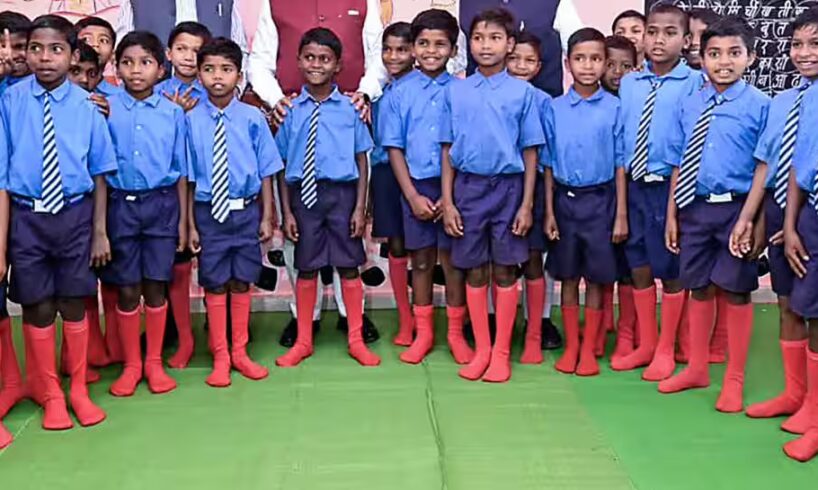
Every April, millions of Indian parents shell out thousands of rupees on school uniforms. And every year, many of them buy uniforms they didn’t need to, because private schools made sure of it.
This is not an accident. It is a system.
Add Zee News as a Preferred Source
#DNAमित्रों | Exposed#DNA #DNAWithRahulSinha #SchoolUniform #PrivateSchool@RahulSinhaTV pic.twitter.com/Tq06t9BP6j
— Zee News (@ZeeNews) April 3, 2026
India’s school uniform market is worth a staggering Rs 72,000 crore. A significant chunk of that money flows not from genuine need, but from a carefully engineered racket that private schools have perfected over years. Zee News has been investigating this organised loot for the past three days, and what we found is as brazen as it is widespread.
The design trick
Here’s how it works. Just before every new academic session, schools make a small tweak to their uniform, a logo change, a colour shift, a minor pattern update. Nothing major. But just enough to make last year’s uniform “invalid.” Parents are then directed to buy from a specific vendor. The old uniform? Still perfectly wearable. But that’s not the point.
Rajinder Singh Chauhan, a uniform retailer in Noida, told Zee News that schools deliberately make these micro-changes so that no one else can replicate the design quickly, forcing parents straight into the arms of school-approved vendors.
The cut system
The economics are brutal. A uniform that costs Rs 300 to manufacture is sold to parents for Rs 900, sometimes Rs 2,000. The manufacturer takes a 10% margin. The retailer takes another 10%. But schools don’t let parents buy from just any retailer. They steer them toward hand-picked vendors who pocket up to 60% profit and kick back 10–20% directly to the school.
This is the cut system. And it runs like clockwork.
Girls pay more
The racket also has a gender dimension. Girls’ uniforms cost consistently more than boys’. A uniform supplier’s own data tells the story:
– Pre-school: Boys Rs 799 vs Girls Rs 834
– Class 1–4: Boys Rs 909 vs Girls Rs 1,006
– Class 5–7: Boys Rs 1,075 vs Girls Rs 1,144
– Class 8–10: Boys Rs 1,144 vs Girls Rs 1,248
On average, girls’ uniforms cost 8% more, meaning parents of daughters pay Rs 500-Rs 1,000 extra every year, for no clear reason.
The rules nobody follows
The rules to stop this exist. Delhi mandates that schools cannot change uniform designs for three years. Uttar Pradesh says five years. Madhya Pradesh has a three-year lock-in. CBSE explicitly prohibits schools from forcing parents to buy from a single vendor.
None of it is followed, because the profits are too large, and the consequences too small.
England, the country that invented the school uniform in 1222, spends roughly Rs 9,800 per child annually on uniforms. In India, that figure touches Rs 15,000. The difference isn’t the quality. It’s the cut system.
Cracks in the wall
The pressure is beginning to show. Delhi’s government has issued a new order requiring schools to provide parents with a list of at least five vendors, with the freedom to buy from the open market. Rajasthan and Telangana have also announced strict action against schools exploiting the uniform mandate.
What parents can do
You are not powerless. Parents can file formal complaints with the District Education Officer, with CBSE, and with courts. The legal framework exists; it just needs to be used. Collectively.
Because private schools don’t fear the government. They certainly won’t fear individual parents acting alone.
The uniform is supposed to make every child look equal. Instead, it has become the most visible symbol of an unequal system, one where schools profit, vendors profit, and parents simply pay.