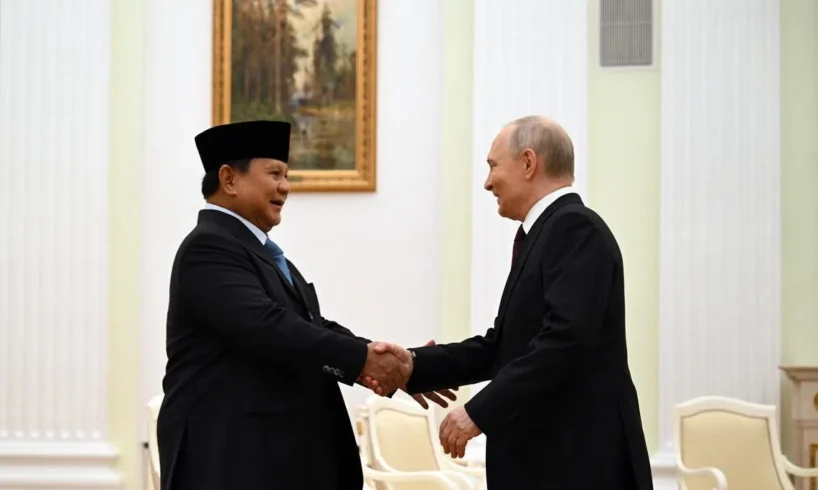
JAKARTA – Indonesian President Prabowo Subianto met his Russian counterpart, Mr Vladimir Putin, in Moscow on April 13, and they pledged closer economic and energy ties amid global uncertainty.
The Indonesian leader’s visit to Russia, his third in less than a year, has become a high-stakes search for energy security, analysts said, amid the US’ move to impose a naval blockade on all maritime traffic entering and leaving Iranian ports.
At the Kremlin on April 13, Mr Putin welcomed Mr Prabowo as “my respected and esteemed friend”, while Mr Prabowo thanked him for receiving him at short notice.
Mr Putin cited both countries’ cooperation in energy, agriculture and space, while Mr Prabowo said Indonesia wanted to continue strengthening cooperation.
Mr Prabowo told Mr Putin that the global geopolitical situation is undergoing very rapid changes.
He added: “We view that Russia has played a very positive role in facing these geopolitical conditions full of uncertainty. Because of that, we feel it is very necessary to consult on how we face the situation ahead and, especially if possible, to continue strengthening cooperation, especially in the fields of economy and energy.”
Despite its vast reserves of coal, gas, nickel and palm oil, South-east Asia’s largest economy still imports large volumes of crude, petrol, diesel and liquefied petroleum gas (LPG), leaving it exposed to external fuel shocks.
The threat of a naval blockade by the US has injected fresh risk into the Strait of Hormuz, one of the world’s most important oil corridors, where even limited military action can drive up crude prices, freight rates and insurance costs.
For Indonesia, that could be as damaging as any actual disruption to supplies. Around a quarter of Indonesia’s crude oil imports come from the Middle East and pass through the strait.
Dr Ujang Komarudin, a political analyst at Al-Azhar University Indonesia, said the disruption around the strait has made alternative supply routes more urgent for countries including Indonesia.
“When there is a problem in Hormuz and oil cannot be obtained through that route, the only option is to obtain it from another country, especially Russia,” he told The Straits Times.
Jakarta is trying to protect itself from volatile markets while avoiding deeper entanglement in the rivalry between major powers.
Russia has clear reasons to engage. Moscow has redirected more oil and other exports to buyers in Asia and other markets outside Europe in the wake of Western sanctions following the war in Ukraine. Indonesia is an attractive market, with its large population and expanding economy.
Analysts broadly agree that Russia can meet a part of Indonesia’s energy needs. They differ sharply on whether doing so would be a political win, an economic bargain or a strategic headache.
Dr Ujang said Mr Prabowo’s push for Russian supplies could bolster his image as a decisive leader. “It is a concrete step to strengthen domestic fuel security,” he said. “This is part of the answer to criticism over whether every overseas trip by the President serves the interests of the people, the nation and the state.”
Since taking office in October 2025, Mr Prabowo has travelled extensively, meeting leaders across Asia and beyond while seeking investment, trade and strategic partnerships. He also visited Russia in June and December 2025.
If he returns from Moscow with a tangible agreement, his trips become easier to justify, some analysts noted.
Professor Hikmahanto Juwana, an international relations expert from the University of Indonesia, cautioned against overstating the significance of any deal.
“I would not go so far as to call it a strategic victory because we are not at war or in competition,” he told ST. “What matters most is that Indonesia’s supply needs are met.”
However, Mr Bhima Yudhistira, executive director of the Center of Economic and Law Studies, argued that Russian crude may prove less attractive once freight charges, insurance premiums, financing complications and political risk are added.
“Insurance becomes more expensive when buying from a sanctioned country,” he told ST. “There could be an additional cost of US$2 to US$4 per barrel compared with the oil Indonesia has usually bought from Singapore.”
Distance also matters. Indonesia already receives supplies through established routes from the Middle East, Singapore and the US. Russian cargoes often involve longer voyages and more complex trading arrangements.
That means a high-profile agreement may yield only modest savings.
Mr Bhima also raised a more delicate issue: diplomacy. Indonesia has recently sought closer economic ties with Washington, including energy cooperation, investment and broader trade access. He warned that there could be retaliation from the US if Indonesia continued importing oil or fuel from Russia.
Russia is just one part of a broader effort to widen Indonesia’s options.
In Japan on March 31, Mr Prabowo discussed energy cooperation and invited investment in industrial projects, critical minerals and nuclear power. In South Korea on April 1, Indonesia announced agreements covering technology, finance, clean energy and supply chains.
But deals with the likes of Moscow would not resolve Indonesia’s deeper structural weaknesses. The country remains heavily reliant on imported LPG, used widely for household cooking. Domestic refining capacity has lagged behind demand growth for years. Fuel subsidies remain politically sensitive. When global prices rise sharply, the effects spread quickly through inflation, consumer spending and the state budget.
Russian barrels might ease immediate anxiety but would not remove Indonesia’s dependence on global markets. “Efforts to buy fuel from Russia do not solve all the problems,” Mr Bhima said.
Until refining capacity expands and import dependence falls, any overseas crisis is likely to be felt in Jakarta through higher fuel costs.
Mr Bhima said: “Indonesia would remain vulnerable to an energy crisis and supply disruptions.”