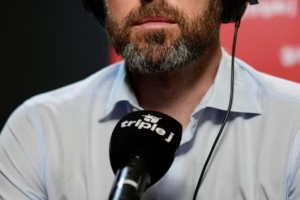
Victoria’s Police Chief Commissioner Mike Bush has criticised the state’s bail laws in tackling youth crime, calling the current system “really destructive”.
Speaking on the Lead Good podcast, Commissioner Bush agreed with ex-con Judo that youth offenders need to be held behind bars for a longer period of time before they are released.
“Honestly, it’s pathetic, honestly, it’s just not it,” Judo said of the system, which can see offenders back on the streets just hours after committing a crime.
“These kids, you guys are giving them bail, giving them the opportunity and another chance to go out in the community and do the exact same thing. It’s putting the community at risk, and these kids need some time to really sit back and understand what they’re doing is wrong.”
The 24-year-old ex-con, who is part of the Lived Experience Mentor Program and currently mentoring seven youths out on bail, said custody is the “perfect time” for intervention.
“You just got to hold them a bit longer, get us involved, we’ll talk to them, we’ll mentor them, we’ll give them the right advice and hopefully it clicks,” he said.
“When kids are in custody, they’re clean, they are not on drugs, they aren’t with their friends, they’re by themselves and it’s a chance to get to them.”
Agreeing, the Commissioner said Judo was “spot on” and he “couldn’t say it any better myself”.
“That’s the piece that we talk about — that you’ve got to understand there are consequences for your behaviour, but it also gives them time to reflect and the opportunity for an intervention.”
“If a young person commits a serious crime, three hours later they’re back out on the street with their peer group and their mates, already to go and do it again, what has been achieved?
“That’s really destructive and we’ve missed the opportunity to announce consequence, to provide the opportunity for reflection and intervention, all missed opportunities”.
‘Got to get ahead of this’:
Commissioner Bush said youth crime can and “must” be fixed.
“It’s incumbent upon all of us to address this. Everyone in Victoria has the right to be safe.” The top cop stressed the importance of getting young people to understand consequences.
“If young people understood … the consequence of what they do, how do we get them to think about that more deeply, they do something. But also understanding there’s not just a consequence for the victims but there’s a consequence for the themselves. “They’ve got to know that there is a tough side to what they do, and that tough side could be, and perhaps should be, losing their liberty. But that can’t be the only answer. We’ve got to get ahead of this, prevention, early intervention, working with young people, working with communities is the best answer and that comes first.”
Crime Statistics Agency figures for 2025 show youth crime rose by 2.3 per cent in Victoria last year, with minors committing 57.6 per cent of carjackings, 52.6 per cent of home invasions, 47.8 per cent of aggravated burglaries and 62.4 per cent of robberies in the state.
Overall, police arrested 1,223 children a combined 6,997 times, with an average of four youth gang members arrested each day last year.
Call for statewide monitoring system
Commissioner Bush last year proposed a statewide monitoring system to track and follow youth offenders, similar to that used in his home country of New Zealand.
“I think it’s important to make sure it’s run by corrections and youth justice and not outsourced, but also that it’s connected to law enforcement,” he told 7News in November.
“So whenever there’s a breach we know about it straight away and we can deploy to that.”
In New Zealand, young offenders aged between 12 and 17 can be fitted with an electronic monitoring device on their ankle.
It will continually send a signal to a “monitoring unit” that is installed at the defendant’s approved address, with real-time information monitored at a control centre.
The individual must remain at the residence at all times, and can only leave if they seek permission for certain reasons, such as court and medical appointments.
If they do leave their home, the anklet uses GPS to send live data to corrections officers who can see their exact location.
They can be monitored for up to 24 hours a day, seven days a week.
Commisoner Bush said he understood Melburnians are fed up and “p**sed off”.
“I certainly understand the perception around safety because it’s so important. If people don’t feel safe in their communities then we’ve got to do something about it.”
Read related topics:Melbourne
Source