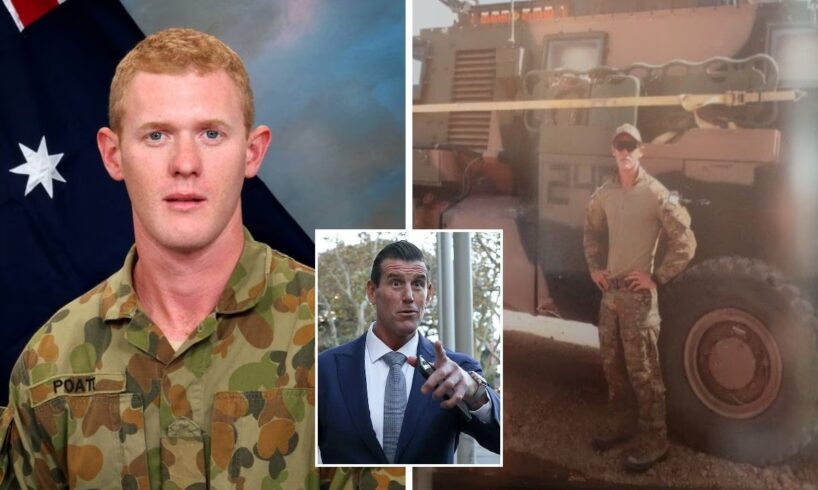
The father of Private Robert Poate, a young Australian soldier riddled with 11 bullets by an Afghan army “friendly”, has condemned the Australian government for allowing his son’s killer to roam free.
Hugh Poate said it’s hard to stomach the fact the Australian Government has dropped the ball on this case while splashing millions of dollars investigating their own elite soldiers and has questioned whether former SAS soldier Ben Roberts-Smith can get a fair trial in this country.
“Ben Roberts Smith has a presumption of innocence and he’s entitled to a fair trial,” Mr Poate said, referring to the five charges of war crime murders levelled against him.
“But I don’t know that he can get a fair trial because allegations that Ben has committed war crimes have been going on for such an inordinate period of time.
“People’s views have been coloured by the media. There’s favourable media and there’s unfavourable media, but it really depends on whether they can select a jury of 12 people who are open minded enough to come to a decision based purely on the evidence provided in this trial.”
Mr Poate, says his family’s story is not just a story of loss; but of a fight for the truth and transparency in all levels of the Australian Defence Force, and the Australian Government more broadly.
The unthinkable breach
The date, 29 August 2012, is etched into the collective memory of many who served in Afghanistan. At Patrol Base Wahab, a place meant for allied cooperation, an unthinkable betrayal unfolded. An allied ANA soldier known as Hekmatullah who was being mentored by Australian soldiers murdered three Australian soldiers and wounded two others in an insider attack.
Those killed were Private Poate, Lance Corporal Rick Milosevick and Sapper James Martin and two other Australian soldiers were wounded.
“Hekmatullah thus committed five war crimes. He was a Taliban infiltrator in the Afghan National Army. He fled the patrol base after his cowardly attack,” Mr Poate said.
The response was immediate and unequivocal: “He was then elevated to the top of the Joint Priorities Effects List (JPEL) which meant he was to be hunted down and could be killed whether armed or not.”
The immediate aftermath and a fierce resolve
Within twenty minutes of the attack, a small team of SAS soldiers led by Roberts-Smith was on the scene. The devastation was palpable; “My son had been riddled with eleven bullets,” Mr Poate said.
Roberts-Smith found that Hekmatullah had escaped the patrol base and had committed the murders. “He also found a photo of Hekmatullah on a mobile phone belonging to an ANA soldier. Ben then put the wheels in motion in the search for Hekmatullah,” Mr Poate explained.
“A few days after the incident, intelligence was received that Hekmatullah was at the village of Darwan. BRS and his small team arrived at Darwan but Hekmatullah had left the village only a few hours beforehand.”
A system questioned
Six months later, Hekmatullah was captured in Pakistan. He was subsequently tried in the Afghan Supreme Court, where, with chilling defiance, he proudly confessed to all four charges – murdering three Australian Soldiers, wounding two, treason and being a member of a terrorist organisation. The judges considered his crimes to be so severe that he was sentenced to death”.
“After the incident the three families of the deceased soldiers were being informed by soldiers returning from that deployment that the incident was due to incompetence by the chain of command in that task force,” Mr Poate said.
An internal investigation report, when finally released, “was clearly grossly deficient in its coverage and raised more questions than answers.
“It was obvious that all evidence of incompetence had been either redacted or omitted”.
Driven by a desperate need for truth, the families then called for a coronial inquest – the first into combat deaths in the 120-year history of the ADF.
“The internal investigation report found no evidence of systemic failures. However, in stark contrast, the coroner found five systemic failures in the chain of command.”
Yet, on the very day these findings were announced, “the response from then Chief of Army, Angus Campbell, was that he had full confidence in the chain of command of that task force”. Adding to the families’ anguish, subsequently, “all officers associated with the incident were promoted”.
The unbalanced scales
At the time of the inquest, Hekmatullah was in a prison in Kabul on death row,” Mr Poate said.
“After the inquest we were subjected to virtually total silence from Defence. In an endeavour to get closure, the families then took it upon themselves to deal with the Afghan Ambassador in Canberra to have Hekmatullah’s death sentence carried out.
“On 3 June 2017 the families were notified by an Army liaison officer that Hekmatullah would be hanged at midday. However, at 4pm that day we were again contacted to say the hangings had been postponed. It was later revealed that DFAT was opposed to the death sentence being carried out.”
Mr Poate said the ultimate betrayal came when Hekmatullah was subsequently released from prison by the Americans during negotiations with the Taliban for an end to the war.
“He is still a free man in Afghanistan today being lauded as a hero for his war crimes.”
“The scales of justice are totally unbalanced by the Australian Government in the war crimes debacle,” Mr Poate said.
“Hekmatullah has proudly confessed to five war crimes and the Australian Government has taken absolutely no action for his court sentence to be carried out. In fact it appears that the government may have actively prevented it. Additionally, the Government has not referred Hekmatullah to the International Criminal Court”.
This stands in stark contrast to the estimated $300 million spent investigating Australian SASR soldiers for war crimes allegedly committed against Afghans but “has given no consideration to the families of Australian soldiers killed by Hekmatullah’s confirmed war crimes”. This is clearly a case of double standards.
As for Hekmatullah, the lack of contrition is a hard pill for Mr Poate and his family to swallow. “He was sentenced to death on the unanimous decision by three judges in the Afghan Supreme Court.”
That sentence hasn’t happened. And it hasn’t happened because I believe that the Australian government has stopped it from happening … because I they don’t support the death penalty even though he was on the JPEL list where he could have been shot on site, whether armed or not.”
Accountability from above
Mr Poate said the question of accountability at higher levels of command remains largely unaddressed.
“It is grossly unfair that the senior ranks of the Army have been shamefully throwing SAS soldiers under the bus in an attempt to shift blame for allegations of war crimes down to the lower ranks,” he argues. Some of the accusations date back 15 years.
Should rules of engagement have been transgressed, then, in accordance with Article 28 of the International Criminal Court, many former senior officers should be in jail right now.
“Article 28 states that, ‘a military commander is criminally responsible for the crimes of a subordinate where he knew or should have known that the persons were committing or about to commit such crimes and took no action to prevent them’.
The focus on individual soldiers, while senior leadership appears to escape scrutiny, underscores a deep-seated frustration regarding systemic accountability. This is another case of double standards.
“These guys are very highly trained. They’re just so used to following orders and doing what they’re told and being accountable for what they do. “And usually there’s a helicopter or a drone above them filming everything they do. “Because if they get into trouble it can be verified and the support will arrive. Everything they did would have been known and filmed on the basis of orders given and debriefs provided.