Introduction: Stock markets are too high and set to fall, says Bank of England deputy
Good morning, and welcome to our rolling coverage of business, the financial markets and the world economy.
Stock markets are too high, and are going to drop back at some point due to the many risks facing the global economy, one of Britain’s top central bankers has warned.
Bank of England deputy governor Sarah Breeden has issued the prediction to the BBC, at a time when the US stock market has risen to record levels despite the Middle East conflict.
She points out:
double quotation markThere’s a lot of risk out there and yet asset prices are at all-time highs. We expect there will be an adjustment at some point.
This chimes with the latest assessment from the Bank’s financial policy committee, which pointed to the risks from high AI valuations, AI disruption, and the private credit market.
As she explains, the big fear is that several risks crystallise at the same time – such as an economic shock that leads to a rapid readjustment of AI valuations, and hurts confidence in private credit.
Breeden is clear that she’s not predicting a correction imminently … but is focused on making the UK financial system strong enough to cope.
double quotation markWhat we are watching for: is how might those prices fall? Will there be a sharp adjustment downwards? And if there is such an adjustment, how will that affect the economy?
I’m not saying it will happen today, tomorrow, in 12 months’ time. It’s ensuring that if it happens the system is resilient.
The agenda
7am BST: UK retail sales report for March
9am BST: IFO survey of German business confidence
10.30am BST: Russia interest rate decision
Share
Updated at 12.11 CEST
Key events
Show key events only
Please turn on JavaScript to use this feature
Oil has now slipped back, following reports that Iranian foreign minister Abbas Araghchi is expected to travel to Pakistan for talks with the US this weekend.
Araghchi is expected to arrive in Islamabad tonight with a small delegation, according to government sources.
Following important discussions with the Pakistani mediation team, a second round of Islamabad peace talks between the United States and Iran is expected, government sources say.
A U.S. logistics and security team understood to already be present in Islamabad to facilitate the negotiation process.
Brent crude has now dipped below $105 a barrel, slightly lower on the day.
Share
Updated at 14.38 CEST
Procter & Gamble has become the latest company to warn that the Iran war is pushing up its costs.
In its latest financial results, P&G flagged that now expects higher commodity costs to cost it around $150m after tax this financial year, on top of $400, of higher costs from tariffs.
Despite that, P&G is sticking with its previous financial guidance, after reporting sales growth of 7% in the last quarter.
Shailesh Jejurikar, president and chief executive officer of P&G, says:
double quotation mark“We’re increasing investments to accelerate momentum with consumers despite the challenging geopolitical and economic environment, while still maintaining our guidance ranges for the fiscal year.
We continue to believe the best path to sustainable, balanced growth is by strengthening execution of our integrated growth strategy. We are confident in the progress we’re making and excited about the longer-term opportunity to leverage P&G’s strengths and unique capabilities to create the CPG [consumer packaged goods] company of the future.”
Share
Oil hits highest level since US-Iran ceasefire began
The oil price has hit its highest level since the US and Iran agreed a ceasefire more than two weeks ago.
Brent crude traded as high as $107.48 a barrel this morning, its highest level since 7 April, the day when the US and Iran agreed to a conditional ceasefire.
The Brent crude oil price over the last three months Photograph: LSEG
That deal included a temporary reopening of the strait of Hormuz, after Donald Trump had threatened Iran with widespread destruction.
But with the strait still largely blockaged, and oil production in the region having more than halved since the war began (see earlier post), anxiety over the conflict is rising again today.
Brent crude had been trading around $72 a barrel before the war began, and hit $199.50 in early March.
Oil is up today despite Trump announcing last night that a ceasefire between Israel and Lebanon would be extended by three weeks.
But, when asked how long he was willing to wait for a long-term peace deal with Iran, Trump replied: “Don’t rush me”.
The risks to the oil price “remain tilted to the upside”, Fawad Razaqzada, market analyst at Forex.com, explains, as the US-Iran stalemate drags on.
Razaqzada adds:
double quotation mark“Oil has been on a firm upward trajectory this week, clearly driven by the collapse of planned talks between the US and Iran.
Tehran has refused to engage while the naval blockade remains in place, fuelling concerns over tightening supply and pushing prices well above $100 per barrel again.
There was a brief pause when Trump opted to extend the ceasefire, but the effect proved short-lived. With no clear timeline for negotiations and both sides entrenched, markets remain in limbo — and prices continue to grind higher.”
Share
Updated at 13.33 CEST
Fertiliser supplies hit by ‘global urea supply shock’
Sarah Butler
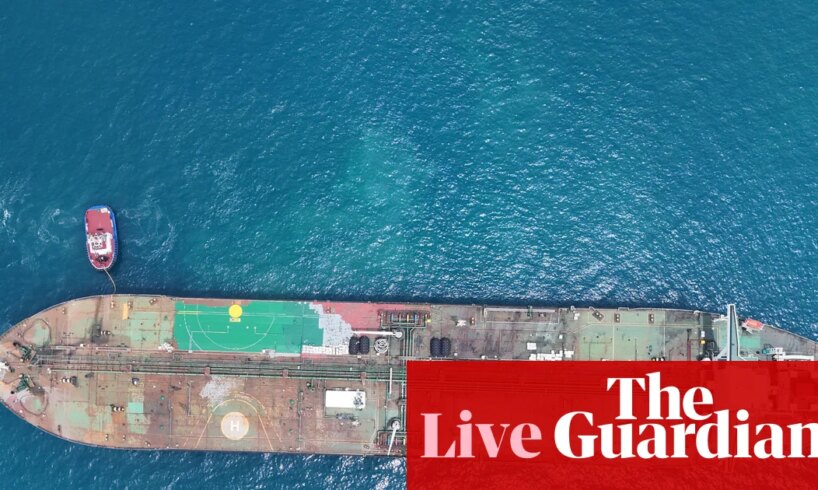
Fertiliser maker Yara has warned of tight supply compared to demand in the months ahead as the blockage of the strait of Hormuz had led to a “global urea supply shock”.
The Norwegian firm said affected production in several countries, and this had been “further amplified by Russian nitrogen plants affected by drone attacks”.
The blockage of the Strait of Hormuz disrupts around 1/3 of global traded urea, as well as other key raw materials for fertilizer production including natural gas, ammonia, phosphates and sulphur.
The company revealed a better than expected 40% rise in quarterly underlying profits to $898m as the price of fertiliser increased. It said it was able to maintain high production levels “enabling reliable supply” of fertiliser by being flexible about where it sourced ammonia when gas prices rose in Europe.
Svein Tore Holsether, the chief executive of Yara, said:
double quotation mark“Global crop prices are only marginally increasing while input costs have increased, and that’s putting an additional burden on farmers, and farmers across the world did not have robust margins before this.”
Share
Russia’s central bank has cut interest rates in an attempt to boost economic growth.
The Bank of Russia has lowered its benchmark rate by 50 basis points, or half a percentage point, to 14.50%.
The reduction follows signs that Russia’s economy is ailing despite the fiscal boost from higher oil prices.
The Bank of Russia says:
double quotation markAccording to high-frequency data, the Russian economy slowed in 2026 Q1, in part due to the adjustment to the earlier tax changes.
The other contributors were a fewer number of business days and unfavourable weather conditions. Investment activity remains subdued. Consumer demand growth continues to decelerate, despite a slight pick-up in March.
Taking into account that economic activity dynamics in 2026 Q1 were largely driven by one-off factors, the Bank of Russia has retained its GDP growth forecast for 2026 at 0.5–1.5%.
Share
European markets head for first weekly loss since late March
European stock markets are on track for their first weekly loss in over one month.
The pan-European Stoxx 600 index has dropped by almost 2.8% so far this week. That would be its first weekly decline since 16-20 March, after four weeks of gains.
Today, the Stoxx 600 is down around 0.9%, with Germany’s Dax losing 0.5% and France’s CAC 40 down 1.2%. In London, the FTSE 100 is now down 66 points or -0.64%.
Markets are entering the final day of the trading week in a cautious mood, says Jim Reid of Deutsche Bank:
double quotation markUS-Iran tensions show no signs of easing while the Strait of Hormuz remains essentially closed.
Ahead of the weekend, there have been no signs of further talks, with Trump saying the “I don’t want to rush myself” when it comes to making a deal, while also claiming that “whatever I’m doing, it seems to be working very well”. Meanwhile, we saw Iran’s President, Foreign Minister and Parliamentary Speaker share similar messages of regime “unity” in short succession last night, after Trump posts claimed “infighting” between “Hardliners” and “Moderates” in Iran.
The rhetoric had also leant in an escalatory direction earlier yesterday, with Trump posting that he’d ordered the US Navy to shoot boats placing mines in the Strait of Hormuz. So all that has left lingering uncertainty, even as Israel and Lebanon have agreed overnight to extend their ceasefire by three weeks according to the White House.
Share
Hapag-Lloyd says one ship has crossed strait of Hormuz
Container shipping group Hapag–Lloyd has reported that one of its ships has crossed the Strait of Hormuz but did not have any information on the circumstances or timing, Reuters reports.
That leaves four Hapag ships in the Gulf, which the company says are staffed with 100 crew, who are well-supplied with food and water.
Share
Updated at 12.45 CEST
Goldman: Gulf oil supply is 57% below pre-war levels
Gulf crude oil production has more than halved since the Iran war began, a new report from Goldman Sachs shows.
Goldman have calculated that oil production has fallen by 14.5 million barrels per day, or 57%, from pre-war levels, due to the closure of the strait of Hormuz and attacks on energy production facilities in the region.
Illustration: Goldman Sachs
The Investment Bank predicts that Gulf production is likely to mostly recover within a few months of reopening assuming:
no renewed strikes on oil assets and
a full and safe reopening of the Strait in coming months.
But, they also see “significant risks” that the last leg of the recovery will take significantly longer and may not fully materialize, especially if the Strait were to remain closed for much longer.
Interestingly, Goldman estimate that the available empty tanker capacity in the Gulf has halved since the start of the war, which would make it harder to boost supply once a peace deal is reached.
Goldman say that once the Strait safely re-opens, the key potential constraints on production will likely be
availability of pipeline capacity and empty vessels to destock previously produced oil, and
availability of materials and workers for field workovers, and
well flow rates
Share
UK companies ramp up selling price expectations after surge in energy prices
UK companies are expecting to hike prices at a much faster rate over the next year, as the Iran war drives up energy costs.
New data from the Bank of England shows that companies expect to have raised prices by 4.4% by April 2027.
Back in February, firms had only expected to have raised their prices by 3.4% in a year’s time.
The increases suggests firms are “adjusting their expectations as a result of the recent increases in energy prices,” the Bank says.
Its latest survey of chief financial officers from small, medium and large UK businesses also found that expectations for year-ahead CPI inflation rose to 3.5% in the three months to April, up from 3.1% in the three months to March.
Share
UK mortgage rates slip back again
The average interest rates on UK mortgages are continuing to slip back from the highs set earlier this month.
Data provider Moneyfacts reports:
The average 2-year fixed residential mortgage rate today is 5.81%. This is down from 5.82% the previous working day.
The average 5-year fixed residential mortgage rate today is 5.70%. This is down from 5.72% the previous working day.
Share
Source