Inside the squalid Leicester home where a rogue doctor sold fake £15,000 cancer cures
13:58, 29 Apr 2026
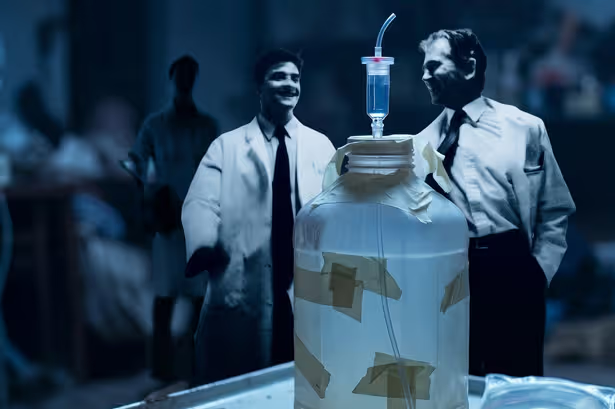
A terminally ill woman paid a fake Leicester doctor £12,000 for bogus cancer cures in the final months of her life(Image: Composite by Dylan Hayward/Getty Images)
A Leicester doctor laughed as he told a dying cancer patient his tumour was “so easy to cure” he would offer a money-back guarantee, before pocketing up to £27,000 in cash from two desperate patients for treatments he knew could never work.
Dr Mohsen Ali, who lost his licence to practise medicine in 2015, convinced vulnerable patients to abandon their NHS care, warning them that hospital doctors were “just trying to make money from chemotherapy and radiotherapy.”
One of those patients has since died. The other faced a worsening prognosis after Ali caused him to delay evidence-based treatment.
He left the country when police searched his premises in August 2019 and has never returned.
The Medical Practitioners Tribunal Service has now permanently erased his name from the medical register, condemning his conduct as a predatory and a dishonest abuse of trust.
Ali, who qualified from Cairo University in 1994, lost his licence to practise on January 13, 2015, after failing to comply with revalidation requirements.
Despite this, he continued to hold himself out as a qualified doctor with GP experience, producing flyers claiming his clinic aimed to achieve “over 90% cure rate in the most challenging illnesses e.g. cancer (malignant tumours).” A thick stack of them was recovered by police from his premises.
Patient A, who had stage three prostate cancer, began seeking treatment from Ali between July and September 2018 after NHS specialists recommended surgery.
He was fearful of the significant side effects and, after being introduced to Ali by a friend who described him as a doctor who could treat cancer, made contact by phone.
It was during that initial call that Ali laughed as he made his pitch. Patient A later recalled: “I asked him if he could cure people with prostate cancer and he replied ‘I’ve cured prostate cancer and have cured all types of cancers, other cancers like breast, lung cancer is more difficult, when someone comes with prostate cancer I’m happy because it is easy to cure.'”
Patient A’s wife later told police she had been ‘so relieved’ when she heard about the guarantee, saying it gave them both ‘so much hope’ and was what ultimately persuaded them to go ahead with treatment.
Patient A told the tribunal that Ali’s status as a qualified doctor was a “very important factor” in his decision.
He paid Ali up to £15,000 in cash across the treatment period, charged a non-refundable deposit of £3,000 and then £350 per session, with a further £300 every two weeks for herbs and supplements. No receipts were ever provided.
From the outset, Ali was evasive about what he was actually injecting into his patients. Patient A told the tribunal: “Once the cannula was in place, Dr Ali would fill a syringe with the liquids in the big gallon bottles which contained coloured liquids.
“He would never tell you what was in each liquid, apart from that one of them was natural vitamin C.”
He was also injected with substances Ali told him were garlic oil and ozone therapy. Clinical oncologist Dr Seema Arif, who gave expert evidence to the tribunal, said she had never heard of garlic oil being administered intravenously and confirmed there were no clinical trials showing any curative effect for any of the substances used.
Throughout the treatment period, Ali repeatedly urged Patient A not to pursue his NHS care.
Patient A told police: “During the entirety of the doctor-patient relationship Dr Ali persistently criticised the NHS and described it as a system which does not want you to get better due to the money they make from drugs. They said to me not to tell the NHS staff that I was using their treatment methods.”
As Patient A’s cancer continued to progress, his PSA (prostate-specific antigen) level rose sharply from 34 to 48. When he raised his concerns with Ali, he was told the rise was “normal” and that levels would settle within four to six weeks if he continued treatment.
Dr Arif said this was “a clear lie” and “highly inappropriate”, adding that the delay had resulted in Patient A’s cancer advancing to a higher stage “with unfavourable outcome.”
A clinic note by consultant urological surgeon Mr Cahill at the Royal Marsden NHS hospital, dated September 11, 2018, recorded that Patient A was “banking on prayer and dietary advice and has got unshakeable faith in this”, adding: “Waiting to see how his management goes before embarking on traditional treatments, I think, is unwise.”
It was only when Patient A told Ali his cancer had spread and he was having NHS surgery that Ali’s position changed entirely. “When I called Dr Ali and told him I was having surgery as the cancer had spread, he said ‘we don’t treat cancer’,” Patient A told the tribunal. “This was not what he had said at the start.”
The case of Patient B was found by the tribunal to be equally grave. She had been diagnosed with ovarian cancer in 2015 and undergone NHS treatment, but by January 2018 had been told by specialists that her cancer was now terminal and that no further curative treatment could be offered.
She and her husband, referred to in proceedings as Mr E, then travelled to Leicester after hearing Ali was a doctor who could treat cancer.
Mr E told the tribunal that Ali had examined his wife’s scans and told them he could cure her. “He said that instead of curing people the NHS was killing them, and the big pharma companies were making money,” Mr E said.
Patient B paid between £10,000 and £12,000 in cash, with no receipts provided. Mr E later told police: “They presented to us as professional doctors and assured me and my wife that they could cure her cancer. I now realise this was a lie and that they took huge sums of money from us under false pretence.”
Patient B has since died.
The conditions in which Ali delivered his treatments were described to the tribunal as posing a serious and immediate risk to patient safety. Intravenous fluids were drawn from five-litre commercial gallon containers which Dr Benjamin Rush, a consultant with the Public Health England (PHE) Health Protection Team, said were identical to those found in a Halfords box at the premises, of the type used to store screen wash or car coolant.
He told the tribunal he had “never seen containers like that used in clinical practice before” and described them as “the most shocking of the finds in the premises.”
The containers had giving sets pushed through their screw-top lids and held in place with masking tape. IV bags were reused between sessions.
Consent forms recovered by police had entries for cancer diagnoses crossed out and replaced with terms such as “wellbeing”, though Dr Rush told the tribunal the original entries remained clearly legible. The PHE concluded the conditions amounted to “significant risk of infection and cross-infection.”
Dr Arif told the tribunal that ozone therapy administered via an intravenous cannula, as Ali had done, was “extremely dangerous” and warned that infusing gas directly into a vein could cause a blood vessel to “explode”, rupture entirely, or trigger an air embolism. She told the tribunal the method was “unknown in clinical practice and research.”
Ali did not attend any stage of the tribunal and provided no evidence or formal response. In early correspondence with the GMC he denied claiming to cure any medical condition and alleged Patient A had attempted to blackmail him.
He later demanded the GMC stop contacting him entirely, writing: “I would be grateful if this matter is brought to a close especially by stopping any emails sent to me from the GMC or any of its affiliates.”
The tribunal rejected his account in full, finding his denials “amount to little more than bare assertions.”
In its determination on sanction it ruled his conduct was “fundamentally incompatible with his continued registration”, describing it as “not a momentary lapse” but “a pattern of deliberate and sustained conduct” and finding he had demonstrated no insight, no remorse and no remediation.