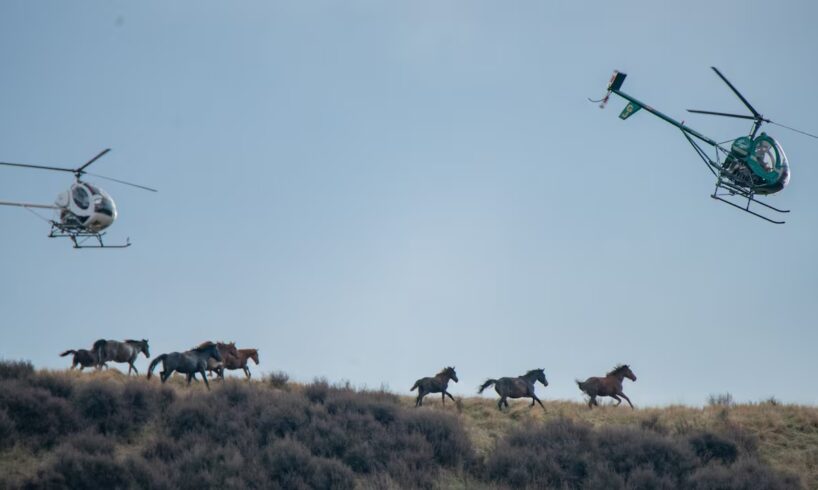
The eight-day muster took place over the Anzac period.
DoC project lead Sarah Tunnicliffe said it was the largest muster operation for the Kaimanawa horses to date.
“The numbers have snuck up over the last few years.”
They missed a year during Covid-19 and another during the cyclone years, she said.
A set of southern yards was built before the Anzac muster, in addition to the existing northern yards, to improve efficiency in mustering the southern herd.
The yards allow mustering over shorter distances, reducing stress on the horses and helicopter costs.
Yards which assisted in the mustering of Kaimanawa wild horses in Waiōuru. Photo / Kaimanawa Heritage Horses
“We mustered in 316 horses,” Tunnicliffe said.
“It was what we, kind of, called a mega-muster, because we worked through both sets of yards.”
Costs for musters at the southern and northern yards were about $100,000 each, covering tracking, stockman time, helicopter use, vets and setup operations, Tunnicliffe said.
DoC principal ranger Nina Manning said another muster was planned for June to get the herd back to a “more sustainable level”.
Tunnicliffe said 97 mares received the immuno-contraceptive vaccine during the eight-day Anzac musters.
The 50 mares from 2022 received their second dose, and another 47 their first, with the second to be done in June.
Immuno-contraception helps maintain a sustainable herd population, reducing the need for culling.
“It’s in the trial stage, so we’re restricted … we’re only allowed to give 50 doses to each side of the ranges,” Tunnicliffe said.
The vaccine had been proven overseas, but not yet in Aotearoa, she said
“Even with the second doses, you’re still only reducing the natural fertility by 70-80%.
“So it’s not likely that we’re ever going to contracept the herd out of existence.”
However, she said the vaccines would “absolutely” make the musters easier.
KHH’s Carolyn Haigh said the delivery of immuno-contraception during the muster showed encouraging progress.
“It’s helping to reduce the number of animals facing uncertain futures while supporting more sustainable herd management.
“This muster has also demonstrated encouraging progress in rehoming.”
Fifty-eight wild Kaimanawa horses were rehomed.
Three were euthanised because of health issues or existing injuries.
Tunnicliffe said rehoming was becoming “more and more of a challenge”.
“Somebody gets a Kaimanawa horse, they don’t need another one next year, because that horse is going to live for another 10 years.”
After the second dose is administered during the June muster, they hope to rehome as many horses as possible.
The Kaimanawa wild horse herd inhabits the Waiōuru Military Training Area in the central North Island.
DoC has long managed the herd with input from the Kaimanawa Wild Horse Advisory Group.
The advisory group includes iwi, animal welfare experts, rehoming groups, environmental advocates and NZDF.
Tunnicliffe said DoC had recently moved to more joint management with NZDF.
“The nuts and bolts of it need to be agreed upon – who does what and when.”
The plan was “long out-of-date” and would be rewritten with the advisory group, she said.
The Kaimanawa herd descends from Exmoor and Welsh Mountain Pony breeds that escaped, were abandoned or released by farmers and the army in the area since 1876.
Land development and hunting limited the population to an estimated 174 by 1980.
The establishment of a protected area in 1981 under the Wildlife Act 1953 meant the number rose to 1700 by 1997.
Many horses were culled through aerial shooting when their grazing and trampling threatened wetlands, tussocks and threatened plant species in the area.
Tunnicliffe said that in the past, some had been mustered before being taken to pet food factories and meatworks, but that had not happened for 10-15 years.
“Rehoming has taken care of the numbers.”
A 2009 NZ Herald story reported that more than half the horses gathered in annual musters since 1997 had been slaughtered.
Annual musters maintained the population at about 500 until 2011, when the herd was reduced to around 300 to allow for biannual musters and cut costs.
The herd had been kept at roughly 300 ever since.
Noam Mānuka Lazarus (Ngāti Whātua o Kaipara) is a multimedia journalist at the Whanganui Chronicle.