Voters in Caerphilly found their town in the national spotlight in an by-election in October. What has changed seven months on?
Mollie Jenkins
15:47, 04 May 2026
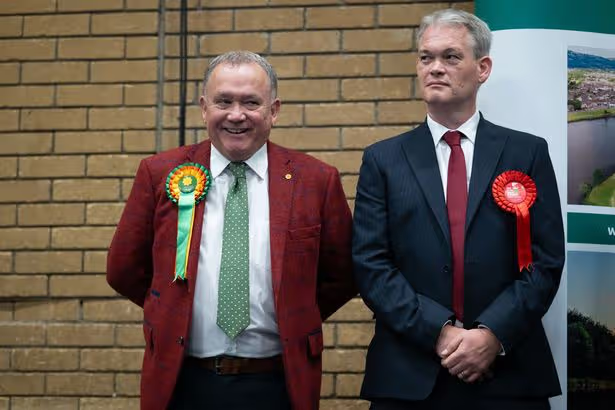
Labour’s Richard Tunnicliffe watches on as a delighted Lindsay Whittle celebrates his election win in October’s by-election(Image: Matthew Horwood)
On October 23 last year the attention of the UK media switched to Caerphilly Leisure Centre. The car park was full of satellite trucks from national media outlets, almost every desk provided by the council was filled, and there was a definite buzz in the air.
For those that lived there the weeks of incessant campaigning, leaflets landing on the doorstep, and people knocking on their doors was over and now it was all about who had the most votes.
People who lived there said it was “weird” seeing their town at the centre of the political world with their X or Instagram feeds full of debate. Arguments, and placards, were everywhere.
Welsh Labour had held the Caerphilly seat at every Senedd election since devolution in 1999. The constituency had only ever returned a Labour MP yet from early on it was clear Labour was in for a tough night.
As the campaign started, and the many, many, placards were put up outside houses, it was obvious it was between Plaid Cymru and Reform UK. Resources, and money, came into that.
But despite all that Labour and Reform UK threw at it it was Plaid Cymru which won. Its eternal candidate, Lindsay Whittle, a long-time councillor who they described as “Mr Caerphilly”, finally got his big moment and was visibly delighted to win with 15,961 votes – 47% of the vote share.
Reform candidate Llŷr Powell came in second with 12,113 votes – more than 10% behind in terms of vote share but a 34% swing compared to the previous equivalent ballot.
Zhari Cooper says she’ll be voting for the Green Party over Reform or Labour at this election(Image: Mollie Jenkins)
There is no doubt that by-election was seen then as a barometer for how Welsh politics was going. There is also no doubt it acted as a boost to Plaid Cymru as while tthe party may not have had the deep pockets of Reform it beat Nigel Farage’s party.
For Reform UK it showed the polls projecting a huge surge in support were being reflected on the ground. It also showed Labour was on course for the historic election defeat pollsters were seeing in their samples and focus groups.
There are important caveats. Caerphilly was a by-election, not a national poll, and that means both intense campaigning that is harder to replicate when there are multiple constituencies at play and also people can vote differently. Hyperlocal issues or campaigns can take the spotlight when people behave differently at a national level. For our free daily briefing on the biggest issues facing the nation, sign up to the Wales Matters newsletter here.
The turning point is widely seen as a BBC debate programme when a mum and her son – who have since signed up as Plaid supporters – challenged Llyr Powell, the Reform candidate, on live TV about how his party had made their family feel unwelcome in the town they call home.
Austin Winkler says people need to turnout to vote(Image: Mollie Jenkins)
The topic of immigration is one that isn’t devolved yet it was a passionate contribution – and rebuttal – and there is a theory that it galvanised people behind Plaid in a bid to keep Reform UK out. Dissecting the result afterwards the parties on the left tried to seek solace that a vote for Plaid wasn’t a vote against them per se.
Despite being a Senedd by-election the changes coming into force for this election mean the ballot on May 7 isn’t first past the post, but a form of proportional representation, will elect six people (not one), and is for the Blaenau Gwent and Rhymni constituency, which is a new boundary entirely.
The most recent YouGov poll for Wales put Plaid Cymru and Reform UK neck and neck in terms of vote share in this constituency the seat projections of academic Jac Larner suggest Reform UK would get three seats, Plaid would get two, and Labour one.
Alternative pollsters More In Common’s latest poll suggests Labour would take two, Plaid Cymru three, and one would go to Reform.
Speaking to voters in Caerphilly a common theme emerged of a desire for change in Welsh politics. But this was also accompanied by uncertainty. Yet one word was repeated time and time again – change.
Joshua Swarbrick says he thinks a change is coming in Welsh politics(Image: Mollie Jenkins)
“It’s probably about time that there is going to be a change,” said Caerphilly resident Joshua Swarbrick. “I think the question at this point is what is the change going to look like.”
In the by-election turnout was 50.43% – above that 50% marker that has never been achieved at a national election – suggesting the people of Caerphilly were engaged in the debate. There are plenty though who do not, despite all the attention, feel politics is for them. Saulo Camilo said: “I don’t really follow politics so I don’t know what is going on.” Asked why he doesn’t vote he said: “I just think my vote, my one vote, won’t make a difference. I personally don’t have that interest in it.”
Saulo Camilo says he doesn’t think his vote will make a difference and doesn’t plan to vote(Image: Mollie Jenkins)
For others their mind is made up. “I know who I am going to be voting for… and who I trust,” Daniel Richards said. While the Plaid supporter said he won’t be changing his mind he said the by-election was divisive.
“I think it was quite tense – it divided everyone. There were so many people on one side, others on the other. You had it on social media and people falling out – it was quite a tense time.”
As Zhari Cooper said: “Politics is a bit mad really.”
She added: “I do not like Reform – they cannot come here. ‘Just don’t come to my town’ – that’s how I feel.”
She’ll be voting Green, she said. “I just agree with their moral standpoints – it’s better than Labour or Reform,” she said.
The by-election was, she said, “mad”. “Where I live I kept seeing Reform signs and I just kept thinking: ‘Are you all right in the head?’.”
Mr Richards’ said his priorities were less on party politics and more on outcomes that the parties can deliver but that he wants “strong leadership”.
“We need to get a good government behind us in Wales and to do the best for us and for the kids – they’re the ones who are going to benefit,” he said.
For now the mood in Caerphilly remains clear change is on the horizon. But Austin Winkler said he had concerns about turnout. “It’s going to be a change – I think everyone is looking for one,” he said. “The problem is will everyone who is moaning go out to make a change?”
Get daily breaking news updates on your phone by joining our WhatsApp community here. We occasionally treat members to special offers, promotions and ads from us and our partners. See our Privacy Notice.