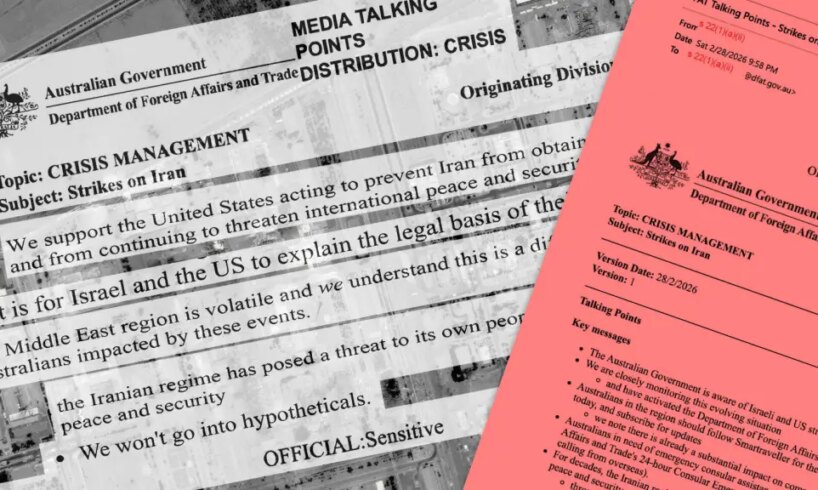
Talking points prepared for government ministers in response to airstrikes conducted by the United States and Israel on Iran reveal initial concern that questions would be raised over the legality of the strikes.
Documents obtained by Crikey through freedom of information (FOI) mechanisms show how government ministers, including Foreign Affairs Minister Penny Wong and Prime Minister Anthony Albanese, were prepared by DFAT to face possible questions on the legality of the strikes by the United States and Israel. The airstrikes began on February 28, kickstarting an ongoing war that has killed more than 5,000 people and plunged the world economy into chaos.
Wong said in an interview with the ABC’s James Glenday on March 2 that “Australia doesn’t walk away from its position that international law and particularly international humanitarian law must be observed”. At an Adelaide press conference a day later, Wong made similar remarks: “We join our partners in calling on all parties to adhere to international humanitarian law.”
Related Article Block Placeholder
Article ID: 1214050
When questioned both by Glenday and in the press conference directly about the legality of the strikes under international law, Wong repeated the line prepared by the department: that this was a matter for Israel and the US.
Five key expected questions with pro forma answers were provided to the government by the department on what was described in the email subject as “Strikes on Iran”, in a document sent on February 28 at 9.58pm. This is standard practice for all manner of issues contemplated by DFAT, and covers a range of diplomatic and geopolitical issues.
The questions were:
Has Israel/the US requested any Australian military support for its strikes?
Will Australia provide any military support for Israeli/US strikes if asked?
Are Israeli/US strikes against Iran consistent with international law?
Does Australia support US President Trump’s call for regime change in Iran?
Will Australia impose further sanctions on Iran?
The talking points were provided to the government approximately five hours after “Operation Epic Fury” began.
The advised DFAT response in respect to questions of potential military support was that Australia would not “go into hypotheticals” and would “not discuss the details of operational discussions with partners”.
In respect of the question of international law, the talking points said: “Australia has a longstanding position of support and respect for international law and is firmly committed to its obligations.”
“It is for Israel and the US to explain the legal basis for their actions,” the note read.
On the issue of whether Australia supported regime change, the standard response was: “The prime minister has made clear that we stand with the brave people of Iran in their struggle against oppression”, and went into detail explaining the various intrusions of Iranian assets and intelligence on Australian soil and against Australian actors.
On further potential sanctions, the talking points added that while Australia had already imposed sanctions on 20 Iranian individuals and three Iranian entities in early February, the government does not speculate on potential sanctions.
Related Article Block Placeholder
Article ID: 1216511
An updated set of talking points was later provided by the department on March 3, following retaliatory strikes by Iran on a number of other Gulf nations with US assets, including Bahrain, Kuwait, Qatar, Jordan, Iraq, Saudi Arabia and the UAE. By this time, the government was also being briefed in DFAT talking points that Iran was attempting to close the Strait of Hormuz, a high-traffic international shipping channel that has since become the economic battleground for the war. These updated talking points included 10 pre-prepared questions with pro forma answers:
Is Australia considering assisted departures for Australians (in the region)?
Did Australia receive any advance warning of the strikes?
Has Israel/the US requested any Australian military support for its strikes?
Will Australia provide any military support for Israeli/US strikes if asked?
Are Israeli/US strikes against Iran consistent with international law?
Does Australia support US President Trump’s call for regime change in Iran?
Is the government aware of Iranian disruptions to international shipping?
Will Australia impose further sanctions on Iran?
Issues with phone connectivity in Abu Dhabi, Dubai and Beirut
Are Australian Embassies and consulates open in the region?
The updated talking points suggested that Australia would “not expect to participate” in any strikes in the Middle East, even if requested by Israel or the US, and also noted that Australia was “not told in advance and would not expect to be”.
Albanese became one of the first world leaders to publicly support strikes on Iran by the United States, described by the ABC as an “unequivocal” response. Albanese said in a joint statement on February 28 alongside Defence Minister Richard Marles and Wong that Australia “stood with the brave people of Iran in their struggle against oppression”.
“We support the United States acting to prevent Iran from obtaining a nuclear weapon and to prevent Iran continuing to threaten international peace and security,” he said.
It came as a contrast to other US allies at the time — the United Kingdom encouraged restraint, while the president of the European Union called the strikes “greatly concerning”.
Notably, unlike some other public appearances made in the past year by the prime minister and foreign minister, on the issue of strikes in Iran, both Wong and Albanese remained relentlessly on-message and stuck to the language and messaging advised by DFAT.
Related Article Block Placeholder
Article ID: 1207714
Crikey has previously reported that the prime minister has diverged from DFAT advice in the past when discussing international affairs in the Middle East. In February 2025, DFAT rushed to prepare talking points for the prime minister following a proposal by President Trump to ethnically cleanse the occupied Palestinian territory of Gaza. DFAT advised that the usable response would be to note “Australia has been clear in opposing forcible displacement of Palestinians from Gaza” — a line not mentioned by Albanese, who instead tried to stay focused on a health funding announcement despite receiving seven questions from journalists about Trump’s remarks.
Conversely, in late May, Albanese made what were described as “some of his strongest comments” to date on the conflict in Israel and Palestine, a week after Australia made a joint statement with 23 other nations on humanitarian aid to Gaza following an Israeli military expansion in the region.
Documents then obtained by Crikey under FOI show Albanese’s criticisms of Israel’s starvation of Gazans as “outrageous” had not been included in talking points prepared by the department, nor were his descriptions of the Israeli government’s “excuses and explanations” for doing so or his references to the idea of a “democratic state [withholding] supply”.
There are a number of factors involved in which talking points end up in front of the foreign minister and prime minister, including the fluidity of the relationship between DFAT, the Department of Prime Minister & Cabinet, and the prime minister and foreign minister’s respective offices.