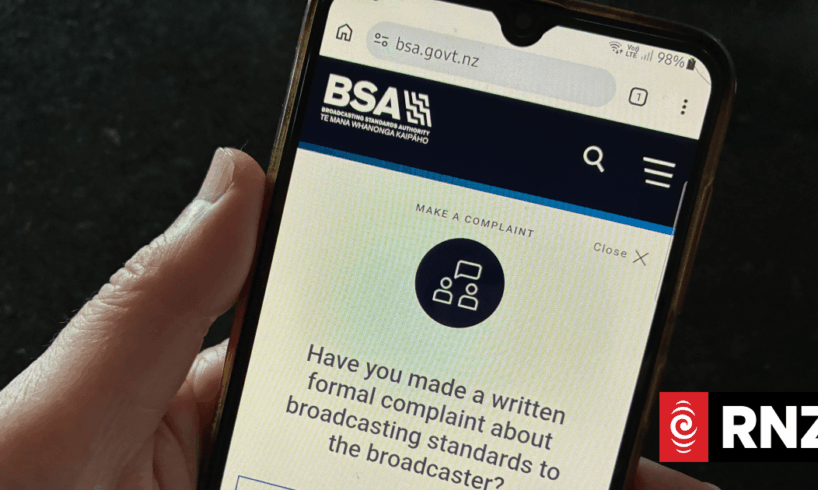
The Broadcasting Standards Authority may soon be abolished or changed with pending media regulation reforms.
Photo: RNZ / Nik Dirga
The Broadcasting Standards Authority (BSA) will be scrapped in favour of having the media self-regulate, the media and communications minister has confirmed.
Paul Goldsmith says New Zealand’s media landscape has changed dramatically but “regulatory settings have not kept up” and the current framework can create inconsistencies and “unfair outcomes”.
“If you’ve got a panel discussion on a podcast that’s on demand, that’s not covered, but if you’ve got a panel discussion on RNZ, it does, and there’s no sort of logic for that,” he told Midday Report.
“And so, you know, we could try and extend the brief of BSA far into sort of social media, or we could say, well, actually, why don’t we just rely on the self-regulation that works fine for print journalism and set the sector free.”
The BSA told RNZ in a statement it has said for more than 15 years the current Broadcasting Act “is no longer fit for purpose”.
“Our primary interest has been to ensure the public continue to have access to accurate, reliable media content, and a regulator they can turn to if they think public standards are breached,” its chief executive said.
Wednesday’s announcement came after the BSA faced backlash from government ministers following a decision to begin regulating podcasts and online media.
A complaint sent by the BSA to The Platform was published on the online platform’s website, outlining concerns raised about allegedly “unacceptable racist comments”.
The letter from the BSA stated it “has found it has jurisdiction” to consider a complaint about The Platform’s live talkback programme on the basis the transmission of the programme met the definition of ‘broadcasting’ in the act.
Minister for Media and Communications Paul Goldsmith.
Photo: RNZ / Mark Papalii
NZ First leader Winston Peters said at the time it was “blatant overreach” by the BSA and “highly concerning”.
The BSA had since concluded it did have jurisdiction over the online media service The Platform, and published a decision saying it could consider a complaint about the show because the programme “meets the act’s definition of ‘broadcasting'”.
Goldsmith told Midday Report the planned law change was not in direct response to that case, but it “raised the broader issue of where the boundary should lie”.
ACT leader David Seymour told reporters at Parliament it was time for the BSA to go. The ACT Party had a private member’s bill to abolish the BSA, which Peters hinted in April his party would support.
Goldsmith had previously said he was “leaning towards” scrapping the BSA altogether. Confirming his decisions in an announcement on Wednesday, he said the BSA was designed for a broadcasting environment that was “rapidly disappearing”.
“Today, audiences move seamlessly between traditional broadcasting, on demand services, podcasts and online platforms – yet only a small portion of that content is subject to the BSA’s regulatory oversight. It doesn’t make sense.”
He said the current framework could create inconsistencies and “unfair outcomes” for media providers, and was confident “greater industry self-regulation” was the most practical way to “level the playing field across platforms”.
“The suggestion is that the Media Council would become a sort of a self-regulatory body for journalism and holding standards, and so people can go through that process,” he told Midday Report.
“Alternatively, they can just turn it off and listen to somebody else. And then any entity, if they find that they’re offending everybody and nobody listens to them, will soon be out of business.”
Several other pieces of legislation reference the BSA. Goldsmith said legislation to repeal the provisions relating to the BSA will be drafted in coming months, and the authority would continue in its role until legislation was passed into law.
He said a bill would “probably not” be ready before this year’s general election in November.
Goldsmith said if there was a shift to a self-regulation model, the government of the day should “take stock” three or four years down the line to “reassure ourselves that it’s working.”
“There’s always the possibility to be more directive down the line, but I think it’s worth having a go in this area.”
BSA chief executive Stacey Wood
Photo: VNP / Phil Smith
BSA chief executive Stacey Wood said the authority’s purpose had never been about protecting the existing operating model, and “it was clear any future regulator would need to look different to the existing BSA”.
Wood said it had always been for lawmakers to decide if the authority played a role in any future regulatory set-up.
“We’ve worked with officials and provided advice on various proposals over the years.”
She said the organisation was proud of the role the BSA had played for over 37 years in maintaining standards in broadcasting. Wood said they would await further advice about the announcement and be ready to assist with the transition to new arrangements.
‘The BSA decided to pick a fight which ended up in its own demise’ – Plunket
The Platform was celebrating the decision, with host Sean Plunket posting on social media that it was a “wonderful 4th Birthday present” for the outlet, which marks that anniversary on Saturday.
He told RNZ he had been “a little surprised” that the government had stepped in on the matter but the result was good news for freedom of speech and for New Zealanders.
“People are saying this is a victory for the platform or a victory for me, not really. I didn’t choose this fight. I was sitting there doing what this outfit’s been doing for the last four years, and I find it amazing that the BSA decided to pick a fight which ended up in its own demise,” he said.
“It means that an outdated government bureaucracy that was seeking to write its own rules and entertaining complaints that didn’t have any real basis has been told that it needs to go away and that its time is over.”
He had no intention of joining the Media Council, he said.
“I don’t want to sit around the table with big newspapers and media players who are owned by overseas investors quite often, and are mostly interested in selling advertising for real estate agents.”
If misinformation was being spread online, people could complain to those spreading it, he said.
“I mean, radio and Zealand spreads misinformation, right? And no one’s stopping you guys from doing it … you guys are just going to have to be more careful about fact checking and whether or not you’re displaying inherent bias, as we all are.
“At the end of the day, I’ll tell you what regulates the platform is our audience. They’ll tell us when we get it wrong, and our numbers will go down and people won’t listen to us.”
‘Irresponsible’ to remove ‘consumer protection’ – Hipkins
Labour leader Chris Hipkins said the move was “risky”.
Photo: RNZ / Samuel Rillstone
“At a time when confidence in the media is being severely tested, removing one backstop without replacing it with something that’s robust and well thought through is a really, really risky thing for the government to be doing.”
Speaking to reporters in Porirua on Wednesday afternoon, Hipkins said a good, robust media was “vital” to a good, robust democracy.
“Just scrapping the BSA is not going to solve the problem.”
He said leaving it up to self-regulation was not the answer either.
Hipkins would not say if Labour would reverse the move, given he had not seen the proposal and did not know how far it would get before the election.
He said the party had not had a chance to discuss it internally yet.
He acknowledged a broader conversation needed to take place regarding the BSA.
“Yes, of course, the world’s changed dramatically since when the BSA was first introduced,” and he said there was a need to consider updating regulation to recognise where people consume information had changed “dramatically”.
“Yes, regulation needs to be updated, but just marching headlong into abolishing basically a consumer protection without any clear sense of what’s going to replace it, I think, is irresponsible.”
He was concerned the government was “rushing headling” into something without considering the consequences.
“They have an anti-media narrative that they’re trying to push, that they somehow think that the media is all to blame for the fact that they’re so unpopular.
“I think the reason that this government’s unpopular is that they’re not doing the things they said that they were going to do.”
ACT MP Laura McClure.
Photo: Supplied
‘Massive win’ – ACT MP
ACT MP Laura McClure – whose member’s bill looked to abolish the BSA – told RNZ it was “absolutely fantastic news for freedom of speech in New Zealand” that she had been campaigning for over seven months.
She said she “100 percent” agreed with having the sector self-regulate.
“For too long the media themselves have been paying a levy to the BSA for not really any decent support or outcomes … the taxpayer themselves has been pouring in millions of dollars too.
“This is a huge one for freedom of speech. We’ve seen the BSA essentially go beyond its remit by saying that it had jurisdiction over the internet and podcasts … and that was not something that Parliament had given it permission to do or or the people of New Zealand.”
She said the self-regulation and laws against incitement or defamation were “absolutely” sufficient to safeguard journalistic integrity, but the potential for misinformation to spread online did need to be addressed “pretty quickly” through targeted government solutions.
“I don’t have that solution yet, but I think it is something that the government should 100 percent be looking into.”
Sign up for Ngā Pitopito Kōrero, a daily newsletter curated by our editors and delivered straight to your inbox every weekday.