The defendant, who can’t yet be named, at various times during his sentencing hearing last week flexed his biceps in front of an audio-visual feed camera, giggled when faeces was mentioned, pounded on the camera after he was muted and stood sideways, sucking in and puffing out his stomach.
He referred to the judge as “Her Majesty”.
While disruptive, it was less so than on at least one other earlier court date when he appeared in person and tried unsuccessfully to break away from an unusually large number of security officers who had surrounded him in the dock.
Auckland District Court Judge Kathryn Maxwell sentenced the defendant on Thursday to five years’ imprisonment for a slew of charges, including the mosque arson.
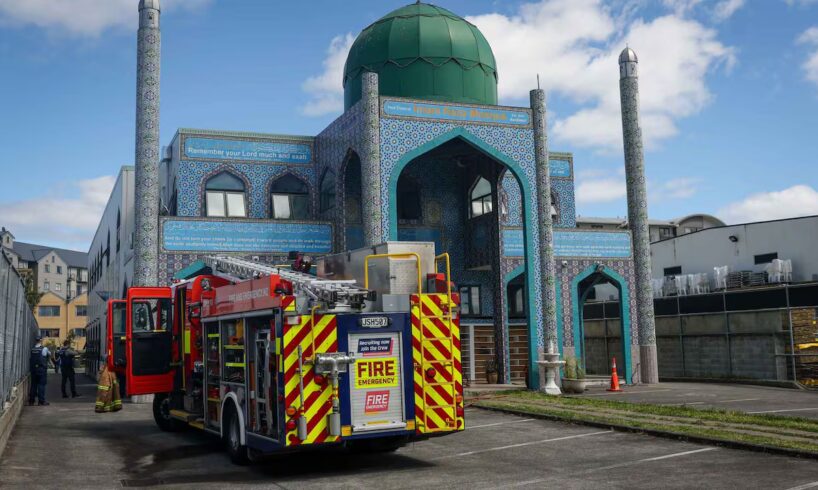
Fire and Emergency New Zealand crews attend to the arson attack at Imam Reza Mosque in New Lynn, Auckland. Photo / Mike Scott
“Unfortunately, he seems oblivious to the harm he’s caused,” she said, noting the need for deterrence and protection of the public.
The judge again cited protection of the community as she declined his bid for permanent name suppression. It remains in place on an interim basis, however, while he contemplates appealing the decision to the High Court.
‘Completely destroyed’
Court documents show the West Auckland resident’s legal troubles began in November 2024, when a fire at Imam Reza Mosque in New Lynn caused widespread community condemnation.
For weeks earlier, police said, he had expressed an intention to either vandalise the building with graffiti or burn it down.
He first arrived on foot around midnight on November 5, using a scaffolding pole from a neighbouring construction site to smash his way through a side door. The building was quiet and empty.
A smashed glass door at Imam Reza Mosque as police investigate a suspicious fire. Photo / Raphael Franks
“He went through the rooms, occasionally damaging a picture or ornament with his scaffolding pole,” according to the agreed summary of facts for his case.
After locating a lighter in the building, he went to the main prayer area and began trying to start fires on various flags and wall coverings.
“After a number of attempts, [he] was successful in setting fire to an internal curtain about 1.8m high, which separated the main prayer room,” court documents state. “The curtain burned quickly, with a significant amount of smoke and flame. [He] grabbed the scaffolding pole and ran from the mosque.”
The fire smouldered for hours unnoticed. It did not spread significantly because of a lack of oxygen, but the mosque was rendered unusable.
“The fire destroyed all internal linings and furniture, melted ceiling panels and caused smoke damage throughout the building,” court documents state. “Many religious items that had been ordered from outside New Zealand when the mosque was built were completely destroyed.
The fire at Imam Reza Mosque smouldered for hours unnoticed and caused considerable damage. Photo / Supplied
“This included copies of the Quran, prayer notes and specific hand-woven embroidered material.”
An insurance company estimated the overall damage to be $1.5 million.
‘Fear and distress’
But the damage went beyond financial, representatives of the 1500-member mosque said in a victim impact statement that prosecutors read aloud in court.
“The mosque is far more than just a building – it is a place of worship, peace, learning and unity for many families,” the statement read, noting that religious programmes, guest speaker events and community gatherings had to be cancelled or disrupted in the 18 months it took to make the building usable again.
“This incident also created fear and distress among members, particularly families, women and children who no longer feel the same sense of safety attending the mosque,” the statement said.
The mosque was extensively damaged during the blaze. Photo / Supplied
“It has caused emotional harm and shaken the trust and comfort that people once had in their place of worship.”
The building was insured, but its insurance excess has increased substantially as a result of the incident, causing further financial strain, the court was told.
“We respectfully ask for fair justice to be served,” the statement concluded.
“We are concerned that our local community has been the subject of a violent attack motivated by hatred and are especially concerned that others with similar views might be encouraged to target the Muslim community again.”
The mosque reopened last weekend.
Excrement attacks
Police executed a search warrant at the then-teenager’s home on the same day as the fire.
In addition to arson, punishable by up to 14 years’ imprisonment, he was charged with three counts of possession of objectionable materials, punishable by up to 10 years.
They included the manifesto of Brenton Tarrant, who is serving life without parole for the Christchurch terrorist attack, as well as videos of that shooting and a mass shooting in the United States in 2022.
The defendant has remained in jail since his initial arrest, accumulating a steady stream of assault-related charges for his behaviour towards Corrections officers at the Mt Eden and Paremoremo facilities.
He picked up his first assault charge in March 2025, about four months after his arrest, when he caused a minor concussion to a senior officer who was escorting him to his cell.
The two had never interacted previously and, without warning or provocation, he threw two punches before he was quickly pinned to the ground. The defendant later said he did it because he wanted to change units in the prison.
Another assault occurred in June 2025 when he split a guard’s lip with an unprovoked punch to the face while handcuffed.
Eleven days later, he picked up another assault charge while being searched for weapons before a police interview.
The most comprehensive court document, however, is for a representative charge of assault against multiple officers at Auckland Prison between October and December last year, outlining instances in which the defendant threw urine or faeces.
“This was distressing to the individual officers and posed an obvious health hazard,” court documents state.
On October 8, the defendant was watching through his cell window as an officer handed out meals. He waited until the serving hatch was opened before grabbing a paper cup already filled with his own urine and throwing it through the small opening.
It splashed over the officer, including his face. The defendant laughed.
He targeted another officer handing out meals on December 9, hitting the officer with a mixture of milk and faeces the defendant had saved in his cell.
Five days later, two officers were helping a nurse hand out medication when he hit them with a concoction of urine and faeces he had mixed in another milk carton.
A week after that, three officers were handing out meals when they were splashed with urine.
‘This is my country’
During that same period, the defendant was complaining about “perceived injustices about how he was being treated”. He picked up a charge of intimidation for the statement he made to officers about wanting to shoot them after his release on parole.
The comments seemed to be directed at officers he perceived to be immigrants, court documents state.
“I’m a f***ing white man, this is my f***ing country,” he told the group. “We built this s***. They just ship you c***s in because nobody else wants to do these s*** jobs.”
In an interview with police this year, the defendant said he didn’t mean it when he threatened the shootings. He expressed remorse for throwing excrement on one occasion, but for the other occasions claimed he would do it all again.
Police prosecutor Yara Alrubayee characterised the officer attacks as hate crimes, noting the victims all appeared to be of a different ethnicity than the defendant.
The defendant’s lawyers disagreed with the statement, but the defendant himself interjected before they could raise the issue.
“Ninety percent of the people who work here are foreigners!” he interrupted. “That’s unfair!”
Alrubayee continued: “To call it anything other than a hate crime would minimise the assault against these officers who were just trying to do their job.”
Defence lawyer Julie-Anne Kincade, KC, said none of the assaults should be viewed in a racial context – it’s not what her client agreed to when pleading guilty.
The judge later agreed not to place weight on his white supremacist views when considering those charges.
Deradicalisation disinterest
Kincade focused largely on her client’s mental health battles and his youth as she asked the judge for 75% in reductions from the sentence starting point. The lead arson offence was committed before law reform that now restricts discounts to no more than 40%.
The defendant’s family described his behaviour in the days before the arson as having become so strange that they got him a referral for mental health services.
It included locking himself inside the family bathroom for 20 hours, climbing on to the roof of a nearby supermarket and expressing delusional ideas and conspiracy theories, according to an affidavit.
Although he doesn’t fit the definition of insanity for a court context, the defendant would no doubt be in the care of mental health services today if he weren’t in custody, Kincade said.
Police officers at the scene of the 2024 incident at Imam Reza Mosque, whose representatives told a court they were concerned its community had been the subject of a “violent attack motivated by hatred”. Photo / Mike Scott
Now in a high-security unit where he’s locked up 23 hours a day, the defendant hasn’t had a chance to receive mental health treatment or rehabilitative programmes, she said.
It’s resulted in a vicious cycle where the isolation has caused him to act out even more, she said.
But Crown prosecutor Sarah Murphy described the defendant’s views as “entrenched”.
“He just hasn’t expressed any interest whatsoever in deradicalisation,” she said, speaking over the defendant as he directed profanities to a list of people unrelated to his case.
“We’d all be relieved if [he] wanted to be disengaged but he just doesn’t.”
The defendant interjected again: “I’m on remand, dum dum. I can’t do any programmes or courses.”
‘A real risk’
Judge Maxwell acknowledged the defendant’s diagnoses of autism and ADHD, but she also noted that he’s intelligent.
While the autism goes some way towards explaining his tendency to fixate on ideas, it does not explain or excuse his choice to fixate on white supremacy or his proclivity for expressing those views in destructive ways, she said.
She settled on a seven-year starting point for the arson, then added three more years for his other crimes, which included an attempted assault on another prisoner with a sandwich press last May and setting a fire in his cell in October.
The defendant had briefly argued with the fellow inmate over chess inside a prison dayroom before grabbing the sandwich press and running towards the victim.
“As the defendant ran closer, he raised his sandwich press above his head to strike the victim,” court documents state.
“However, he lost his footing and ended up completing a ‘Superman’ type dive, culminating in the defendant himself and the sandwich press crashing on to the back and head of the victim at the same time.”
A Givealittle page was set up to raise funds for the extensive repairs needed after the blaze at Imam Reza Mosque. Photo / Supplied
The fire inside his cell, meanwhile, put others at risk as the entire prison wing filled with smoke.
That blaze was extinguished by a sprinkler system and the defendant emerged from his cell “coughing and covered in wet dust and soot”, documents state.
The judge allowed 50% in total discounts: 10% for his youth, 15% for mental health and the rest for his guilty pleas.
“Autism does not predispose someone to violence,” the judge said, noting the defendant started watching edits of the Christchurch terrorist attack when he was 13 and has been unpersuaded by his family’s efforts to lead him in a different direction.
“He has very much been the author of his actions.”
The judge then explained why she wouldn’t grant him permanent name suppression, which the defence had argued would be “catastrophic to his rehabilitation”.
Another district court judge had ordered in July that the defendant’s then-interim suppression be lifted, but that decision was later overturned by the High Court.
Judge Maxwell noted his behaviour in prison has continued to be “highly problematic” even with High Court-granted suppression. He’s made no secret of his extremist views, she said.
“He appears to speak with pride,” the judge said, noting the defendant laughed at the idea of paying the mosque restitution.
“There is no remorse.”
The judge also cited concerns expressed by those who frequent the mosque. They opposed suppression and said the frightening situation had been made more stressful by members not knowing who in the community targeted them.
Without that knowledge, they’ll feel particularly vulnerable when he’s released from prison, they said.
The judge concurred.
“Thought must be given to their vulnerability,” she said.
“He appears to present a real risk to the wider community.”
Craig Kapitan is an Auckland-based journalist covering courts and justice. He joined the Herald in 2021 and has reported on courts since 2002 in three newsrooms in the US and New Zealand.
Sign up to The Daily H, a free newsletter curated by our editors and delivered straight to your inbox every weekday.