Cash-strapped mortgage holders could be paying more on their home loan, as the national budget does little to remove excess inflation.
In a grim warning, economists say the budget did not do enough to reduce spending, as the deficit continues to climb.
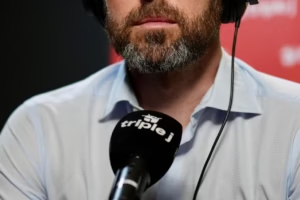
AMP chief economist Shane Oliver warns the budget locks in structurally higher spending and budget deficits across the medium term, doing nothing to help ease the pressure on the Reserve Bank of Australia.
“Over the short term there was a bit more stimulus in there which could add to inflation at the margin,” he told NewsWire.
“It’s not huge but it certainly doesn’t make the Reserve Bank’s job any easier.”
Prior to the budget announcement, Mr Oliver forecasted an additional interest rate hike in August.
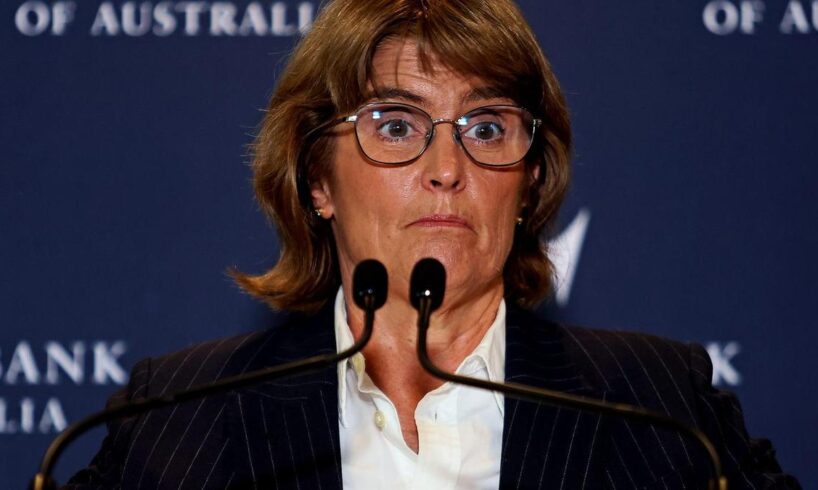
Camera IconEconomists say the budget did not take the pressures off RBA governor Michele Bullock and the board NewsWire / Christian Gilles Credit: News Corp Australia
He said Tuesday’s budget did not take enough money out of the economy to change this prediction.
Betashares chief economist David Bassanese agrees, highlighting the government did not announce major savings.
“In terms of the overall macroeconomic impact, the Budget does not appear to greatly add to near-term inflation risks,” he said.
“The Budget is hardly super restrictive either, so does not lessen the burden on the RBA to tighten policy further if need be.”
Would have been a disaster
While the Australian government did not reduce spending by enough to take the pressure off the Reserve Bank of Australia, they avoided the temptation of spending more and giving further relief to households.
Even though housing bills are rising, largely thanks to soaring oil and gas prices due to the US – Iran Middle East war, Mr Oliver says helping households would have actually hurt mortgage holders in the long run.
“The temptation would have been to do more – like some of the state budgets – that would have been disastrous,” Mr Oliver said.
“It was good to see the government holding back, I think we needed to see more of a cut back in the near term”.
Camera IconTreasurer Jim Chalmers announced his fifth budget on Tuesday night. NewsWire / Martin Ollman Credit: News Corp Australia
Mr Oliver said any relief from the government should be targeted at those who need it over broad payments to every Australian.
“I’m not a great fan of giving relief to everyone because it is very expensive and gets too inflationary,” he said.
“So if you want to help people, you target it to those who really need it.
Household budgets have been stretched as fuel prices rallied from $US56 ($A80) per barrel, before temporarily touching $US120 (A$167) per barrel.
For every $10 increase in the price of oil, Australians pay an extra 10 cents at the fuel pump.
According to the budget papers, the Treasury predicts oil prices to stay above $US100 ($A138) a barrel before easing back to $US80 ($110) by next year.
How big is Australia’s debt?
According to the Australian Office of Financial Management the nation’s gross debt is sitting at $964.2bn.
Over the next four years it is tipped to rise each and every year before reaching $1.2 trillion.
Figures released by the Treasury department, says the debt will jump to $982bn by the 2026 financial year and cross the $1 trillion mark in mid 2026.
Camera IconAustralia’s debt is forecasted to reach $1 trillion in the next few months. NewsWire / Nicholas Eagar Credit: NewsWire
In the 2027 financial year, debt is tipped to rise to $1.051 trillion before lifting by $70bn to $1.12 trillion in 2028.
By the end of the forward estimates, Australia is projected to owe $1.249 trillion as gross debt peaks at 35.6 per cent of GDP.
From this point debt is tipped to slow before falling back to 27.2 per cent of GDP by 2037.
This is tipped to be the peak of the nation’s debt, as Australia starts paying it back over the next decade.
By 2037, Australia’s gross debt is expected to fall back to 27.2 per cent of GDP.
$100bn in savings
Mr Oliver says Australia must reduce its debt by around $100bn over the next four years to get spending back to 25 per cent of GDP, moving the government out of the way of the private sector.
“You need about a 2 per cent cut in the public sector share of GDP,” Mr Oliver said.
“If you did that it would take us back to levels that prevailed prior to covid and free up capacity for stronger private sector activity and allow for lower interest rates without generating inflation.”
“We saw only a small share of that in Tuesday’s budget.”