He’s serious. “I haven’t got time for that.”
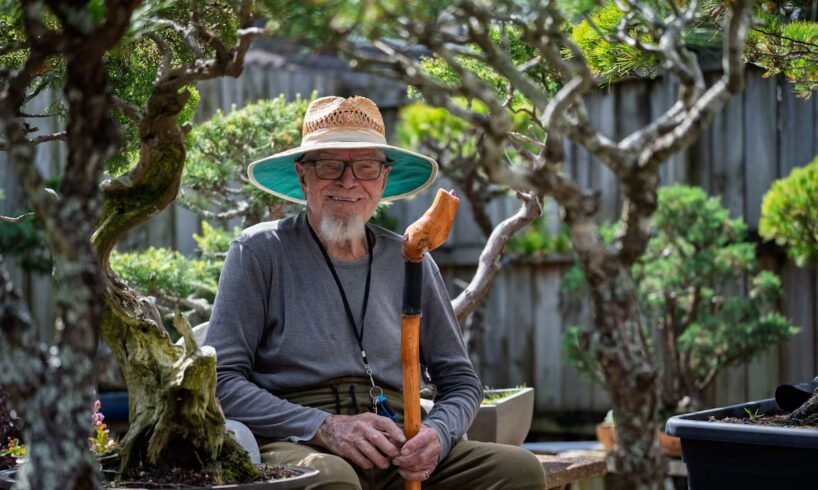
This is clear as you approach Bob’s Sandringham home, which could be mistaken for an intensely packed Kings Plant Barn from a satellite. Large trees line the kerb and as the sliding gate clicks back, a world of greenery emerges. Bonsai of all sizes, species, ages and origin wrap around the entire house.
Bob rattles off a list. Kauri, kōwhai, kahikatea, pōhutukawa and rewarewa are among his collection of native trees in miniature form. The rest are mostly pines, oaks and maples from Japan, China and Australia. They zig-zag, arch and twist up from the roots into the foliage, forming unique knots and curves in the bark along the way. He also keeps a variety of mosses, fruit trees and green tea.
Bob estimates he now cares for about 200 plants. This number was more like 350 before the costs of fixing a leaky roof forced him to subdivide his property and downsize the garden.
Bob’s passion for the outdoors grew through the cracks of World War II Germany. As a little boy, he tended to the family garden. “I was the middle child of nine and it meant I had to look after the youngsters. I was going out doing little jobs to bring home extra money or food.”
At the time, children went to public school until the age of 14, and those who couldn’t afford to continue education privately took on vocational apprenticeships. “Of course when I turned 14, I went into agriculture. I learned all about farming. In Germany, it was called mixed farming.”
After the war ended, Bob sought a fresh start to life and went to England to work on dairy farms. Eventually, this led to Canada, where he learnt about large-scale farming on a ranch spanning thousands of acres. In between farming, Bob had a stint as a nurse trainee in a Canadian hospital, only to fail the last exam because of the language barrier.
Bob doesn’t speak a word of German any more. He briefly describes his time in the compulsory Hitler Youth with a frown on his face. “You walk through that door and shut it quickly behind you. And that’s what I did. That’s the only way I can explain fitting into a new life.
“It’s as simple as that.”
A new door opened when Bob came to New Zealand in 1959 for a holiday. He loved it so much that he stayed. “When I came out here I went back into horticulture, got a job with the city council. I became a teacher, teaching apprentices.” In this time, he learnt pottery, picture framing, jewellery-making and weaving. Also, a number of natural healing practices: massage, reiki and reflexology. He practises suiseki, the art of collecting and appreciating small stones resembling people and landscapes.
You’ll also never catch him without crystals. They line bookshelves and mantelpieces in his home, peek out of pots and sculptures in his garden, and are embedded into his jewellery and walking sticks. He also carries his two favourites in his pocket at all times: one amethyst and one rose-quartz.
On a second visit to Bob’s house, I double check suspiciously whether he’s hiding any other pastimes. “Oh, I did ice skating.” Good to know.
Bob describes his colourful time working with the council as the best 26 years of his life: “We had tickets to everything… except rugby.” And it was here that he first discovered bonsai. One afternoon, Bob spotted a book about bonsai in his boss’ office, and asked “what’s this?” He went to bed reading it at 9pm. Fast-forward to 2am and his eyes were still glued to the pages.
I ask him whether it was the first time he had ever seen or heard of bonsai. “Yeah. And it was just in a book. Honestly, it was just something.”
Time didn’t apply to Bob when he read about bonsai for the first time, let alone now when he’s out in the garden. “I look at my watch, think five more minutes then I’ll go into the house for lunch. And then all of a sudden, I look again. A half hour has gone past. Then, ‘Oh, I’m just going to have a look at this. I’m going to wait out here.’ And then, ‘I was supposed to have lunch.’ See, that’s how it’s an obsession.”
In 1979, bonsai master Saburo Kato visited Auckland to attend a bonsai convention. It was here that the two met, and Kato encouraged Bob to be his student in Japan. He didn’t go. They met again at another convention in Hawai’i, and Bob was confronted again: “So, when are you coming to Japan?” He saved the money, and off he went to learn from one of the greats.
This became one of many trips to Japan for Bob, who says he “just fell” for the country. He opted to stay in homestays with hosts who had similar interests to him, such as bonsai or jewellery, and garnered a deep appreciation for the country’s “politeness, food, beauty and elegance”.
Bob also learnt from another bonsai master: Ben Suzuki. On a sabbatical to Los Angeles, Bob spent time collecting unusual plants for display in Auckland Domain, with every other minute dedicated to classes and tutoring.
When he returned, he formed the Auckland Bonsai Society and became the president for 20 years. During these years, appreciation for horticulture flourished in Auckland. Flower shows were frequently held and Bob showcased his bonsai through the annual Japan Day event as well as Model X, a hobbies expo held in Henderson.
Bob has many students of all demographics who are keen to learn the art of bonsai. He makes it clear bonsai is not just a skill to be learned, or a tree to be tamed, but something to be felt. “Sometimes nature tells you what the tree should look like. It is just … what comes from within. You can look at things and say, ‘Oh, yes, it’s beautiful’, and that’s as far as it goes. But [my obsession] goes deeper than that.
“When I went to Japan to study bonsai, the first thing they said to me … [was] ‘Bob-san, remember your heart, your mind and your hands’. These are the three important things; whether you are cooking, whether you are baking, whether you’re doing jewellery, anything. It’s got to come from within.”
Bob sits up, looks me dead in the eye and tells me that this applies to writing and photography too. He raises a fist and beats it to the left side of his chest. “It’s got to come from here. If you weren’t interested, it wouldn’t work for you. You never become good.”
He softens his eyes. “Always think of your heart first.”
Sign up to The Daily H, a free newsletter curated by our editors and delivered straight to your inbox every weekday.