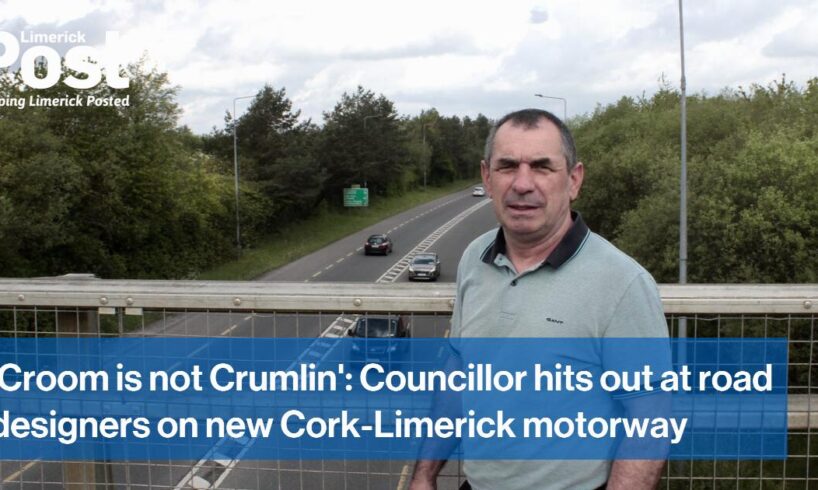
Independent Ireland councillor John O’Donoghue has some strong words for the new motorway from Croom’s perspective. Photo: Gareth Williams.
“CROOM is not Crumlin” is Independent Ireland councillor John O’Donoghue’s message to the road designers of the proposed Cork-Limerick M20 plan.
The Limerick Post joined the Adare-Rathkeale area representative in his native village to take a look at the issues, as he sees them. To date, he has held a number of public meetings in Croom regarding the perceived problems with the current design of the project – with over 1,000 people having signed a petition opposing the plans.
Cllr O’Donoghue is quick to point out, when I meet him along the picturesque banks of the River Maigue, that he is not against the long overdue new road from Limerick to Cork. However, he does believe that directing heavy local traffic back into Croom is neither safe nor sensible.
At a special local authority meeting last September, Council members sent a very clear message to the Mid West Road Design Office following a design update. At the time, local representatives were united in their views that the delivery of the N/M20 Cork to Limerick road should not have unintended negative consequences for towns and villages along the route, such as Patrickswell and Croom. This clarion call came after significant proposed changes to traffic flow around Patrickswell village with the partial closure of Junction 5 at Attyflin.
Advertisement
Signup for the Limerick Post newsletter
Going forward, the long-awaited project is expected to cut future travel times between Limerick and Cork by 40 minutes for cars, 45 minutes for busses, and 50 minutes for heavy goods vehicles. But Cllr O’Donoghue is more concerned that the current designs will see Croom hurtling backwards to the dark old days of heavy traffic congestion.
A HGV driver and farmer by trade, Cllr O’Donoghue is convinced that current M20 designs would once again force heavy freight vehicles and farm machinery back through a hamlet which has been bypassed since 2001.
‘This bypass is a huge worry to me’
“I’m not crying for the sake of crying. There is a reason for this, and to quote another councillor, ‘you can’t beat local knowledge’,” Cllr O’Donoghue tells me.
“I was born two miles up the road. I moved a couple of miles farther away at a young age. I’ve been to school in Banogue and then I went to a place called Dromin-Athlacca. They have one hurling team and football team – we’re all the one community.
“I know what Croom has been like. I know what Croom is like, and I like to think that I’m one of the people that knows what Croom could be like in the future. Saying that, this bypass is a huge worry to me.”
He described the motorway plans as “a complete backward step”.
“If I want to go back to the 1980s, I’d like to go back to the music and not to the mayhem that we had with traffic congestion here in Croom. This is a thriving community, and a lovely place to live. At the minute, the bypass is fully operational and helping the town. But what’s going to happen when it becomes a motorway is there will be no access for anything in between including heavy vehicles and agricultural machinery.”
A notoriously tight corner at the top of the Main Street, across from the site of old post office, is also a huge concern for O’Donoghue, local businesses, and residents in the village, he says.
‘An active travel scheme that goes to nowhere’
The Independent Ireland councillor is of the view that the traffic infrastructure in Croom is not sufficient, with road widths too narrow to cope with the large trucks and tractors that will have nowhere else to go.
“There’s around 900 students in the secondary school. The national school is thriving as well. The hospital is absolutely flying it down there. Croom is only going one way and we are not going back to traffic bottlenecks with potential hazards,” Cllr O’Donoghue says.
“Road Safety is what everybody is absolutely about. But how is it safe when two busses meet and one has to climb up on the footpath? That’s not road safety, but that is what we’re going to be faced with.
“We’re going to have an active travel scheme that goes to nowhere and ends up in the footpath. There’s no joint up thinking.
“The road design team have never refused to meet anyone, but it’s what is coming out of those meetings that is frustrating. Unfortunately, we’re dealing with people that are so curtailed that I have to remind them that this is Croom, it’s not Crumlin. The people making the decisions don’t seem to see that,” he suggested.
“We are talking about safety on the main road, but why then are we compromising the safety of anybody inside in the town? This is where you will have the pedestrians, this is where you will have the younger generation, this is where you will have the footfall. It’s narrow enough, at the best of times, so once the motorway is done, you will either avoid Croom altogether, or you will have to suffer,” he predicts.
If planning is granted, the new motorway will be constructed in phases, including the construction of long-awaited bypasses of Charleville, Buttevant, and Mallow initially.
Dependent on the approval and planning process, construction of the project could begin in 2028. It is estimated that the project will take approximately seven years to fully complete, meaning the vital motorway may not be finished until 2035.
Limerick City and County Council is progressing the development of the N/M20 Cork to Limerick project in partnership with Cork County Council, Cork City Council, Transport Infrastructure Ireland, and the Department of Transport. The project is a priority investment in the Government’s National Development Plan 2021-2030.
When contacted by the Limerick Post, the local authority revealed that contrary to some reporting, the L1478 Fanningstown Road to the north of Croom will not be closed as part of the N/M20 project and will be connected to the existing N20 national road providing direct connectivity with Limerick, Patrickswell, and Adare via the existing road network.
“The project is being designed in accordance with the appropriate Transport Infrastructure Ireland (TII) national design standards. The existing L1478 and future declassified N20 will be of sufficient width to allow all HGV and agricultural traffic that currently uses the public roadway.
“The project team have engaged extensively with property owners, communities, businesses, and other stakeholders, through the public display events, in person meetings, public webinars and the interactive project website, during the project development. The project team continues to welcome feedback as we progress towards the statutory planning process,” the Council stated.
Further information on the road is available on corklimerick.ie.
– Local Democracy Reporting Scheme