George Clarke Simpson rose to lofty heights and was even knighted as the latest Little Did You Know feature reveals
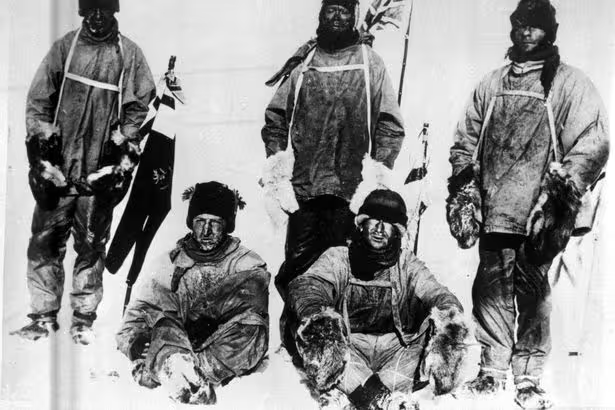
The five men from the 1912 Scott Expedition to the South Pole. From left, Dr E. A. Wilson, Lt. H. R. Bowers, Captain Robert Falcon Scott, Petty Officer Taff Evans and Capt. L. E.G. Oates – George Clarke Simpson stayed at base camp(Image: Submitted)
If you are passing along East Street by what was the former Halifax Bank building until last year, look up and you may be able to spot one of the many Blue Plaques around the city – this one to Sir George Clarke Simpson, whose family lived and worked in an umbrella business in the late 19th century.
But little did you know that Sir George not only accompanied Captain Scott on the ill-fated mission to reach the South Pole in 1912 but he was also was a pioneer of modern weather forecasting and a director of the Met Office between 1920-1938.
His grandfather – Alderman Arthur Simpson -started the umbrella shop in Bag Lane, the former name of East Street and his father was a toy dealer in the adjacent property, where Sir George grew up.
Born in 1878, George was educated at the Diocesan School on Friar Gate and at Derby School before going to university in Manchester and Gottingen in Germany.
There he began his serious studies into the Earth’s atmosphere, and furthered his research by living in Lapland for a year and taking weather readings several times a day.
George Clark Simpson pictured at about the time of the Scott expedition 1019-1912(Image: Derby Telegraph)
In 1905, he volunteered to be a scientific assistant in the Meteorological Office, before returning to Manchester, where he became the first ever lecturer in meteorology at a British university.
The following year, George joined the Indian Meteorological Service as an Imperial Meteorologist at their headquarters in Simla and inspected many of the meteorological stations in India and Burma.
In 1910, he was asked by Captain Robert Falcon Scott to become part of his Antarctic expedition and he constructed one of the continent’s first weather stations at the base camp at Cape Evans.
The whole expedition created great excitement across Britain, and not least in Derby where financial donations were raised to purchase several state-of-the-art meteorological devices.
George conducted balloon experiments to test the atmosphere and determine how altitude affects temperature and was in command of the station for several months when Scott’s team left for the South Pole in November 1911.
George did write a cautionary note at this time which said: “It appears that with all our resources, there is little margin, and a few accidents or a spell of bad weather would not only bring failure, but very likely disaster.”
At work on his experiments(Image: Submitted)
George’s calculations and predictions were one of the most important influences on Scott’s tactics. Simpson would be recalled to India and visit his home town in June 1912, still unaware of the terrible end that had befallen Scott and his men as they fell prey to the horrific weather conditions.
Word of their fate did not reach Britain until the following year. Modern meteorologists have confirmed that Simpson’s climate predictions would have been accurate in any other year – there had simply been no way of predicting the unique and dramatic change in conditions that trapped Scott’s party near the Pole.
It seems that George frequently visited his family in Derby and in June 1912 before Scott’s fate was known, he spoke to the Derby Telegraph and said: “We lived a very happy life together and I should think it was one of the most happy expeditions that ever went out.
“Everyone pulled together splendidly, and we got through our work well. The plans we made for the expedition were carried out with very little alteration, but of course, they had to be altered a little to meet unforeseen difficulties.
“The instruments which were purchased out of the Derby fund all behaved splendidly, and were thoroughly used. In consequence, a large amount of data has been amassed, which has never been obtained by other expeditions.
“By the aid of small balloons, I was able to investigate the upper atmosphere, and find how the temperature varied during the year. These small balloons were sent up and they had attached to them little instruments that were liberated by means of a time fuse, and fell upon the ice.”
The Blue Plaque in East Street to commemorate the life and work of George Clarke Simpson(Image: Derby Telegraph)
Word that the expedition had failed – Norway’s Roald Amundsen has reached the South Pole first – and the polar party had largely perished reached George at Khud Cottage in India in early 1913 and it is reported it sent him into a deep depression.
But he rallied and would go on to become a Fellow of the Royal Society, Director of London’s Meteorological Office in 1920 and President of the British Meteorological Society in 1940.
During his Met Office tenure, he was engaged in research work in the fields of atmospheric electricity, ionization, radioactivity and solar radiation.
He investigated the causes of lightning and in 1926 established the Simpson wind force scale, a modification of the Beaufort wind force scale which is the current standard scale used worldwide but still called the Beaufort wind force scale.
Although he retired in 1938, he was called back to take charge of the Kew Observatory in the Second World War and continued research until 1947 – into the electrical structure of thunderstorms, the reflective effects of the snow and the effect of radiation on polar ice.
He died in Bristol aged 86 in January 1965.
It was in 2014 that Sir George Clarke Simpson’s Blue Plaque was put onto the East Street building – the first one to feature an electronic tag which people can scan with their mobile phone to bring up a link to a website where there will be more information about the plaque’s recipient.
The next instalment in the ‘Little Did You Know’ series will be coming soon. Meanwhile, catch up with some of the best ones below: