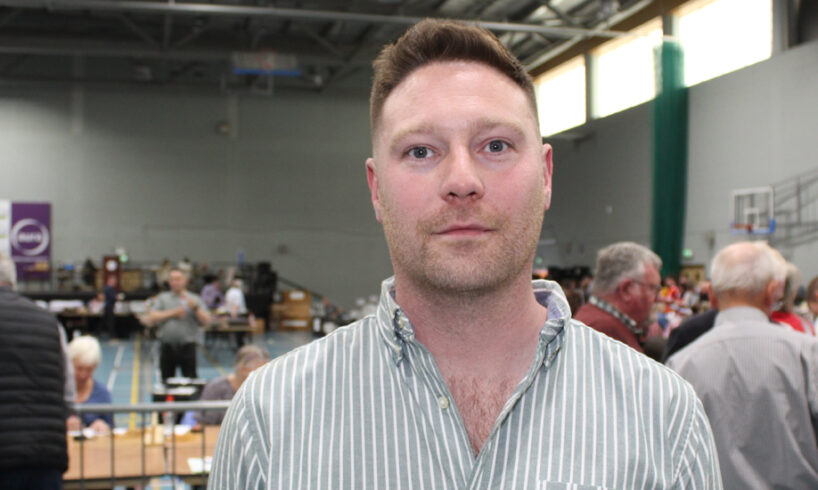
Donegal County Council has been asked to support a full research study into how people are experiencing the Defective Concrete Blocks scheme.
The motion was brought to the May plenary meeting by Independent Councillor Declan Meehan, who said the council needs “a clear, fact-based understanding” of what is working, what is not working, and what barriers people are facing.
He also called for tenants and households in council homes affected by defective concrete blocks to be included.
Cllr Meehan said there were “two separate but connected issues” that needed to be examined.
“First, we need a clear fact-based understanding of how people are actually experiencing the DCB scheme,” he said.
“What is working, what is not working and what barriers people are facing.
“And secondly, we need to fully understand the human experience of living in homes affected by defective concrete blocks.”
Cllr Meehan said discussions around the scheme can too often become focused solely on figures, including numbers of applications, approvals, grants and remediation options.
“But those statistics only tell part of the story,” he said.
“This motion is about gathering evidence directly from the people living through this crisis every single day.”
He said homeowners who have completed remediation should be asked “whether the scheme worked for them in practice, did they feel supported, and were there financial pressures, rising costs, delays or obstacles that made the process more difficult than it needed to be, or was their experience of the scheme all tickety-boo.”
“We also need to hear from those who are actively engaged in the scheme right now,” he said.
“Families who are navigating construction works, displacement from their homes, constantly rising costs, stress, uncertainty, and disruption to daily life.”
Cllr Meehan said it was also “critically important” to hear from people who are registered for the scheme but have not yet proceeded.
“If people have registered but are not engaging further, we need to understand why,” he said.
“Is it fear about financial exposure? Is it a lack of access to credit to cover shortfalls? Is it concern about temporary accommodation? Is the process too complex?
You may also be interested in
“Are people overwhelmed by the scale of what lies ahead? Are they unable to find contractors or can they simply not afford it?
“We shouldn’t speculate. We should ask, listen, and gather the evidence properly.”
Cllr Meehan said the research would help Donegal County Council and the Defective Concrete Blocks Committee advocate more effectively for improvements to the scheme.
Seconding the motion, Cllr Joy Beard from the 100% Redress Party said the research was “very badly needed”.
“For years now we’ve spoken about the defective concrete crisis through numbers, through applications, grants and statistics, but we have to remember behind every file is a family that’s living through this,” she said.
Cllr Beard said councillors regularly hear different narratives about the scheme, with some saying it is working while homeowners are telling them they are “literally at breaking point”.
She added that any research must not become “a report that is left sitting on a shelf”, but should inform future policy decisions, reviews of the scheme and practical supports.
In its response, Donegal County Council said undertaking such a study would require extensive resources and is outside the remit of the council as administrator of the scheme.
Director of Service Michael McGarvey said he fully agreed that the motion was important, but explained that the council’s priority was administering the scheme on behalf of the Department through assessing and paying applicants.
Mr McGarvey said that if the motion was adopted, the council would write to the Department of Housing, Local Government and Heritage asking it to consider commissioning such a study across all designated local authorities.
He added that Donegal County Council would engage with any such study if commissioned.
Fianna Fáil Cllr Martin McDermott suggested there may be scope to explore funding through the Local Community Development Committee, Donegal Local Development CLG or Inishowen Development Partnership.
Cllr Meehan accepted that the research was outside the council’s remit, but argued that Donegal County Council was “best placed” to engage in the work.
He said the council should engage with relevant stakeholders, including Donegal Local Development CLG and Inishowen Development Partnership, and “think outside the box”.
“It doesn’t have to necessarily be resource heavy within the council itself,” he said.
“Ultimately, what we want to do here is capture the experiences, the good, the bad, and the ugly, and to ground our advocacy in that research and in that understanding.”