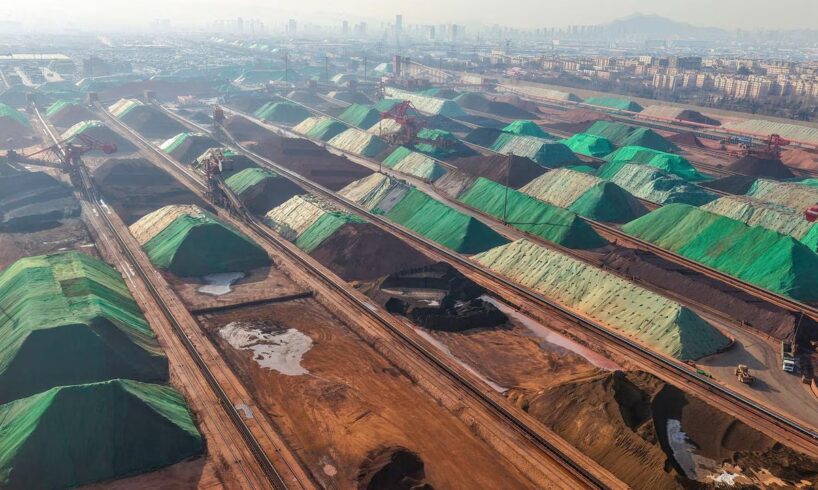
A top mining executive revealed the “stunning” moment China’s ‘steel cartel’ ambushed Australia’s five biggest miners in a high-stakes meeting with a secret chart that showed how much money it was making.
The China Mineral Resources Group (CMRG), which represents close to 80 per cent of Chinese steel mills, is forcing Australia’s multibillion-dollar iron ore industry into a corner as it demands a bigger slice of the profit pie.
Michael Shoebridge, a leading national security analyst and the founder and director of the independent think tank Strategic Analysis Australia, said the Australian government and our big resource companies need to have their “eyes wide open” to what’s happening.
He told news.com.au China’s “cartel-like” behaviour is now a huge threat to the Australian economy.
“The Chinese government is starting to use its massive power to dictate the prices and conditions under which Chinese companies buy Australian iron ore,” he said.
“They are trying to control the market through a single-buyer approach, and that is entirely about slashing the prices we get for our exports.
“They are doing this through what we would call cartel-like behaviour. The Chinese government can compel its companies, whether they are state-owned or supposedly private, to co-operate with Beijing. In this case, it allows them to organise their iron ore buyers into a unified buying cartel.”
Cartel ambushed miners with bombshell document in meeting
Australia’s iron ore industry is worth over $100 billion annually, making it the country’s single largest export and accounting for about one-quarter of all national resource and energy commodity earnings.
Up to 85 per cent of exports are sent to China, which uses it to make crude steel as it manufactures over 50 per cent of the world’s total steel supply.
However, top mining executives in Australia — from BHP and Fortescue — have warned that negotiations are getting tougher.
At a minerals conference on Wednesday, they revealed a tense behind the scenes showdown where Chinese officials cornered Aussie miners over their massive profit margins.
Tim Day, who is in charge of BHP’s multibillion-dollar West Australian iron ore business, said recent talks with the cartel had been tough and they were only likely to become more difficult next year.
“We’re through it now, which is the good part, but it will be on again next year … and it is getting more complex …” Mr Day told The Australian Financial Review Mining Summit in Perth.
“What does that … mean for the Australian iron ore industry in particular? You will see over time that this will continue to play that way, and the power and size of China [will] just have that impact.”
Dino Otranto, the chief executive of the mining division of Fortescue, said the cartel had been seeking a bigger slice of profits for years.
He reportedly told the summit of a meeting in Beijing in 2022 when China’s five biggest steelmakers sat across the table from the five largest iron ore miners.
Aussie miners were left “stunned” when Chinese officials flashed a highly accurate, secret chart on the screen showing the profits taken by all 10 parties at the meeting, he said — adding that the slide included details on a privately held iron ore miner.
The slide showed that Aussie miners were enjoying profits of up to 80 per cent, while the Chinese steelmakers were losing money.
“The contrast was stark: 70 per cent to 80 per cent profit margins on one side, which was us, and negative margins on the other side,” Mr Otranto told the conference.
“And then the CMRG concept was wheeled out, and the title of the slide was ‘shared prosperity’. And everybody started to clap.”
China’s aggressive ‘take it or leave it’ demands
Defence expert Mr Shoebridge agreed that China’s tactics have become increasingly bellicose in recent months and the cartel approach had been successful for Beijing.
“Their pressure on Australian miners has been quite corrosive,” he said.
“It’s essentially a ‘take it or leave it’ demand. It is almost as if you are dealing with a single monopoly buyer for iron ore that simply wants to dictate the terms of trade.
“The Chinese signalled they were going to start behaving like this a few years ago, and they have slowly worked to put the tools in place to do it. We are now seeing the result of plans made years ago that are finally being implemented.
“Another thing they are attempting to do is force contracts to be settled in the Chinese currency rather than in US or Australian dollars. This is designed purely to advantage Beijing and reduce the revenue flowing back to Australian mining companies.”
He said there is not a lot Australia can do to combat this cartel-like behaviour, because the Chinese market is completely dominant when it comes to our iron ore.
“The big wake up call for Australia is realising that the massive profits and revenues we have relied on from iron ore are going to shrink,” he said.
“This shows exactly why we must do much more to diversify the Australian economy away from the Chinese fallback we’ve taken. We need to become far less dependent on the China market and the profits from iron ore.
“This underlines the glaring problem with the Australian government’s mantra that we have ‘stabilised’ the relationship with China. The Chinese government operates completely differently to ours and uses every ounce of coercive and market power it can get its hands on. That means our relationship is simply not stable.”
China warned on trade imbalance
While China feels it has been hard done by on iron ore, other nations are in talks with Beijing to address growing trade imbalances.
Germany’s economy minister is visiting China this week, with Berlin saying it wanted to boost co-operation with a key partner.
Delegates there are warning the superpower that it is buying increasingly less German exports, while Germany’s importing of Chinese goods had gone through the roof.
Katherina Reiche stressed the importance of fair competition and greater predictability in a meeting with Chinese Vice Premier He Lifeng, her ministry said.
Ms Reiche underlined that “Germany’s interest [was in] balanced, reciprocal, and mutually beneficial trade relations, as well as the potential of the Chinese market”, her ministry said in a statement.
She also held talks with Commerce Minister Wang Wentao about potential co-operation between German and Chinese companies on the first day of her three-day trip, the ministry said.
The minister is the latest senior German official to head to Berlin’s top trading partner as they seek to navigate increasingly complex ties.
China — long a reliable market for German exports, from cars to factory machinery — has in recent years become a fierce competitor in many industries, turning the relationship on its head.
Ms Reiche, accompanied by a business delegation and German MPs, said that China and Germany “are linked by one of the most significant economic relationships in the world”.
“In times of global uncertainty, we need dialogue, trust and robust partnerships. I will therefore advocate on the ground for modern co-operation — based on openness, competition and mutual benefit,” she said.
As well as Beijing, Reiche will visit the southern Chinese city of Guangzhou. But there are many areas where Beijing and Berlin disagree, from trade practices to human rights.
The economy ministry noted that in particular, there was now a “clear trade imbalance” between the world’s number two and number three economies.
German exports fell by around 10 per cent in 2025, to roughly 80 billion euros ($93 billion), while imports from China rose to around 170 billion euros, it said.
Increasing competition for German businesses in China has been one factor weighing on Europe’s top economy, which has stagnated in recent years.
Chancellor Friedrich Merz visited China in February, and the widening trade gap was also a key focus.
Still, both Berlin and Beijing are keen to strengthen ties at a time of global uncertainty sparked by US President Donald Trump’s often erratic policies.
Read related topics:China
Source