New data shows one area of the city has the highest levels of child poverty in the country, but what lies behind these worrying numbers and what more must be done
David Dubas-Fisher-LE and Liam Thorp Political Editor
04:00, 31 May 2026
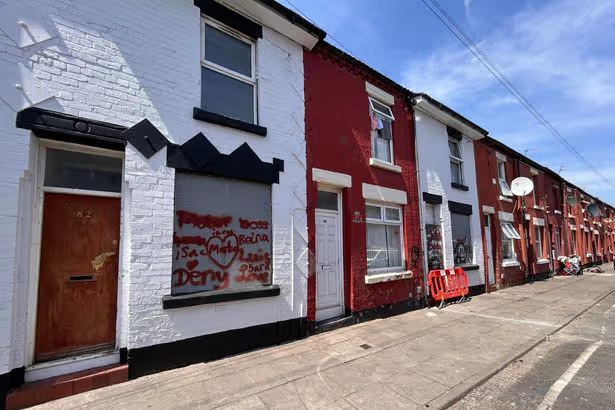
The Arundel neighbourhood of Liverpool, which lies off the northern end of Smithdown Road, has the highest rates of child poverty in the country
It’s a blisteringly hot day on the streets that lie off the northern section of Liverpool’s famous Smithdown Road. On each of the side streets, children are playing in the road, smiling as they shoot water pistols at each other or play chase. The doors of many of the homes are open as parents watch on, keeping an eye on their excitable offspring.
It’s a pleasant scene, the like of which Liverpool has experienced for generations, but one that masks a difficult truth. Parents in this area are at ground zero of a parenting crisis which is literally worse than anywhere else in the entire country.
Toward the top end of Smithdown Road, past the Toxteth Park Cemetery, lies Arundel Ward. The families who live here, are drawn from diverse backgrounds, and they live in cramped, shoddy housing next to derelict buildings, covered with metal shutters and graffiti.
Arundel Ward has a population of just over 3,500 people and according to the most recent data, the ward has the highest levels of child poverty, not just in Liverpool, but in the whole of the United Kingdom.
Official data shows that leading up to April 2025 757 children in the Arundel neighbourhood live below the breadline. This works out as over two-thirds (69%) of those under the age of 16 living in these streets.
The impact of these high levels of poverty are seen by Liz Parsons, who manages the nearby Picton Children’s Centre.
The Arundel neighbourhood of Liverpool, which lies off the northern end of Smithdown Road, has the highest rates of child poverty in the country
She says the data is skewed somewhat by a specific pocket of the Arundel ward where child poverty rates are especially high, adding: “There are areas of the city where you would see high child poverty rates ward-wide such as Everton, Kirkdale and Anfield – but that ward has a high concentration in one specific area.”
Giving some explanation for the numbers, she adds: “There is a high concentration of small terrace streets, lots of families living in close confinement. There is poor housing stock and high levels of Serco accommodation, so families that are new to the country.
“But I think in reality, if you are born in Liverpool, raised here in multi-generational families and have children, you are going to face challenges. We have got mortgage and rent increases, fuel costs increasing, high food costs. Look at the cost of baby milk, the cost of nappies, all of those things are factors, and I think it’s multi-faceted.”
Growing up in poverty is something Liz Parsons, who is also a Labour councillor, knows well. She says: “I was born on the field at the back of this children’s centre and we lived in a terrace street. We couldn’t afford wallpaper so my dad drew Mickey Mouse on the walls for us.
“I didn’t find out until I was older that my Christmas presents hadn’t been stolen. They had been sent back to the catalogue because my family couldn’t keep up with the payments. This was 50-years-ago so this has always been a community with these challenges of high concentration of housing, of families and young people trying to get a start.”
Working in a children’s centre, she is all too familiar with the ongoing impacts of the austerity era. She adds: “When I started working here 18 years ago, I’d never heard of food bank vouchers. And then probably about 10, 11 years ago, we started getting requests for food bank vouchers. It was shocking at the time that these requests were coming from working parents, but that is common now.
Picton Children’s Centre manager Liz Parsons
“You only have to look at health data to know that the long-term impact of children being raised on a diet of junk food, because it’s cheaper than healthy food. This will have a long-term impact potentially on their cancer rates, obesity rates, heart rates, diabetes. All of those issues that can be formed in the crucial first 1,001 days.”
It is important to say that since the latest data, several significant policy changes have been made. The most significant of these being the Labour government’s eventual decision to scrap the two-child benefit cap, which is expected to pull hundreds of thousands of children out of poverty.
“I’m really pleased the two-child benefit cap has been lifted,” says Cllr Parsons. “We now have a drop-in clinic at each of my three sites for benefits and welfare advice once a week. We have council teams working with us once a month at a drop-in to provide housing support, Citizens Advice are with us.
“I’m also pleased about the rollout free breakfast clubs. We’ve got a family that came into our welfare clinic that found after a simple check of what they were entitled to is now £3,000 a year better off. That’s huge.
“For an individual family, you can literally reverse that trend in days if you understand their situation and what they need to thrive.”
But with the war in Iran already pushing prices up higher, staff at the children’s centre know they will become even more of a lifeline for families in this area. They already keep nappies and baby wipes on site because of how often these items are requested and the centre works with partners to provide prams and buggies for desperate parents.
“I’m very concerned about the additional cost of living pressures coming our way,” adds Cllr Parsons. “It’s challenging and it feels very risky right now, but this is a city that thrives on helping people. We want to do anything we can to give people a little bit of breathing space.”
But is it enough for the families of Arundel ward and the many others across this city and this country who are seeing their children grow up in poverty?
For Professor David Taylor Robinson, a professor of public health at the University of Liverpool and an expert in this area, the answer is no.
The Arundel neighbourhood of Liverpool, which lies off the northern end of Smithdown Road, has the highest rates of child poverty in the country
He explains: “We saw the biggest rise in poverty over the austerity period of any OECD country, so it is going to take a huge effort to turn that around.
“So really the lifting of the two-child benefit cap was the bare minimum required. The government keeps saying it is going to lead the biggest reduction in child poverty over the course of a Parliament, which is great, but we are still only talking of these numbers coming down by a few percentage points.
“Even then we are still running a system with almost a third of our kids in poverty, which is not the level of ambition we should have.”
Speaking about some of the specific factors affecting the Arundel Ward, Professor Taylor-Robinson adds: “There is no doubt that there are lots of different layers of disadvantage. Almost half of all families from ethnic minority groups are in poverty, which is just crazy. It is a similar number for families where someone has a disability.
“We need a joined up strategy across different sections of government – including health – in order to really tackle this problem. It’s great that we have a strategy, but the investment we are seeing is not at the scale required to address the current challenge.”
The new data from the Department of Work and Pensions shows that across the country, a total of 2.43 million children under the age of 16 were living in poverty in the year ending April 2025. That’s before housing costs are even taken into account, meaning that nearly one in five children (19%) are living in poverty in the UK.
Secretary of State for Work and Pensions, Pat McFadden said: “This government is determined to turn the tide on poverty after years of rising hardship. The statistics show that effort is beginning to make a difference – household incomes have risen 5% in real terms, food bank usage has fallen, and food insecurity is down.
“But we know there is more to do. That is why we are raising the National Living Wage by up to £900 a year for a full-time worker, cutting average energy bills by £150 from April, and delivering our Child Poverty Strategy which will lift 550,000 children out of poverty by the end of this parliament.”