Listen to this article
Estimated 5 minutes
The audio version of this article is generated by AI-based technology. Mispronunciations can occur. We are working with our partners to continually review and improve the results.
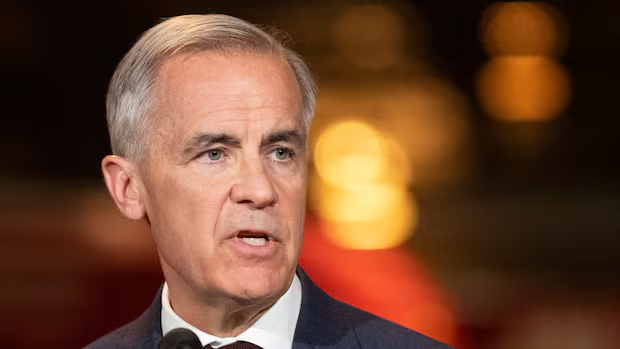
Prime Minister Mark Carney said his negotiating team made “some progress” during trade talks in Washington this week, but there’s “lots more to do” to land an overall agreement.
Carney’s comments on Thursday came as Canada-U.S. Trade minister Dominic LeBlanc and the country’s chief trade negotiator, Janice Charette, briefed a special advisory council for more than two hours about their meeting with U.S. Trade Representative Jamieson Greer.
Flavio Volpe, who sits on the advisory committee on Canada-U.S. economic relations, described the briefing as “very candid” and said the details suggest conversations are moving in the right direction.
“It appears that the instructions from the White House is find a way,” said Volpe, the Automotive Parts Manufacturers’ Association president. “Find a way to deal with the irritants in their relationship, but to remain in the relationship.”
Canada and Mexico recently wrote letters stating they want to renew CUSMA for another 16 years. The U.S. gave Canada its letter on Tuesday, but has not made public what it says.
Volpe said what he learned on Thursday points to the U.S. wanting to remain in CUSMA, but said there was not a “specific confirmation that yes” Trump’s administration would renew the trade pact.
Automotive Parts Manufacturers’ Association president Flavio Volpe speaks with Prime Minister Mark Carney earlier this year. (Eduardo Lima/The Canadian Press)
North America’s free trade deal is up for review on July 1. Volpe said the countries don’t see that date as a deadline but a moment to signal their intent — which they are already doing.
He noted that date could pass and CUSMA will remain in place in “full force.” If the three countries don’t unanimously agree to renew the free trade pact, it would trigger annual reviews.
The U.S. gave Canada its latest list of irritants on Tuesday which didn’t contain any “surprises,” Volpe said, and has consistently been shorter than the list the U.S. gave to Mexico.
He said the U.S. did not list the solutions it wants to see.
“I would suggest that the way that they’re being presented now is between parties that want to get somewhere together, rather than a first salvo in a divorce,” said Volpe.
The U.S. has said its irritants include Canadian provinces keeping American alcohol off the shelves, issues with Canada’s Online Streaming Act and what American officials have called “unfair” treatment of Montana power producers.
The government directed the CRTC on Wednesday to review a recent decision to increase funds streaming services like Netflix must contribute to Canadian content.
WATCH | Canada moves to broaden U.S. trade talks, renew CUSMA:
Canada moves to broaden U.S. trade talks, renew CUSMA
Canada-U.S. Trade Minister Dominic LeBlanc said a meeting with his American counterpart was positive, after the federal government moved to renew the Canada-U.S.-Mexico agreement and ramp up cross-border trade talks.
Last fall, when the U.S. called off trade talks with Canada citing Ontario’s anti-tariff ad, Volpe said the U.S. Trade Representative was taking his lead from the White House.
He said now it appears the White House is allowing Greer to do his work and report back.
The briefing with LeBlanc and Charette also noted Canada raised U.S. President Donald Trump’s ongoing “national security and emergency tariffs” with the U.S. team, Volpe said. Those tariffs are hitting a series of Canadian sectors.
Thursday marks one year since Trump doubled his “Section 232” tariffs to 50 per cent on Canadian steel and aluminum. The Canadian Steel Producers Association continues to call on the U.S. to remove the tariffs after shipments to the U.S. dropped by 60 per cent last year.
Candace Laing, president and CEO of the Canadian Chamber of Commerce, who is also on the advisory council, said the sectoral tariffs are the key issue for Canada.
“The biggest splinter on our side or thorn in our side is the 232 tariffs and finding our way to a reasonable place around that,” Laing told CBC’s Power and Politics.
WATCH | Carney says CRTC’s tax hike isn’t what Canadians need:
Carney orders CRTC to reconsider Cancon tax on U.S. streamers
Ottawa has directed the CRTC to review its recent decision to increase the amount of Canada-earned revenue that U.S. streaming giants must put toward Canadian content creation, as Ottawa gears up for difficult U.S. trade negotiations.
Laing said she has “a lot of optimism in finding our path forward,” but said that’s in the context that anything can happen.
“It’s a very unpredictable environment,” she said.
She said discussions are progressing with the U.S. about trade irritants and they need to see that through to move on to the next level of talks.
Conservative Leader Pierre Poilievre has long criticized Carney for getting elected on a promise to negotiate a trade deal with the U.S., but since then has been “losing, losing, losing,” he’s said.
Conservative MP Mark Strahl took aim at Carney on Thursday when asked about how he’s handling CUSMA.
“This government’s kind of been failing to make that a priority, even though Mark Carney said that they’d be the one to solve that problem,” Strahl said.
Global Affairs Canada released a statement Thursday saying that committee members continued to talk about the impact of Trump’s sectoral tariffs and his latest proposed levy over forced labour.
Last month, Carney said Canada has made specific proposals to the U.S. administration that include aluminum, automobiles and critical minerals.