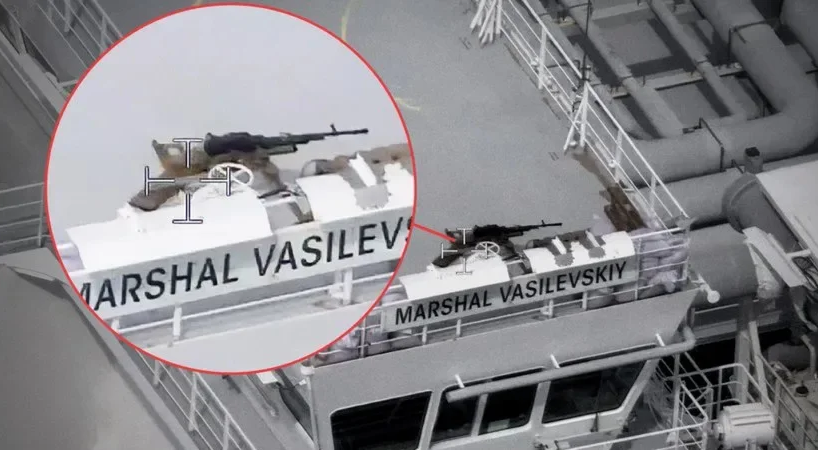
Russia has started arming its tanker ships with machine guns (Photo: Delfi Estonia)
Images captured by the Estonian Border Guard last month show a Russian tanker, the Marshal Vasilevskiy, operating in the Baltic Sea with two heavy machine guns mounted on either side of the deck above the bridge.
An Estonian border guard surveillance plane spotted the Russian LNG tanker as it was sailing past Estonia’s western islands and northern shore toward Russia’s Bolshoi Bor port in the Gulf of Finland.
Two sandbagged firing positions armed with 12.7mm Kord heavy machine guns were spotted aboard the ship.
Defense news outlet TWZ noted that the Marshal Vasilevskiy is not part of Russia’s shadow fleet, but has been subject to sanctions nonetheless. This appears to be the first direct evidence of Russia installing weapons on a civilian ship in the Baltic region.
The ship is owned by Russian state-controlled energy company Gazprom and regularly supplies Kaliningrad with natural gas. Four its voyages have been identified since August, 2025.
The guns on the Marshal Vasilevskiy were most likely intended to defend against Ukrainian maritime drones.
Ukraine carried out drone strikes on the Kronstadt Naval Base in St. Petersburg earlier in June, in what appears to have been the first strike of its kind against the Baltic Fleet.
“By targeting Kronstadt, Ukraine signaled the opening up of a new front in its drone war with Russia, namely against the Baltic Fleet while it is in port,” the article stated.
The Marshal Vasilevskiy is now Russia’s only floating storage and regasification vessel, a ship that takes on board super-cooled LNG and then converts it into gas that is then fed into pipelines, TWZ noted.
Defense analysts at TWZ argued that arming the LNG tanker with heavy machine guns sends a signal to NATO forces not to interfere with it, in addition to repelling potential drone attacks.
“With the Kord gun, the vessel could bring down a helicopter with ease, forcing a boarding force to kinetically attack the ship before attempting boarding,” TWZ wrote.
The outlet noted, however, that the crew of a vessel such as the Marshal Vasilevskiy would not be trained to operate heavy machine guns, which raises the likelihood that the ship’s crew includes members of the Russian military or, more likely, the Federal Security Service (FSB).
It is also possible that man-portable air defense systems (MANPADS) could also be stowed below decks to defend against UAV attacks.
Strikes on St. Petersburg and Russia’s Baltic Fleet
An overnight drone attack on St. Petersburg on June 3 ignited several blazes in the area, with one fire breaking out three kilometers from the venue that was hosting the St. Petersburg International Economic Forum, where Russian dictator Vladimir Putin slated to speak on June 5.
Soon after, Denis Shtilerman, co-owner of Ukrainian Fire Point drone manufacturer, announced that Ukrainian Defense Forces had struck two Russian ships during the attack on St. Petersburg.
Unmanned Systems Forces Commander Robert “Madyar” Brovdi confirmed that the strikes mainly targeted a Russian patrol corvette, the Boikiy, which was armed with guided missiles.
Ukraine’s Security Service (SBU) confirmed the strikes on Russian ships in the Kronstadt naval base and the St. Petersburg oil terminal.
“A strike was carried out at the mooring site of warships in Kronstadt,” SBU reported.
“The results of the attack and the scale of damage inflicted on the enemy are now being clarified.”
The agency added that at least four separate large fires were recorded at the struck oil terminal.
Boikiy corvette was undergoing repairs in Kronstadt. It is a relatively new vessel, having been commissioned in 2013.
Follow us on Twitter, Facebook and
Google News