The Australian Space Agency kicked off Australian Space Week on Sunday with a new event aimed at inspiring young people to pursue a career in space exploration.
The inaugural Space Day Out was held at the Australian Space Discovery Centre in Adelaide’s Lot Fourteen precinct and attracted around 2,000 people.
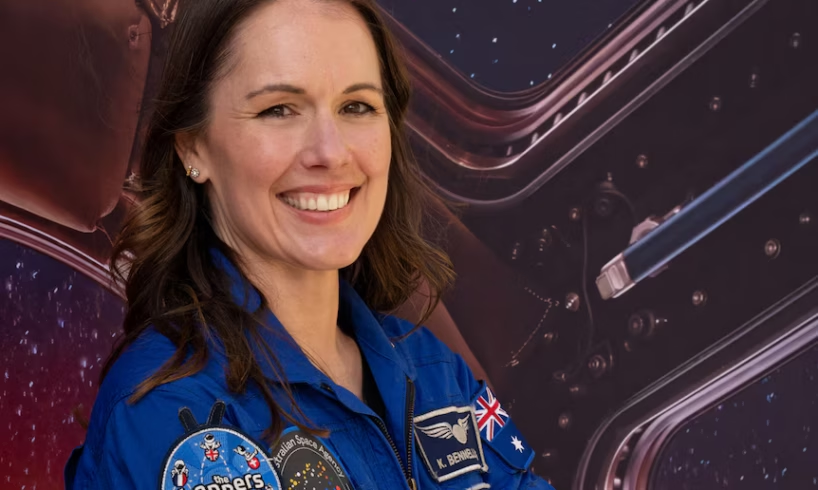
Many had a close encounter of the hero kind when they met Australian astronaut and special guest Katherine Bennell-Pegg.
Nine-year-old Chase Iannuzzi from Melbourne was gifted the day out for his birthday and said he was excited to travel to Adelaide because he wanted to see “an actual real” astronaut.
That dream came true when he met 2026 Australian of the Year Ms Bennell-Pegg on Sunday.
“It was just so exciting,” Chase said. “I’m really, really, really into space. Like, super. I have space Lego, space pictures … I think it’s awesome. I really want to be the first person to go to Mars and Pluto.”
Chase wants to visit Mars and Pluto.
Young fan and aspiring astronaut Alice also had stars in her eyes when she met Australia’s first female astronaut.
“When I grow up I want to be an astronaut,” Alice said. “I have since I was three. My biggest dream is going to space and walking on the moon.”
She said Ms Bennell-Pegg loved the pink-and-white astronaut costume she wore to the event.
“It was really fun,” Alice said. “I asked if she was a lefty or a righty, and she’s a righty [handed].”
Nurturing the next generation
Ms Bennell-Pegg emphasised the importance of inspiring young people in STEM (science, technology, engineering and mathematics) fields.
“Right now in Australia, we’re leaving too much talent on the launch pad,” she said.
“We’re seeing the lowest-ever enrolments in Year 12 physics across the country and the lowest-ever enrolments in intermediate maths and in higher maths, and this at a time where we have so many issues facing us as a nation and globally.
“What I’ve seen since I’ve come back from astronaut training and got out and about across Australia is how space is a magnet to keep young people engaged with science and maths.
“It gives them something to aim for and that drive to get through the hard parts to a compelling breadth of different careers in STEM.”
Ms Bennell-Pegg said her focus for now was on speaking to young people and exciting them about space.
“Also, remaining match-fit for space, should that opportunity ever arise.”
She highlighted Australia’s engagement with the European Space Agency and the potential benefits for the nation’s scientists and engineers.
“I’m excited not just for me, but for what it could do for our scientists, our engineers, and our future workforce,” she said.
“But right now, my focus is on the ground. Most of an astronaut’s career is on the ground, training and preparing for space.”
Aspiring astronaut Alice had stars in her eyes when she met Australia’s first female astronaut. (ABC News: Luke Pike)
Economic impact of reaching for the stars
Chris Picton, SA minister for defence and space industries, said space was pivotal to the state’s economy across several sectors.
“Whether that’s defence industries, whether that’s agriculture which relies on space, but of course telecommunications as well,” Mr Picton said.
“Space is becoming more important, and we want to be at the forefront of that here in South Australia. Having the Space Agency [and] having some of these key companies here in our state really give us the leading edge.”
The head of the Australian Space Agency, Enrico Palermo, said space was critical to the nation’s economy, defence, and understanding of navigation and weather systems.
“Today is a chance for young and old to engage with space, understand that criticality but also be inspired at a time when we really need to boost the number of students entering higher degree mathematics and physics,” Mr Palermo said.
“South Australia is one of the leading growth states in terms of our space economy in Australia.
“In recent years, we’ve seen more than $75 million underpinned by investments by the National Reconstruction Fund.”
He said the state had deep roots in the space sector, including Australia’s first flights to space from the Woomera test range.
He also pointed to the importance of Lot Fourteen-based businesses, including satellite telecommunications company Myriota, and Southern Launch, which operates the Koonibba Test Range.
“That initial crucible of space startups started here in South Australia,” he said.
Enrico Palermo says space is critical to the nation’s economy, defence, and understanding of navigation and weather systems. (ABC News: Lincoln Rothall)
Close encounters of the aspirational kind
Mc Bennell-Pegg said one of the most common misconceptions about space was that it was a “nice to have”.
“Whereas it’s actually a ‘need to have,'” she said.
“Space underpins our modern economy, our daily life, the breadth of science, and also prepares for our future by exciting young people about their futures in STEM.”
She knows the power of a meet-and-greet all too well. During childhood, meeting her idols made space feel within reach.
“Becoming an astronaut was a childhood dream,” she said.
“I remember growing up and having the chance to meet Paul Scully-Power and Andy Thomas, two Australians that have been to space but representing other nations.
“It was really impactful for me to see that they’re just real people that had worked hard towards a dream and managed to get there.”