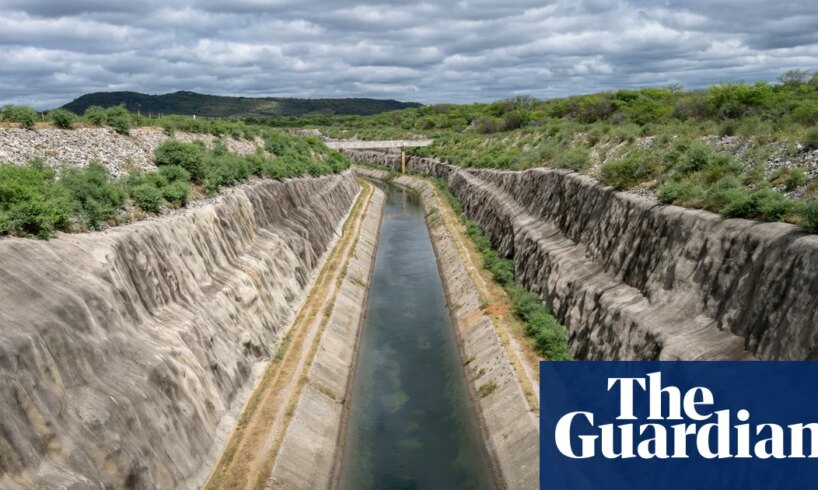
A concrete canal cutting through the Caatinga scrubland feeds a surface reservoir two and a half miles from Maria de Fátima Ferreira da Silva’s home in rural Brazil. The canal passes Sertânia and continues until it reaches Monteiro, the next town along, where it spills its precious cargo into the bed of the Paraíba River – a human-directed inflow into the seasonally dry waterway.
Such proximity to a reliable water source would usually be considered a blessing in the sertão, a vast outback in Brazil’s north-east known for its punishing droughts. But not for Ferreira, who was displaced nearly 20 years ago by the construction of the canal and now lives in a house without any water supply, despite the nearby reservoir.
“There’s no water; what are we supposed to do without water?” says the 54-year-old, who depends on what she can grow on her smallholding.
Maria de Fátima Ferreira da Silva in her maize crop at Salão productive rural village. She bathes at the reservoir and collects water there for her smallholding and donkey, and pays to fill her barrel with drinking water each month
The canal and reservoir are part of a big hydrological supply system billed as the solution to the sertão’s water scarcity: the diversion of the 1,700-mile-long São Francisco River, the longest river running entirely on Brazilian territory and the source of 70% of the north-east region’s water supply.
The ever-present threat of drought in the sertão is only likely to increase with the climate crisis, which accelerates desertification and is already driving a shift to a hotter, drier climate in this region. While programmes such as Water for All and One Million Cisterns have improved water access across the north-east, the São Francisco diversion does so at scale, providing water security to 12 million people, the government says.
But nine years after the canal first brought water to Monteiro, some continue to question the scheme’s success – particularly for the communities that were the most affected by the infrastructure project but feel its benefits the least.
“In my view, the diversion has not been beneficial. It caused immense damage to the donor basin while yielding little effectiveness for the sertão,” says Janaína Andrade, a regional prosecutor for citizen rights, who acts like an ombudsman in Paraíba state, where Monteiro is located.
double quotation markSome people don’t remember what it was like in the past: we were vulnerable, we were thirsty, it was difficultAgnaldo Freitas da Silva, Vila Lafayette residents’ association
Lula has a personal interest in easing the water insecurity in the sertão, having migrated from there as a child.
Ana Paula Pires Koga, a geography professor at the Federal University of Catalão, who has studied the project, says: “In his first term, in 2006, Lula made the diversion part of the growth acceleration [infrastructure] programme.” The president talked about “quenching the thirst of the sertanejos”, she adds.
Construction of the £2.1bn ($2.8bn) river diversion scheme, which began in 2007, required the expropriation of about 2,000 properties to make way for the infrastructure required to move enough water to feed rivers and reservoirs across four states: two main canals, each more than 130 miles long, hundreds of miles of secondary canals, as well as tunnels, aqueducts, pumping stations and electricity substations.
The 848 most vulnerable families were relocated to 18 planned neighbourhoods known as “productive rural villages” (VPRs), such as Vila Salão, where Ferreira lives. Each family was given a three-bedroom house and a few hectares of land as part of a compensation package that also includes financial support.
Yet Vila Salão is a far cry from the government’s vision of VPRs as communities connected to running water and sewage services, equipped with a health centre and a school, and receiving enough water to irrigate one hectare (2.5 acres) for each family. The houses in Vila Salão are not connected to the water mains, and the communal buildings stand abandoned in the centre of the grid-shaped neighbourhood.
Maria de Lourdes Souza da Silva at home in Lafayette village in Monteiro, where the arrival of water allowed her to grow a range of fruit, vegetables and other crops
Andrade says: “People were relocated to the productive village – but without water. They had no water for human consumption, for their livestock or for agricultural production.
“All these people who were relocated had artesian wells and were self-sufficient. They were taken to a territory without means of production and became dependent on benefits,” she says.
That has been Ferreira’s experience. Some of her neighbours in Vila Salão have dug a well, but she cannot afford to do so. So she goes to the reservoir to bathe and collect water for her modest crops and donkey, and pays to have a 1,000-litre barrel filled with drinking water every month. “Things were better before,” she says.
Even in Vila Lafayette, a VPR up the road in Monteiro with better living conditions, there is a persistent sense of loss among the uprooted people.
“I can’t complain,” says Maria de Lourdes Souza da Silva, 64. But she remembers how, 17 years earlier, her mother was taken ill after being told she had two weeks to leave the home she had spent a lifetime building. Her mother died shortly afterwards.
“I just wasn’t that happy [about moving] because I lost my mother and the place where we lived in the process,” Souza says. “That was where we were raised, where our roots were.”
“We’re trying to put down new roots,” she adds, sitting among pots of desert roses on her porch.
With the diversion works concluded – albeit after long delays amid abandoned projects and cancelled contracts – the federal government considers it has done its part, although Lula continues to inaugurate various additional sections of the project since returning to power in 2023.
“Some cities are feeling tangible benefits, but the big question is about water reaching the populations scattered across the semi-arid region,” says Pires Koga.
The ministry of development and regional integration refused an interview and did not directly answer questions. It simply said that its responsibility was limited to transporting the water and that distribution to citizens and community relocation were “the exclusive responsibility of operators and state and municipal administrations”.
In Vila Lafayette, the persistence of the residents’ association, with support from Andrade’s office, made it the first VPR to be connected to mains water and, last year, to receive the promised water for irrigation.
Irrigated fields, most planted with maize, at Lafayette village. The crops are fed with water from the São Francisco River
Agnaldo Freitas da Silva, who is vice-president of the residents’ association, says: “I went knocking on the door of the state assembly, and I took part in their public hearings. I said: ‘I’m not going to let it go; the state government has to give us water. We can’t stay in this situation.’”
Freitas, 52, hopes to install solar panels to reduce the community’s energy costs for pumping the irrigation water from the canal. The school, which was never staffed, has been converted into a cold-storage facility where dairy farmers can keep their milk before it is sold.
It has not been easy, Freitas says, but he is satisfied with the life he has made for himself. He keeps chickens and has fish tanks, as well as growing fruit and vegetables that he sells through a government programme to support family farming.
“Some people don’t remember what it was like in the past: we were vulnerable, we were thirsty; it was difficult. Today we’re all rich; we have what we need,” he says.
Edileuza dos Santos Leite and her husband, José Ricardo Leite, outside their home in Salão, Sertânia. The village has yet to receive any water from the São Francisco River project, which Edileuza blames on a lack of local unity
The residents of the shabbier Vila Salão, 17 miles away, have not been so lucky, because they have not managed to pull together, says Edileuza dos Santos Leite, 55. “People aren’t united here,” she says.
She hopes the state governor, who is running for re-election this year, will fix things. “God willing, we’ll have water soon,” she says.