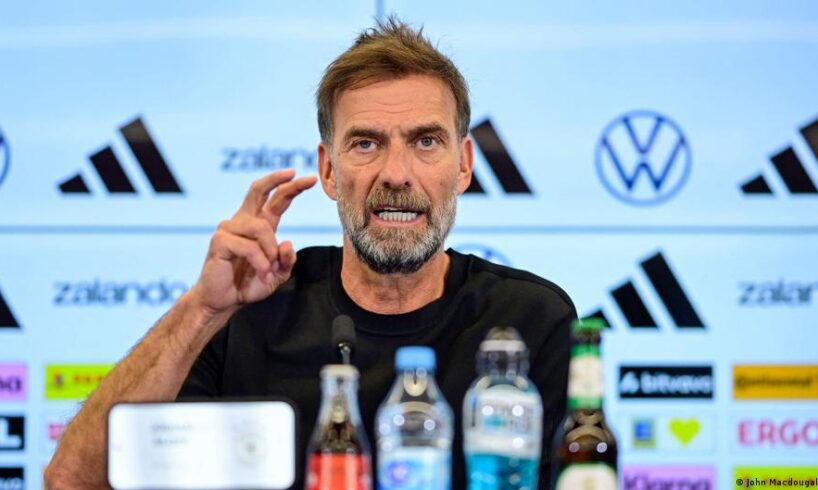
Jürgen Klopp had long been the overwhelming favorite to become the new head coach of Germany’s national football team. On Friday, the German Football Association (DFB) made his appointment official.
DFB President Bernd Neuendorf announced at a press conference in Frankfurt that Klopp had signed a contract that would see him remain Germany coach through the 2030 World Cup. He is to officially take up the post on August 15.
“It is a great honor to sit here,” Klopp said. “I had an idea how big the job is, but when you are directly involved, you feel the responsibility even more. It is a very special day for me.”
At the same time, the new Germany coach, who often appears light-hearted in public, appeared to issue a stern warning to the gathered reporters.
“On the day you don’t want me anymore, tell me and I’m gone,” he said. “If you misbehave and don’t leave my family alone, I’m gone.”
Rudi Völler stays on as sporting director, but there are changes to the coaching staff. Two former Klopp colleagues in Peter Krawietz, who was Klopp’s assistant manager at Borussia Dortmund and Liverpool, and Pep Lijnders, who was with Klopp at Liverpool, have joined the 59-year-old head coach. Former Bundesliga player and Germany international Sven Bender is also part of the staff.
Unsusual is that Klopp’s agent, Marc Kosicke, has been handed a position in the new Germany set-up. The 55-year-old is to be responsible “for strategy, development and innovation.” Klopp said he needed his close confidant because although playing good football is the priority, “we must also change lots of other things. We need people who can do this alongside me.”
Technically, Kosicke will be an “an external consultant,” not a DFB employee.
Former Germany defender Per Mertesacker, who spent eight years running Arsenal’s youth academy, is to succeed Andreas Rettig as the DFB’s managing director for sport in January. Rettig had previously announced that he would be stepping down at the end of the year.
The obvious choice
For years, the charismatic Klopp had been seen as the ideal candidate. In recent weeks, he had been the boss-in-waiting, following Julian Nagelsmann’s departure after Germany’s disappointing performance at this summer’s World Cup in North America.
This was the third consecutive World Cup that has ended in disappointment for Germany, with two group-stage exits and the knockout defeat to Paraguay in the round of 32 on June 29. Euro 2024 was more positive, but generally Germany have not enjoyed a successful tournament since Euro 2016. For a four-time World Cup winner and a three-time European champion, a decade-long span of disappointment sits far below expectation.
Jürgen Klopp’s cheeky manner on TV during the 2026 World Cup brought him even closer to the German jobImage: Marco Bader/HMB-Media/IMAGO
A candidate in waiting
Klopp’s approach to the Germany job has been a long time coming. Even as far back as late October 2024 when he took the job as “Head of Global Soccer” for Red Bull, there were reports that either his contract included a clause allowing him to become Germany head coach in the future or he had a gentleman’s agreement to do the same.
And during this summer’s World Cup, his role as a pundit for MagentaTV seems to have moved him ever closer to the job. His analysis was seen as on point, but Klopp caused a stir when he said, “Luckily, it’s Julian Nagelsmann who’s picking the team. For now.” Those two words hung over Nagelsmann, and even though Klopp apologized, it almost felt like he knew his time was fast approaching.
After the loss to Paraguay, Klopp continued to distance himself from the job, saying it wasn’t time to talk about that.
“When the next tournament comes around and whoever is head coach is asked, what is your goal? If they don’t say ‘European champion,’ then people will say, ‘Have you got no ambition? We are Germany!’ No, we were football Germany. In order to become that force again, we’ve really got to give it our all,” Klopp said on MagentaTV.
Klopp had been providing “strategic vision and support” as well as helping “coaches develop” in his job at Red Bull. However, his role in the dismissal of RB Leipzig head coach Ole Werner after just one season has been seen critically in the media. Werner guided RB Leipzig to third place in the Bundesliga and returned the club to the Champions League.
The real Jürgen Klopp
To view this video please enable JavaScript, and consider upgrading to a web browser that supports HTML5 video
A popular figure
His success in the dugout combined with his warm, funny character has made him a fan favorite in most places in Germany. After playing in Mainz, he guided the club to the Bundesliga for the first time. His departure was emotional, as both Klopp and many of the crowd shed tears.
At Borussia Dortmund, he won back-to-back Bundesliga titles, and took the club to the Champions League final in 2013. More recently, he spent nine years with Liverpool, where he delivered a first league title in more than a quarter of a century, as well as glory in the 2019 Champions League final. He has a history of leading clubs with strong working-class roots to success, allowing him to maintain a bond to the core values of the clubs in question. In combination with his holistic style of coaching, Klopp is seen as one of the best coaches in the world.
During his break from coaching, Klopp was awarded the highest civic award in Germany as a result of his outstanding contribution to democracy and his impact on the football world. He was credited with becoming a role model, a football ambassador and someone who has improved the image of Germany around the world, particularly in the United Kingdom.
Recently, his face has been hard to miss. Famous for being in a raft of adverts, Klopp has cemented his status as one of the most famous Germans rather than just a great football coach from Germany.
Jürgen Klopp has changed the way many people around the world think about GermansImage: Metodi Popow/IMAGO
Could Klopp lead Germany to Euro 2028 glory?
With Euro 2028 in the United Kingdom and Ireland, Klopp will be familiar with many of the stadiums and the way football works in the country. He will have a long run-up at the title, though.
His first game in charge of Germany will be in Amsterdam on September 24 against the Netherlands in the Nations League. This will mark the start of a new format of international break. Unlike in previous years where there have three two-week international breaks in September, October and November, the 2026-27 season will see September and October’s breaks merge into one. November’s will be the same.
This means Klopp’s first time in charge of the team would be for a three-week break in late September, which will see Germany play Greece in Augsburg three days after the Amsterdam game. Four days after that, Germany will play Serbia in Munich before closing out the international break in Thessaloniki against Greece on October 4. This longer break will offer Klopp a chance to hit the ground running and generate a real clarity over his playing style and who the core of his Germany team will be.
With Klopp in charge, there will be no stopping Germany fans daydreaming of what their team will look like in the not-too-distant future. Heavy metal football, as Klopp once famously described his style of play, might well be on the way for a team that is currently out of tune.
This article was originally published on July 3, 2026. It was updated on July 24, 2026 with the official announcement of Jürgen Klopp’s appointment as Germany coach.
Edited by: Chuck Penfold