Shafaq News
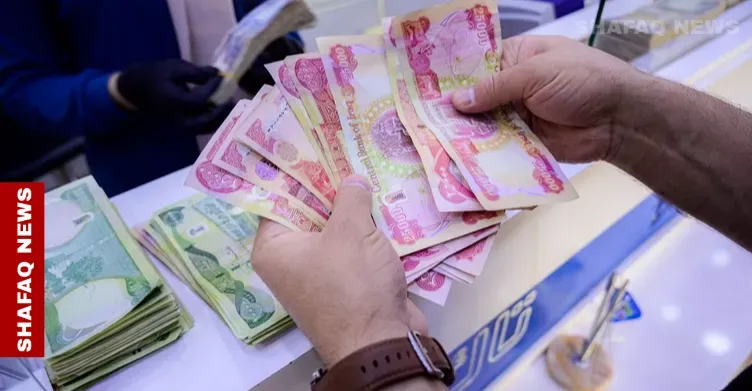
Iraq’s banking sector has entered a
sensitive phase as liquidity declines and financial commitments expand, raising
fears of delayed salary payments in the coming period and placing government
institutions under mounting fiscal pressure.
Parliamentary and economic voices warn
that the gap between government spending and oil revenues is widening, pushing
the country toward a difficult financial environment that directly affects
citizens’ daily lives.
This December, salaries for government
employees were delayed beyond their usual schedule due to liquidity shortages
at state-owned banks. Retirees experienced similar delays as banks struggled to
release their payments on time. According to informed sources, banks are
finding it increasingly difficult to secure the required cash, forcing several
days of postponement and creating concerns that the crisis could repeat in the
coming months if liquidity issues are not resolved swiftly.
Salary Delays
Economic expert Durgham Mohammed Ali said
the current situation stems from a higher-than-expected budget deficit, as the
budget was drafted based on an oil price that did not materialize.
He told Shafaq News that this increased
the deficit and placed pressure on treasury transfers sold by the government to
banks through domestic borrowing instruments.
Ali explained that this reduced the
deposits available for investment in treasury transfers, weakening banks’
ability to lend to the government and pressuring the state’s large operational
commitments, especially with oil revenues coming in 25% lower than projected.
He added that the situation has created
administrative delays in salary coverage, noting that “other excuses fall
outside economic reasoning and into purely administrative causes.”
Teachers and public employees across Iraq
have launched widespread protests over delayed salaries, low wages, and stalled
allowances, expressing mounting frustration with deteriorating living
conditions.
Tensions have risen further as salary
payments for some security forces were recently disrupted due to external
pressure affecting state banking channels. The crisis has been sharpened by a
severe liquidity shortage at Al-Rafidain Bank, which left thousands of retirees
without their December pensions. This banking failure has intensified public
anger and eroded trust in the government’s ability to safeguard wages.
Financial and banking expert Mahmoud
Dagher said, “Salary payments cannot be stopped, even if it requires external
borrowing.”
In an Interview with Shafaq News, he said
that protecting employees’ rights and ensuring timely salary disbursement
remains “an absolute priority,” regardless of financial pressures.
“93T Dinars Frozen”
Economist Mohammed al-Hasani said most of
Iraq’s monetary mass—93 trillion Iraqi dinars (Approx B72.5B) out of a total 99
trillion—is stored in private homes rather than in the banking sector.
“This reflects weak public trust in local
banks and has pushed vast sums of money out of economic circulation, worsening
the liquidity crisis,” he added.
Al-Hasani told Shafaq News that Iraq’s
fiscal policy “has entered a state of inability” to regulate local currency
supply, secure dinar liquidity, and meet internal obligations such as salaries
and operational spending. He described the situation as “an early warning sign
of negative effects that could impact the entire national economy.”
He called for urgent measures to restore
trust in Iraq’s banking sector, attract household cash deposits into the
system, strengthen customs and tax revenues, combat corruption, and reduce
expenditures.
Data from the Central Bank of Iraq shows
that about 87% of the country’s total cash supply—95 trillion dinars (Approx
$72.5B) out of 109 trillion—remains outside the formal banking system.
Roughly 80% of Iraq’s operating budget
goes to salaries for more than seven million employees and retirees.
Financing Expenditures
Mudhir Mohammed Saleh, the financial
adviser to the caretaker prime minister, said Iraq’s legal framework grants the
Ministry of Finance broad flexibility in managing liquidity inside state
institutions.
He said this allows the government to
rotate cash without undermining the solvency of state-owned banks or the
structure of the financial system.
Speaking to Shafaq News, Saleh noted that
without an active legislature, the government holds no constitutional or legal
authority to conduct sovereign borrowing, either domestically or
internationally.
However, he said the law allows the use of
short-term treasury advances funded exclusively by state-owned banks as part of
liquidity management, and that these do not constitute sovereign borrowing in a
legal sense.
He emphasized that these advances are the
country’s only legal tool to maintain essential government spending until the
legislature regains its constitutional authority to issue financial laws.
Collapse of Rafidain Bank Assets
Under these conditions, a well-informed
source revealed that the state-owned Rafidain Bank has faced repeated liquidity
crises, the latest of which caused delays in releasing pension payments.
The source told Shafaq News that the
situation has raised serious questions about the fate of the bank’s liquidity
over recent years, especially given the substantial resources it once held.
He said Rafidain’s assets had previously
exceeded 20 trillion dinars but have now dropped to around 1 trillion dinars—or
even less—according to his account, though these figures could not be
independently verified.
The source added that the responsibility
now lies with oversight institutions, including the Integrity Commission and
the judiciary, to launch a full investigation into the bank’s financial management,
spending, and current asset levels in order to safeguard public funds.
These warnings come amid rising concerns
over Iraq’s expanding financial challenges, particularly with the announcement
that domestic debt has reached around 90 trillion dinars (nearly $69 billion),
the highest level in the country’s history.
Will the Lebanese Scenario Repeat itself
in Iraq?
Observers interviewed by Shafaq News note
several similarities between Iraq’s current financial landscape and the early
stages of Lebanon’s economic collapse.
One indicator is the emerging gap between
bank-issued dollar rates and the real prices on the parallel market.
They also point to a precedent from
Lebanon: the collapse of a major bank after it was sanctioned by the United
States—an event that served as an early alarm before the wider crisis.
In Iraq’s case, there is a fear that the
liquidity troubles at Rafidain Bank may represent a comparable warning sign.
Given Iraq’s heavy dependence on oil
revenues, some hope that higher global oil prices could ease financial
pressures. However, caution persists that such relief would be temporary and
cannot provide a sustainable solution.
Written and edited by Shafaq News staff.