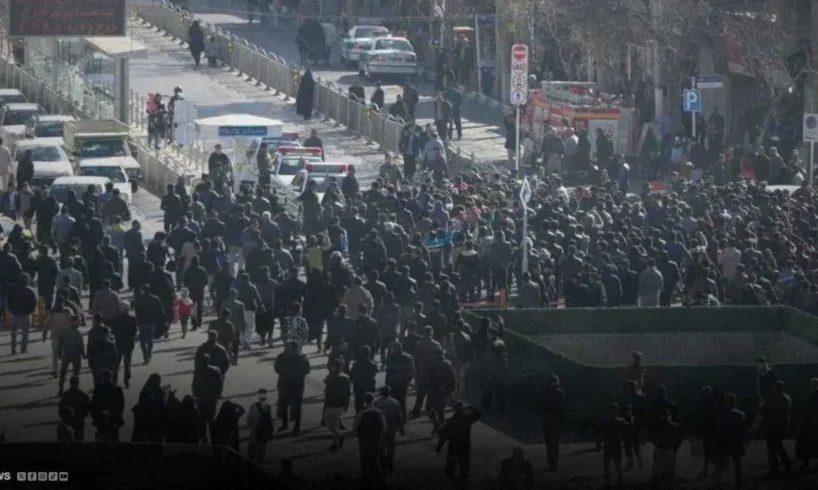
Shafaq News
Iran’s latest wave of protests has
unfolded at the intersection of acute economic distress, contested narratives
of legitimacy, and heightened regional and international scrutiny. While
demonstrations were triggered by the rapid collapse of the national currency
and mounting cost-of-living pressures, the state’s response —and the
counter-narratives advanced by international actors and rights groups— has
turned the unrest into a broader test of governance, credibility, and control.
Iranian officials uniformly frame the
protests as a reaction to economic hardship rather than a political revolt. The
sharp depreciation of the rial, which slid to record lows on the parallel
market, trading at roughly 1.74 million rials per dollar, disrupted commercial
activity and eroded purchasing power, particularly in urban markets. Traders
and shopkeepers, especially in Tehran’s Grand Bazaar and mobile phone markets,
emerged as early participants, protesting currency volatility, import
disruptions, and sudden price hikes.
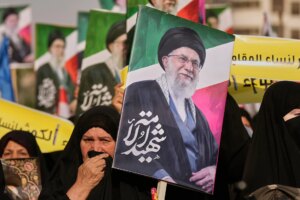
Supreme Leader Ayatollah Ali Khamenei
publicly acknowledged these pressures, describing the fall of the rial as a
serious disruption to business and daily life. However, he rejected the idea
that the protests reflected systemic political rejection, instead attributing
the “unnatural” currency surge to hostile external actions. Within this
framing, economic grievances are real and legitimate, but their escalation into
unrest is portrayed as engineered rather than organic.
President Masoud Pezeshkian has adopted a
more conciliatory tone. Through government spokesperson Fatemeh Mohajerani, he
instructed ministries to open channels of dialogue with protesters and urged
security forces to avoid force against peaceful demonstrators in an attempt to
contain unrest without conceding political ground.
A central feature of official messaging is
the strict distinction between peaceful protesters and what authorities label
as violent infiltrators. Iranian media and security institutions have
highlighted incidents in which police officers and a Basij member, Ali Azizi,
affiliated with the Islamic Revolutionary Guards Corps, were killed during
clashes. These cases are presented as evidence for the authorities that parts
of the protests crossed into armed violence, involving knives, firearms, and
attacks on public buildings.
Parliamentary voices echo this narrative.
Ebrahim Azizi, head of the National Security and Foreign Policy Commission,
argued that “hostile actors sought to exploit economic grievances through
external coordination and funding.” He claimed that merchants ultimately
distanced themselves from unrest, limiting its spread.
Yet Azizi also issued a notable warning:
relative calm should not be mistaken for public satisfaction, criticizing the
draft 1405 budget for 2026 for “failing to prioritize livelihoods, healthcare,
and security,” implicitly acknowledging that the economic roots of discontent
remain unresolved.
Foreign involvement, especially from the
United States, features prominently in Tehran’s framing. Iran’s Foreign
Ministry accuses Washington of deliberately provoking unrest through rhetoric
aligned with “maximum pressure” policies and sanctions. From this perspective,
economic protests become a vulnerability exploited by external adversaries
rather than an indictment of domestic governance alone.
Armed Forces Commander Amir Hatami said
the rapid transformation of demonstrations into unrest did not reflect Iranian
society’s awareness, attributing escalation to “hostile planning.” He stressed
that economic demands have no connection to foreign leaders.
Washington, however, has inserted itself
directly into the narrative. President Donald Trump cautioned that Washington
was prepared to intervene militarily if Iranian authorities used lethal force
against peaceful demonstrators.
A US State Department spokesperson told
Shafaq News that President Donald Trump warned Iran against resorting to lethal
force, threatening a strong response if protesters were killed. The
spokesperson described the demonstrations as reflecting “understandable anger”
over the government’s failure to deliver a better life, language that sharply
contrasts with Tehran’s emphasis on foreign manipulation.
One of the most contentious aspects of the
unrest is the human toll. Iranian authorities have not released comprehensive
nationwide figures for casualties or arrests. Instead, state media such as Fars
News Agency and Tasnim News Agency have selectively reported on incidents
involving security personnel, emphasizing targeted attacks on the state.
In contrast, the US-based organization
Human Rights Activists in Iran (HRANA) reports a far higher toll: at least 36
deaths, including two police officers, and more than 2,000 arrests. HRANA
claims protests occurred in 285 locations across 92 cities in 27 provinces. The
group also alleges raids on medical facilities treating wounded protesters and
notes that internet restrictions have hampered independent verification.
Reuters cites independent monitors
estimating dozens of deaths and thousands of detentions, while noting the
absence of official nationwide data. Amnesty International and Human Rights
Watch have not issued protest-specific totals but situate the unrest within a
broader pattern of concerns over excessive force and arbitrary detention in
Iran’s past protest waves.
At street level, the protests’ character
appears fluid. Iranian state media interviews with traders emphasize economic
demands —currency stability, price controls, and market predictability— and
reject political motives. Some merchants told state outlets that “rioters”
intervened in peaceful gatherings, provoking clashes and introducing
confrontational slogans.
International reporting paints a more
complex picture. Agence France-Presse reports that while economic frustration
dominates, some demonstrations have included slogans calling for political
change or the overthrow of the ruling system, particularly as protests spread
beyond commercial centers.
Most observers agree on the sequence, if
not the interpretation: economic shock triggered the protests, but in certain
locations, economic anger intersected with deeper political dissatisfaction.
Whether this represents a marginal escalation or a potential shift in
trajectory remains a point of dispute.
The result is a landscape of parallel
narratives. Iranian authorities frame the unrest as a dual challenge:
legitimate economic grievances requiring dialogue and policy fixes, alongside
organized violence fueled by foreign interference that demands firm security
measures. Human rights groups and opposition voices, by contrast, emphasize
civilian harm, mass arrests, and political repression, arguing that the scale
of detentions reflects a broader crackdown.
What remains clear is that currency
instability and declining living standards lie at the heart of the unrest. Less
certain is how far economic protests can be insulated from political meaning in
a context where trust in institutions is fragile and external pressure is
constant. As Iran navigates this moment, the balance it strikes between
economic reform, controlled engagement, and coercive enforcement will shape not
only the immediate trajectory of the protests but also the durability of the
state’s claim that the streets are demanding relief, not regime change.
Read more: Trader protests reshape Iran’s crisis while US signals grow sharper
Written and edited by Shafaq News staff.