Editor’s note: This is a developing story and is being updated.
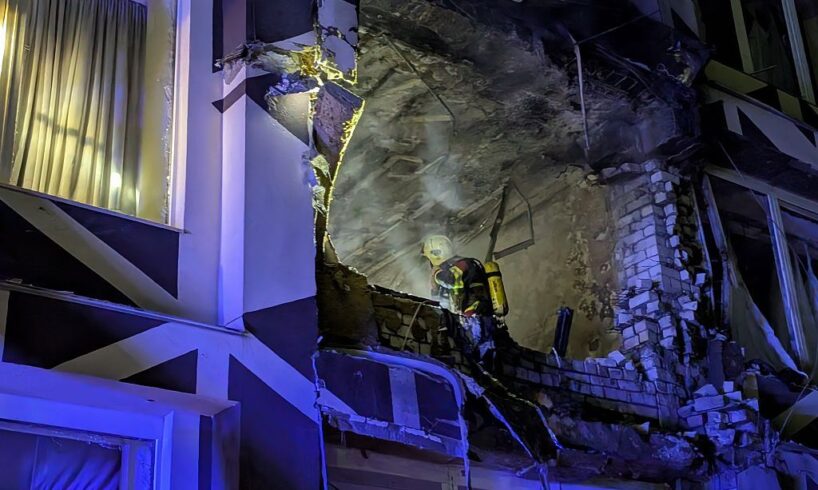
Four people were killed and 19 others injured in Kyiv after Russia launched a mass missile and drone attack across Ukraine overnight on Jan. 8-9.
A paramedic was among those killed as a result of a double-tap strike, and 14 of the 19 wounded were hospitalized, Kyiv Mayor Vitali Klitschko reported.
“One paramedic died, and four were injured while assisting people, in the Darnytskyi district,” he said.
Several neighborhoods in the capital were affected, including the Dniprovskyi and Darnytskyi districts.
Authorities said residential buildings in the Pechersk and Desnianskyi districts sustained damage from drones and falling debris, and a fire reportedly broke out in the Shevchenkivsky district.
Explosions were first reported in Kyiv around 11:45 p.m. local time as air defense systems engaged aerial targets, according to local officials. Earlier, the air force had warned of a ballistic missile threat and reported drones heading toward the capital.
Another nationwide missile threat was issued around 2:13 a.m. local time after Ukraine’s air force detected Russian fighter jets taking flight.
Additional cruise missile explosions rocked Ukraine’s capital at about 3:00 a.m. local time, a Kyiv Independent journalist on the ground reported as Russia continued its overnight attack.
A residential building in Kyiv’s well-known Comfort Town apartment complex reportedly had a fire burning as a result of the attack, according to local media.
Running water and electricity have been disrupted in parts of Ukraine’s capital as a result of Russian strikes on critical infrastructure, Klitschko said.
“In the Darnytskyi district, a drone crashed in the courtyard of a residential building. A one-story store nearby and the windows of a nearby nine-story residential building were partially damaged,” he said.
In the Dniprovskyi district, fires burned in two residential buildings, Klitschko reported.
Shockwaves damaged the roof of another residential building, and drone debris fell on a children’s playground, he added.
“In the Pechersky district, as a result of drone debris falling, the facade of a nine-story residential building was partially destroyed. A non-residential multi-story building was also damaged,” Klitschko reported.
In Kyiv’s Desnyansky district, the territory of a shopping center and a sanatorium was damaged as a result of the Russian attack, he said.
In the suburb of Brovary, located east of Kyiv, emergency workers saved “a mother, a father, a grandmother, and a five-year-old child” from under rubble, the Internal Ministry reported.
Earlier in the night, Russia also launched a missile strike on Lviv, Ukraine’s westernmost major city, targeting critical infrastructure, Mayor Andriy Sadovyi reported. The Ukrainian military reported that the missile—yet to be identified—was launched from the Kapustin Yar missile range in Russia’s Astrakhan Oblast.
Kapustin Yar is a known launch site for Russia’s Oreshnik intermediate-range ballistic missile (IRBM). Russia regularly uses close, and short-range ballistic missiles in aerial attacks against Ukraine, but IRBMs and intercontinental ballistic missiles (ICBMs) are far larger, can be equipped with nuclear payloads, and are designed to hit targets at far longer ranges.
The Western Command of Ukraine’s Air Force later confirmed the Russian strike on Lviv was conducted using an unidentified ballistic missile that traveled at a speed of 13 thousand kilometers per hour.
“The type of rocket with which Russian aggressors attacked the city will be established after studying all its elements,” the Western Command said in a post to Facebook.
There has so far only been one confirmed use of Oreshnik when Russia used one to strike the eastern city of Dnipro in November 2024.
Earlier on Jan. 8, President Volodymyr Zelensky warned that Russia was planning a large-scale attack.
“There is information that another massive Russian attack may happen tonight. It is very important to pay attention to air alerts today and tomorrow and to always go to shelters. The Russians haven’t changed one bit. They are trying to exploit the weather,” Zelensky said.
Despite ongoing peace talks, Russia has continued its bombardment of Ukraine, frequently targeting energy infrastructure in an effort to plunge entire regions into darkness as Ukrainians endure freezing winter temperatures.
As a result of recent Russian attacks, more than 1 million people in the Dnipropetrovsk Oblast remained without water and heating as of the morning of Jan. 8.