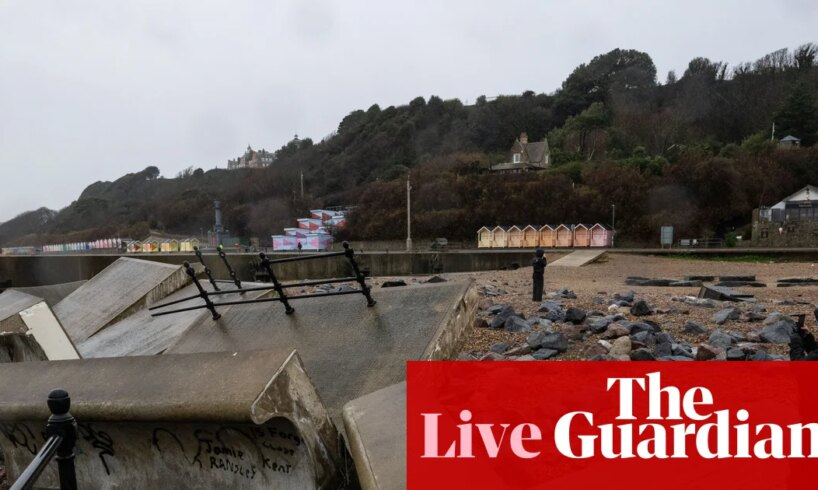
Fresh snow and ice warnings issued for Scotland and northern England for much of Sunday
Fresh weather warnings for snow and ice have been issued by the Met Office for much of Scotland and the north of England on Sunday.
A yellow warning covering large parts of Scotland, the East and West Midlands, north-east and north-west England and Yorkshire will come into force at 2am on Sunday, expected to run until 3pm.
Share
Key events
Show key events only
Please turn on JavaScript to use this feature
Closing summary
Fresh weather warnings for snow and ice have been issued by the Met Office for much of Scotland and the north of England on Sunday. A yellow warning covering large parts of Scotland, the East and West Midlands, north-east and north-west England and Yorkshire will come into force at 2am on Sunday, expected to run until 3pm.
A separate yellow warning for ice will cover large parts of England and Wales from midday on Friday until midday on Saturday as partially thawed snow refreezes, accompanied by wintry showers and freezing fog. In Northern Ireland, a yellow warning for snow and ice will come into force from 5pm on Friday and run until 11am on Saturday, with the Met Office warning of icy patches and some hill snow.
RNLI volunteers battled horrendous conditions to rescue people from boats as Storm Goretti hit Cornwall. Falmouth RNLI responded to seven separate incidents on Thursday night in “hurricane strength” winds described as the “worst” ever seen by volunteers.
The government has been urged to convene a meeting of the emergency Cobra committee to respond to Storm Goretti. Gideon Amos, Liberal Democrat MP for Taunton and Wellington in Somerset, said: “The government’s Cobra committee must urgently be convened to ensure fast help is delivered across the region. The south-west is routinely overlooked by the government, but we cannot be ignored in this time of need.”
Extra engineers have been brought in from other areas to help restore power to properties in the south-west and west Midlands, which felt the strongest impacts of Storm Goretti, the National Grid said. The utility company said it had restored power to 169,380 properties across the south-west, Midlands, and south Wales by noon on Friday.
Disruption on the roads also affected the criminal justice system, with no remand prisoners at all being transported to Birmingham Crown Court. An aborted sentencing hearing for a HMP Birmingham inmate convicted of the attempted murder of his wife was told only six members of staff were on duty in the court’s cell block.
Cornwall and the Isles of Scilly have been dealing with the aftermath of Storm Goretti after the winter storm battered the areas with 100mph winds. On Friday morning, Cornwall council recommended that residents avoid travelling as a large number of roads remained closed due to fallen trees, downed power lines and debris.
The stadium of Cornish Pirates rugby club in Penzance has been damaged by Storm Goretti. The roof on the main grandstand at the Mennaye Field has had large chunks torn off it by the strong winds, reports the PA news agency.
The north and north-east of Scotland have seen several days of “intense” snowfall, ice and sub-zero temperatures which have led to school closures and travel disruption. Scotland’s first minister John Swinney said earlier that efforts are now turned towards recovery.
As Storm Goretti sweeps across the UK and pummels parts of the nation with wind, rain and snow, many local authorities in England and Wales activated or extended the Severe Weather Emergency Protocol (SWEP) in recent days – providing emergency accommodation to people sleeping rough who are at risk of harm or death. The Mayor of London’s office announced on X that it had activated SWEP on Friday, the second time this year after activating it on 2 January.
You can read our full report here
ShareJem Bartholomew
As Storm Goretti sweeps across the UK and pummels parts of the nation with wind, rain and snow, many local authorities in England and Wales activated or extended the Severe Weather Emergency Protocol (SWEP) in recent days – providing emergency accommodation to people sleeping rough who are at risk of harm or death.
The Mayor of London’s office announced on X that it had activated SWEP on Friday, the second time this year after activating it on 2 January.
It comes as the Manchester Evening News (MEN) reports that two people have died while sleeping rough in Manchester during recent cold weather – Michael Heaton, 26, who was found dead on 30 December, and Anthony Horn, 47, discovered on 26 December.
“Rough sleeping is extremely dangerous all year round, but a night spent in freezing temperatures or in the most extreme weather can be deadly,” Francesca Albanese, executive director of policy and social change at Crisis, told the Guardian. “It’s vital that people who would otherwise be sleeping on the streets are helped into safe, emergency accommodation.”
“SWEP saves lives,” Albanese said, but she added that broader action was necessary to boost emergency accommodation throughout the year, as well as greater investment in building social housing and ensuring housing benefit is sufficient for people to cover existing housing costs.
More than 15,000 people experienced rough sleeping in 2024, according to Crisis, up from under 12,000 in 2022. Local Authorities aren’t legally required to activate SWEP, but it’s seen as a humanitarian duty during cold or extreme weather.
Meanwhile, the Salvation Army said in a press release: “We ask the public to also look out for rough sleepers and contact Streetlink – thestreetlink.org.uk – to let them know their location. If someone is in immediate danger, or if the person is under 18 years old, call 999.”
Share
Updated at 17.59 CET
The Scottish environment agency has warned of a flooding risk in the days ahead.
David Morgan, flood duty manager at the Scottish Environment Protection Agency (Sepa), says:
As temperatures rise following recent cold conditions, thaw of lying snow from Sunday onwards will increase the risk of flooding.
Share
Here are some more photos from across the UK as Storm Goretti continues to take hold:
A person runs past Turner’s Memorial in Buxton, Britain, 09 January 2026. Photograph: Adam Vaughan/EPAHazard tape is wrapped around grave stones next to a fallen tree in Falmouth Cemetery in the aftermath of Storm Goretti on January 09, 2026 in Falmouth, England. Photograph: Hugh Hastings/Getty ImagesA person holding an umbrella crosses London Bridge as Storm Goretti brings strong gusts and rain to London, Britain, 09 January 2026. Photograph: Tolga Akmen/EPAShare
Disruption on the roads also affected the criminal justice system, with no remand prisoners at all being transported to Birmingham Crown Court.
An aborted sentencing hearing for a HMP Birmingham inmate convicted of the attempted murder of his wife was told only six members of staff were on duty in the court’s cell block.
Judge Richard Bond informed barristers attending the hearing remotely: “I am really sorry we are in this position but the prison service have not produced anyone at Birmingham Crown Court today.”
The case was later adjourned to 6 February after the judge ruled a video-link appearance was not satisfactory, given the seriousness of the case and the need for an interpreter.
Share
Employers have a duty of care to factor bad weather into risk assessments, resilience planning and business continuity, says Ruth Wilkinson of the Institution of Occupational Safety and Health (IOSH).
Wilkinson told the PA news agency:
Snow, ice, and other severe weather are foreseeable hazards. Employers have a clear duty to protect health and safety, which means factoring bad weather into risk assessments, resilience planning, and business continuity.
This isn’t just about the office; it includes offsite work and travel. Can staff work safely? Can they work remotely? Policies, clear arrangements, and flexibility are essential.
Businesses need to monitor official weather guidance, plan ahead, and make sure everyone knows the procedures. Health and safety doesn’t stop at the office door – preparedness, clear communication, and a culture that prioritises people over logistics are what keep businesses moving safely.
ShareJamie Grierson
Steve Willington, the Met Office’s chief forecaster, said more snow was possible on Sunday, after a “largely dry” Saturday away from north-eastern parts of Scotland and England.
A yellow warning for snow and ice will be in force for much of Scotland from 2am until 3pm on Sunday.
Willington said:
A further 2-5cm of snow is possible to accumulate at low levels within the warning area on Sunday, with 10-20cm possible over higher ground. With much of this falling in areas that have already seen severe snowfall, ongoing disruption is likely.
Those in central and southern England and Wales will see this fall as rain, in what will be a wet Sunday for many.
A yellow warning covering large parts of Scotland, the East and West Midlands, north-east and north-west England and Yorkshire will be in place from 2am until 3pm on Sunday.
Yellow weather warnings for snow and ice have been extended into Saturday for large parts of Scotland, England and Northern Ireland.
A yellow warning for snow and ice comes into force from midday on Friday until 3pm on Saturday, with further snowfall possible across parts of northern England and much of Scotland, while a widespread risk of ice is expected to cause disruption.
A separate yellow warning for ice will cover large parts of England and Wales from midday on Friday until midday on Saturday as partially thawed snow refreezes, accompanied by wintry showers and freezing fog.
In Northern Ireland, a yellow warning for snow and ice will come into force from 5pm on Friday and run until 11am on Saturday, with the Met Office warning of icy patches and some hill snow.
ShareJamie Grierson
Snow and ice will grip much of the UK over the weekend as the country is left reeling in parts from the effects of Storm Goretti, which left thousands of people facing power cuts, school closures and travel chaos.
The storm brought winds of nearly 100mph after forecasters issued a rare red warning for “dangerous, stormy” winds in the south-west.
Downing Street said support was being offered to homes left without power.
Forecasters recorded 15cm of snow at Lake Vyrnwy in Powys, 7cm at Preston Montford in Shropshire and 7cm in Nottingham. Altnaharra, in Sutherland, recorded 27cm of snow, with 26cm at Loch Glascarnoch and 22cm at Durris in Kincardineshire.
The lowest temperature recorded overnight was -13.3C at Braemar, Aberdeenshire, while a peak gust of 99mph was reported at St Mary’s on the Isles of Scilly, the highest recorded since 1991, according to the Met Office.
Share
Below are some more weather-related images coming in via the newswires today:
Sheep in fields covered with snow near Strines in the Peak District on Friday. Photograph: Richard McCarthy/PAA fallen tree in Falmouth, Cornwall, after the area was hit by strong gusts from Storm Goretti overnight. Photograph: Matt Keeble/PAPeople sledging in the Bannau Brycheiniog national park (formerly Brecon Beacons) on Friday. Photograph: Ben Birchall/PAA snowman sits in front of the frozen fountain of Victoria Square after overnight snow, on Friday in Birmingham. Photograph: Christopher Furlong/Getty ImagesA car drives along a flooded country lane in Dunsden, Oxfordshire, after a nights heavy rainfall during Storm Goretti. Photograph: Geoffrey Swaine/ShutterstockShare
Updated at 15.24 CET
Here are the latest figures on properties without power in the south-west of England: More than 40,000 properties were without power just before 2pm on Friday, according to the National Grid’s website.
Additionally, about 9,000 properties had no power in the West Midlands; more than 700 had no power in the East Midlands; and more than 200 were without power in Wales.
Share
Updated at 15.24 CET
Extra engineers have been brought in from other areas to help restore power to properties in the south-west and west Midlands, which felt the strongest impacts of Storm Goretti, the National Grid said.
The utility company said it had restored power to 169,380 properties across the south-west, Midlands, and south Wales by noon on Friday.
Field operations director Roisin Quinn said:
Fallen trees, heavy snow and stranded vehicles have made it difficult for our teams to reach some areas to carry out repairs safely.
Engineers are working around the clock to get customers reconnected as quickly and safely as possible.
Share
Source