The huge shake-up of boundaries would be the biggest change to Nottinghamshire’s map for 50 years
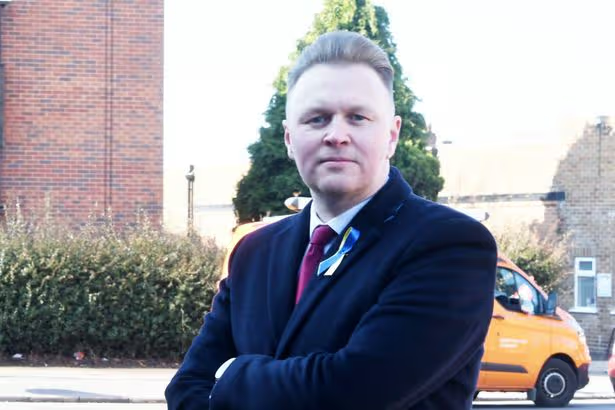
Michael Payne, the Labour MP for Gedling(Image: Marie Wilson/Nottingham Post)
Concerns have been raised that Nottingham City Council’s plan for a “land grab” in a huge shake-up of boundaries fails to meet a crucial test as a final decision is due in months.
The Labour-run authority’s plan could see Nottingham’s current boundaries expand to cover areas including Beeston and Arnold.
The changes would mark the biggest shake-up of boundaries for 50 years and ahead of the government making a final decision by the summer, one MP has raised concerns about the city council’s plan.
Michael Payne, the Labour MP for Gedling, spoke about the issue in the House of Commons on Thursday (January 22), saying: “The secretary of state’s department issued very clear guidance on February 6 last year, which said that ‘we expect local leaders to engage their members of parliament and to ensure there is wide engagement with local partners and stakeholders, residents, workforce and their representatives, and businesses on a proposal.’
“My constituents are concerned that the proposal by Nottingham City Council for reorganisation in Nottinghamshire fails to meet that test.
“Can the Secretary of State give me and my constituents in Gedling an assurance that his department will firmly apply the guidance that he set on 6 February 2025?”
Steve Reed – the housing, communities and local government secretary – replied by saying: “Yes, we will apply that guidance. Of course, we will listen to all representations about proposals for reorganisation, including proposals for Nottinghamshire.”
Beeston is one of the areas most likely to become part of a bigger city under the government-led local government reorganisation (LGR) programme, which could see villages and towns across Nottinghamshire change forever.
The government says it is leading the LGR programme to save taxpayers money and to simplify councils.
Discussions have been underway on what the programme means for the future of Nottinghamshire’s map since December 2024 and much of the argument has centred around an expansion of Nottingham.
Nottinghamshire currently operates a mix of systems, with the city council already serving as a unitary authority providing all the services in its area.
The county then relies on a two-tier model, where the county council handles major services and smaller district and borough councils manage smaller-scale services.
LGR will mean the scrapping of small councils and the creation of two new unitary authorities across the whole of Nottingham and Nottinghamshire.
Three core proposals are on the table in terms of what this would mean for boundaries.
Northern parts of Nottinghamshire – like Bassetlaw, Newark, Mansfield and Ashfield – would simply become part of a bigger county council under all three options as their local district authority disappears.
For those living in Rushcliffe, Gedling and Broxtowe – their future map varies significantly between the three options.
The government will make a decision between options including a bigger city covering all of Rushcliffe and Broxtowe, or a bigger city covering all of Gedling and Broxtowe.
The city council’s third bespoke option would instead see Nottingham expand to only cover parts of surrounding areas, rather than the full existing district and boroughs.
Beyond the consultation issue itself, Mr Payne previously expressed opposition to the city council’s options by saying: “It risks resentment and confusion in communities, it creates winners and losers and it offers no strong financial or public service delivery justification for the boundary changes that it demands.”
Nottingham City Council has said that in terms of a consultation, a formal Boundary Commission review would have to take place under its plan and that a consultation would come at that stage.
The authority says it is more than confident that the review could be done by 2028 – when new councils are set to become operational.
Nottingham City Council leader Neghat Khan(Image: Joseph Raynor/ Nottingham Post)
Previously explaining the need for their bespoke option, city council leader Neghat Khan said: “The reality is that the current city boundaries – set in 1997 – don’t reflect the ‘real’ Nottingham.
“While our official population is 328,000, the built-up area of our city contains over 750,000 people, many of whom call Nottingham home.
“We can’t let outdated boundaries or political preference dictate what is right for Nottingham and Nottinghamshire.”
The government is now considering the three competing options before making its final decision in the summer of 2026.
The first elections for the new councils are then scheduled to take place in 2027, with the new authorities officially commencing operations in 2028.